Department of Anesthesiology, Shuang Ho Hospital, Taipei Medical University, New Taipei City, Taiwan.
Department of Anesthesiology, School of Medicine, College of Medicine, Taipei Medical University, Taipei, Taiwan.
Medicine (Baltimore). 2022 Mar 11;101(10):e28903. doi: 10.1097/MD.0000000000028903.
Current practice guidelines recommend the use of nasal cannula as an alternative pre-oxygenation method for tracheal intubation. However, the efficacy of high-flow nasal oxygenation versus standard facemask oxygenation has not been fully evaluated.
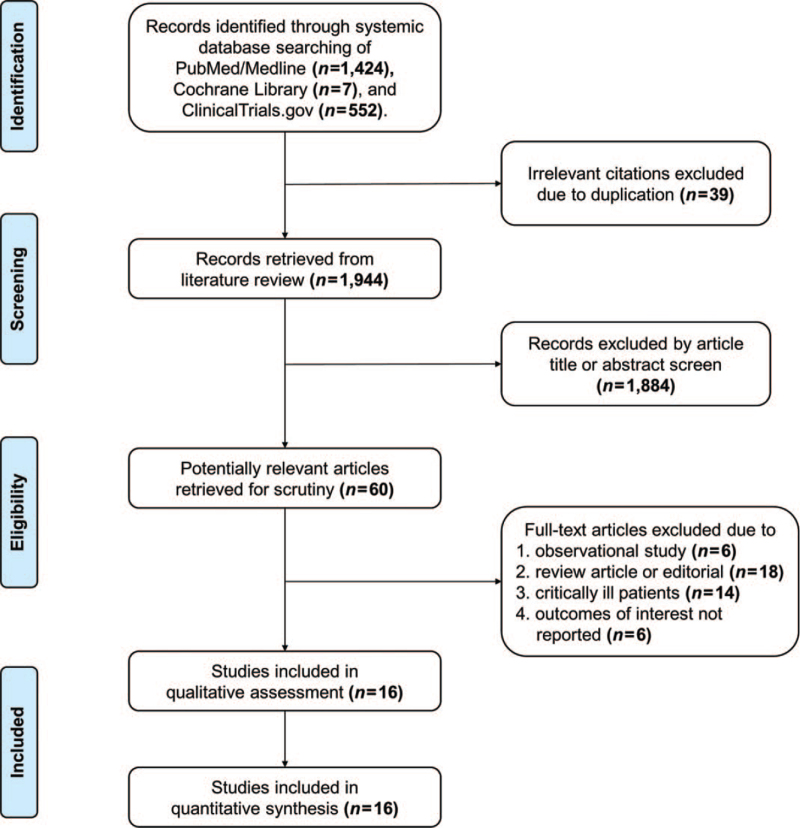
We searched PubMed, Cochrane Library, and ClinicalTrials.gov for English-language studies published from January 1, 2000 to November 30, 2021. We included randomized controlled trials which compared high-flow nasal oxygenation and facemask oxygenation as the pre-oxygenation maneuver. Primary outcome was arterial partial pressure of oxygen (PaO2) after pre-oxygenation. Secondary outcomes were safe apnea time, arterial desaturation during intubation, lowest peripheral capillary oxygen saturation during intubation, and patient comfort score. Random-effects models and Mantel-Haenszel method were used for data synthesis.
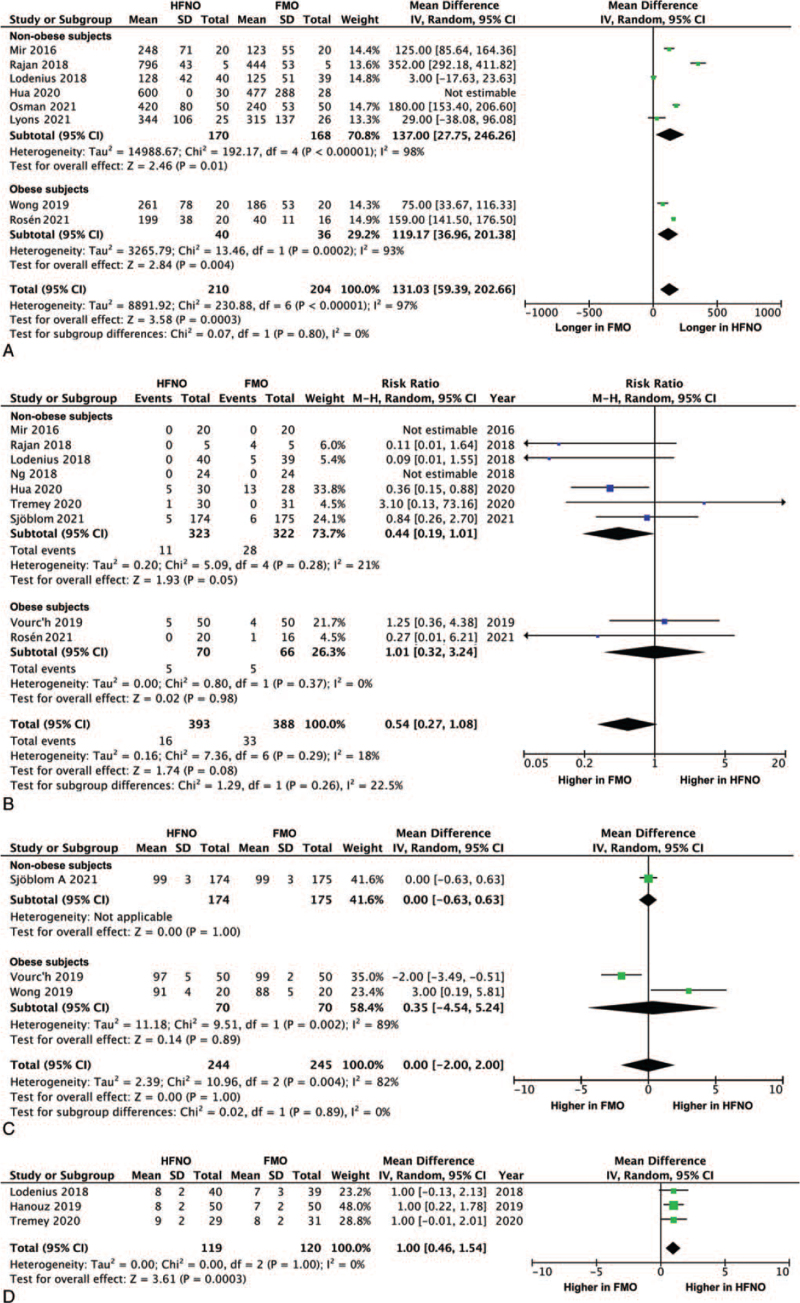
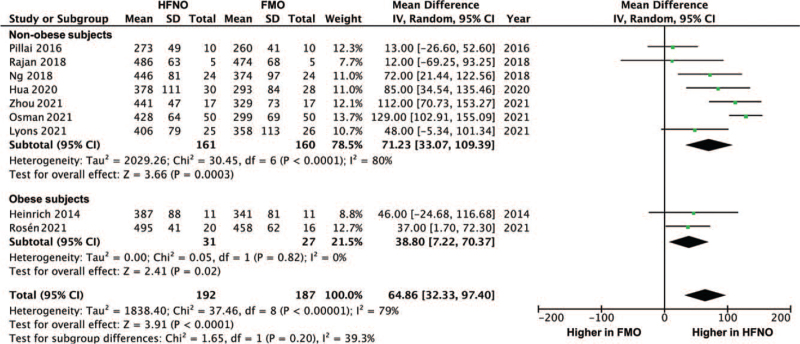
A total of 16 randomized controlled trials and 1148 patients were included. High-flow nasal oxygenation achieved a higher PaO2 compared with facemask, mean difference: 64.86 mm Hg (95% confidence interval [CI]: 32.33-97.40, P < .0001). Safe apnea time was longer in high-flow nasal oxygenation, mean difference: 131.03 seconds (95% CI: 59.39-202.66, P < .0001). There was no difference in the risk of peri-intubation desaturation or lowest peripheral capillary oxygen saturation between groups. Patient comfort score was higher in high-flow nasal oxygenation, mean difference: 1.00 (95% CI: 0.46-1.54, P = .0003).
High-flow nasal oxygenation better enhanced PaO2 and extended safe apnea time and is not inferior to facemask oxygenation in preventing desaturation during tracheal intubation. High-flow nasal oxygenation may be considered as an alternative method, especially for patients with a potential difficult airway.
目前的实践指南建议使用鼻导管作为气管插管的替代预充氧方法。然而,高流量鼻氧与标准面罩氧疗的疗效尚未得到充分评估。
我们在 PubMed、Cochrane 图书馆和 ClinicalTrials.gov 上检索了 2000 年 1 月 1 日至 2021 年 11 月 30 日发表的英文研究。我们纳入了比较高流量鼻氧和面罩氧作为预充氧操作的随机对照试验。主要结局是预充氧后动脉血氧分压(PaO2)。次要结局为安全无通气时间、插管期间动脉血氧饱和度下降、插管期间最低外周毛细血管血氧饱和度和患者舒适度评分。采用随机效应模型和 Mantel-Haenszel 法进行数据合并。
共纳入 16 项随机对照试验和 1148 例患者。与面罩相比,高流量鼻氧可获得更高的 PaO2,平均差值:64.86mmHg(95%置信区间[CI]:32.33-97.40,P<.0001)。高流量鼻氧的安全无通气时间更长,平均差值:131.03 秒(95% CI:59.39-202.66,P<.0001)。两组间插管期间的低氧血症或最低外周毛细血管血氧饱和度风险无差异。高流量鼻氧的患者舒适度评分更高,平均差值:1.00(95% CI:0.46-1.54,P=.0003)。
高流量鼻氧可更好地提高 PaO2,延长安全无通气时间,在预防气管插管期间低氧血症方面与面罩氧疗无差异。高流量鼻氧可作为一种替代方法,尤其适用于有潜在困难气道的患者。