Australian Centre for Precision Health, Unit of Clinical and Health Sciences, University of South Australia, Adelaide, Australia.
South Australian Health and Medical Research Institute, Adelaide, Australia.
Am J Clin Nutr. 2022 Aug 4;116(2):531-540. doi: 10.1093/ajcn/nqac107.
Higher vitamin D status has been suggested to have beneficial effects on the brain.
To investigate the association between 25-hydroxyvitamin D [25(OH)D], neuroimaging features, and the risk of dementia and stroke.
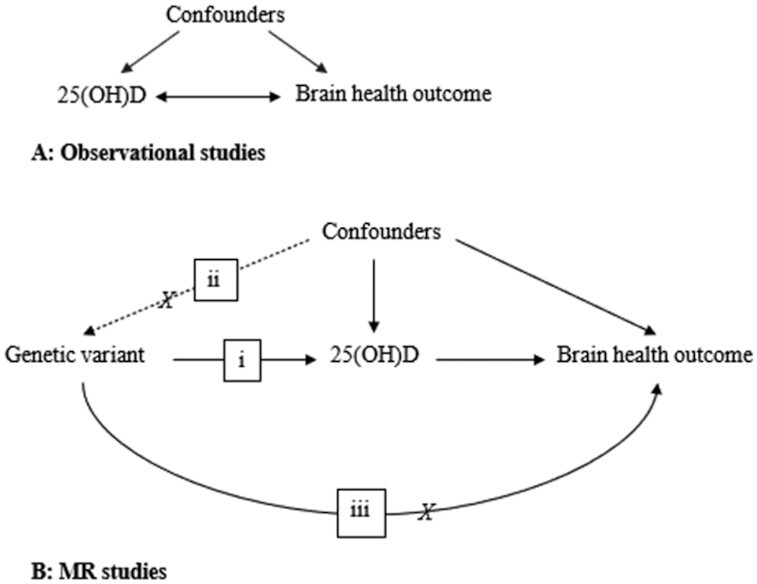
We used prospective data from the UK Biobank (37-73 y at baseline) to examine the association between 25(OH)D concentrations with neuroimaging outcomes (N = 33,523) and the risk of dementia and stroke (N = 427,690; 3414 and 5339 incident cases, respectively). Observational analyses were adjusted for age, sex, ethnicity, month, center, and socioeconomic, lifestyle, sun behavior, and illness-related factors. Nonlinear Mendelian randomization (MR) analyses were used to test for underlying causality for neuroimaging outcomes (N = 23,901) and dementia and stroke (N = 294,514; 2399 and 3760 cases, respectively).
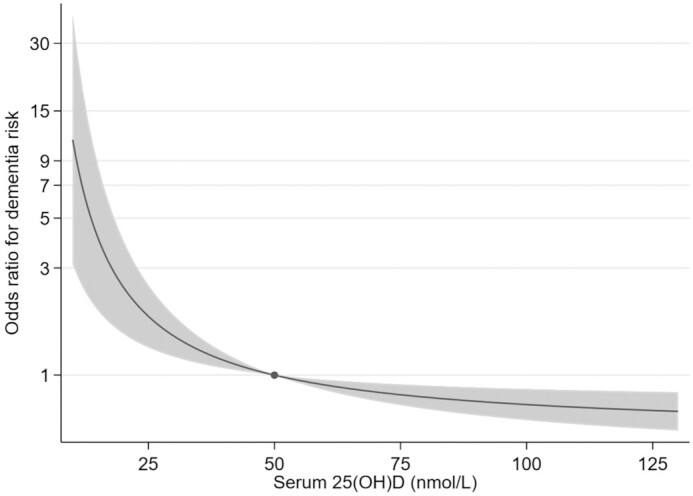
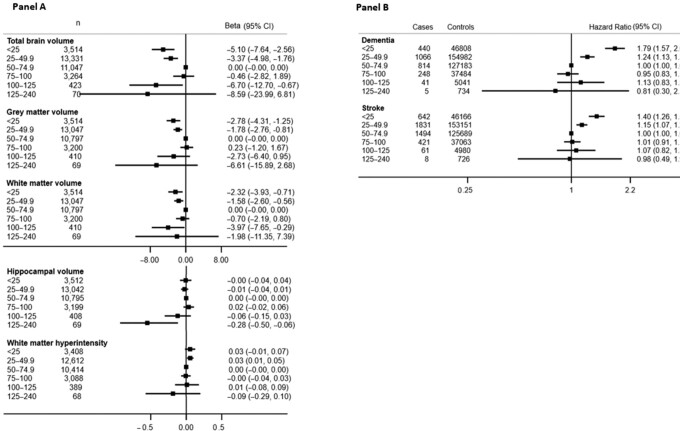
Associations between 25(OH)D and total, gray matter, white matter, and hippocampal volumes were nonlinear, with lower volumes both for low and high concentrations (adjusted P-nonlinear ≤ 0.04). 25(OH)D had an inverse association with white matter hyperintensity volume [per 10 nmol/L 25(OH)D; adjusted β: -6.1; 95% CI: -11.5, -7.0]. Vitamin D deficiency was associated with an increased risk of dementia and stroke, with the strongest associations for those with 25(OH)D <25 nmol/L (compared with 50-75.9 nmol/L; adjusted HR: 1.79; 95% CI: 1.57, 2.04 and HR: 1.40; 95% CI: 1.26, 1.56, respectively). Nonlinear MR analyses confirmed the threshold effect of 25(OH)D on dementia, with the risk predicted to be 54% (95% CI: 1.21, 1.96) higher for participants at 25 nmol/L compared with 50 nmol/L. 25(OH)D was not associated with neuroimaging outcomes or the risk of stroke in MR analyses. Potential impact fraction suggests 17% (95% CI: 7.22, 30.58) of dementia could be prevented by increasing 25(OH)D to 50 nmol/L.
Low vitamin D status was associated with neuroimaging outcomes and the risks of dementia and stroke even after extensive covariate adjustment. MR analyses support a causal effect of vitamin D deficiency on dementia but not on stroke risk.
较高的维生素 D 状态被认为对大脑有益。
研究 25-羟维生素 D [25(OH)D]与神经影像学特征以及痴呆和中风风险之间的关系。
我们使用英国生物库的前瞻性数据(基线时 37-73 岁),研究 25(OH)D 浓度与神经影像学结果(N=33523)和痴呆和中风风险(N=427690;3414 和 5339 例发病病例)之间的关系。观察性分析调整了年龄、性别、种族、月份、中心以及社会经济、生活方式、晒太阳行为和与疾病相关的因素。非孟德尔随机化(MR)分析用于测试神经影像学结果(N=23901)和痴呆和中风风险(N=294514;2399 和 3760 例)的潜在因果关系。
25(OH)D 与总容积、灰质容积、白质容积和海马体容积之间的关系呈非线性,低浓度和高浓度下容积均较低(调整后的 P-非线性≤0.04)。25(OH)D 与脑白质高信号容积呈负相关[每 10nmol/L 25(OH)D;调整后的β:-6.1;95%CI:-11.5,-7.0]。维生素 D 缺乏与痴呆和中风风险增加相关,25(OH)D<25nmol/L 的风险最高(与 50-75.9nmol/L 相比;调整后的 HR:1.79;95%CI:1.57,2.04 和 HR:1.40;95%CI:1.26,1.56)。非孟德尔随机化分析证实了 25(OH)D 对痴呆的阈值效应,与 50nmol/L 相比,25nmol/L 参与者的风险预计高出 54%(95%CI:1.21,1.96)。MR 分析表明,25(OH)D 与神经影像学结果或中风风险无关。潜在影响分数表明,将 25(OH)D 增加到 50nmol/L 可预防 17%(95%CI:7.22,30.58)的痴呆。
即使进行了广泛的协变量调整,低维生素 D 状态仍与神经影像学结果以及痴呆和中风风险相关。MR 分析支持维生素 D 缺乏对痴呆有因果关系,但对中风风险没有因果关系。