Department of Biological Sciences, Baze University, Abuja, Nigeria.
Department of Clinical Sciences and Nutrition, University of Chester, Chester, UK.
J Hum Nutr Diet. 2023 Feb;36(1):216-225. doi: 10.1111/jhn.13021. Epub 2022 May 9.
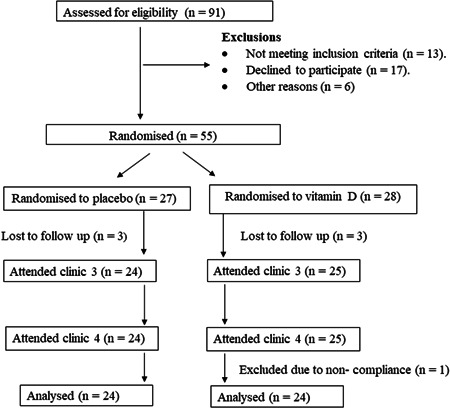
Observational studies suggest links between reduced serum 25(OH)D concentration and increased cardiometabolic disease risk. However, these studies provide limited evidence of causation, with few conclusive randomised controlled trials (RCT) having been carried out to date. This RCT investigated the effect of vitamin D supplementation on vascular function and cardiometabolic disease risk markers, in 55 healthy males aged 18-65 years with plasma 25(OH)D concentration <75 mol L and body mass index ≥24.9 kg m .
Participants were assigned to consume 125 µg day (5000 IU day ) vitamin D or placebo for 8 weeks. Blood samples and vascular function measures were obtained at baseline, as well as at weeks 4 and 8. The primary outcome was arterial stiffness, an indicator of cardiovascular disease (CVD) risk, assessed by pulse wave velocity. Biomarkers of CVD risk, insulin resistance and endothelial function were measured using an enzyme-linked immunosorbent assay.
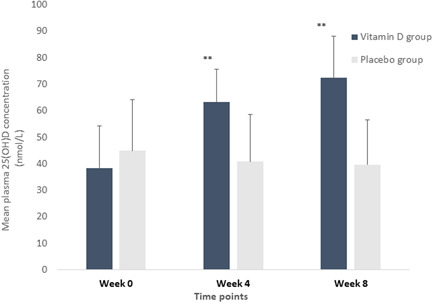
Daily oral intake of 125 µg supplemental vitamin D led to a significant improvement in plasma 25(OH)D concentrations over the 8-week intervention in the vitamin D group compared to the change in the placebo group (p ˂ 0.001). In the vitamin D group, the baseline mean ± SD 25(OH)D concentration was 38.4 ± 15.9 and this increased to 72.8 ± 16.1 nmol L after 8 weeks of supplementation. The intervention had no effect on arterial stiffness, as measured by pulse wave velocity, although vitamin D supplementation did lead to a decrease in mean ± SD brachial pulse pressure from baseline to 8 weeks of -2.9 ± 3.4 mmHg (p = 0.027) in the vitamin D group compared to the same period in the placebo group. The intervention had no effect on the remaining cardiometabolic parameters.
Overall, treatment significantly improved brachial pulse pressure but no other cardiometabolic disease risk markers. To follow on from this pilot RCT, future large-scale clinical trials over longer durations may offer further insights.
观察性研究表明,血清 25(OH)D 浓度降低与心血管代谢疾病风险增加之间存在关联。然而,这些研究提供的因果关系证据有限,迄今为止,很少有确凿的随机对照试验(RCT)进行。本 RCT 研究了在 55 名年龄在 18-65 岁、血浆 25(OH)D 浓度<75 μmol/L 和体重指数≥24.9 kg/m 的健康男性中,维生素 D 补充对血管功能和心血管代谢疾病风险标志物的影响。
参与者被分配在 8 周内每天服用 125 µg(5000 IU 天)维生素 D 或安慰剂。在基线、第 4 周和第 8 周采集血样和血管功能测量值。主要终点是脉搏波速度评估的动脉僵硬度,这是心血管疾病(CVD)风险的一个指标。使用酶联免疫吸附试验测量 CVD 风险、胰岛素抵抗和内皮功能的生物标志物。
与安慰剂组相比,每天口服 125 µg 补充维生素 D 在 8 周的干预期间,维生素 D 组的血浆 25(OH)D 浓度显著升高(p<0.001)。在维生素 D 组中,基线时的平均±标准差 25(OH)D 浓度为 38.4±15.9 nmol/L,补充 8 周后增加到 72.8±16.1 nmol/L。尽管维生素 D 补充确实导致与安慰剂组相比,在 8 周的干预期间,肱动脉脉搏压的平均±标准差从基线下降了-2.9±3.4 mmHg(p=0.027),但该干预对脉搏波速度测量的动脉僵硬度没有影响。该干预对其余心血管代谢参数没有影响。
总体而言,治疗显著改善了肱动脉脉搏压,但对其他心血管代谢疾病风险标志物没有影响。在此试点 RCT 的基础上,未来更大规模的临床试验可能会提供更长时间的进一步见解。