Department of Molecular Medicine and Surgery, Karolinska Institutet, Stockholm, Sweden.
Department of Surgery, Breast Centre, Capio St. Göran's Hospital, Mariebergsporten 2, 11219, Stockholm, Sweden.
Breast Cancer Res Treat. 2022 Jun;193(3):589-595. doi: 10.1007/s10549-022-06588-2. Epub 2022 Apr 22.
In clinically node-positive breast cancer patients receiving neoadjuvant systemic therapy (NST), nodal metastases can be initially marked and then removed during surgical axillary staging. Marking methods vary significantly in terms of feasibility and cost. The purpose of the extended TATTOO trial was to report on the false-negative rate (FNR) of the low-cost method carbon tattooing.
The international prospective single-arm TATTOO trial included clinically node-positive breast cancer patients planned for NST from November 2017 to January 2021. For the present analysis, patients who received both the targeted procedure with or without an additional sentinel lymph node (SLN) biopsy and a completion axillary lymph node dissection (ALND) were selected. Primary endpoint was the FNR.
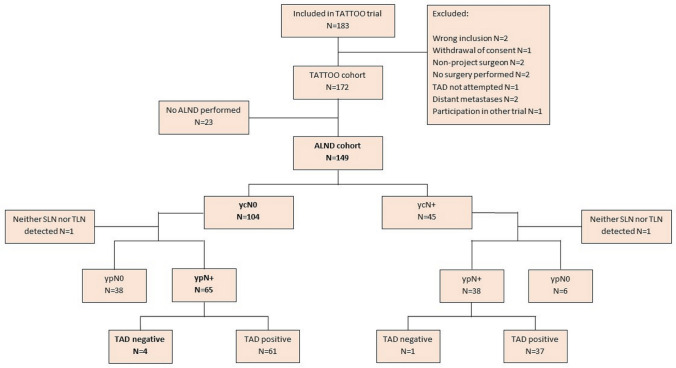
Out of 172 included patients, 149 had undergone a completion ALND. The detection rate for the tattooed node was 94.6% (141 out of 149). SLN biopsy was attempted in 132 out of 149 patients with a detection rate of 91.7% (121 out of 132). SLN and tattooed node were identical in 58 out of 121 individuals (47.9%). The combined procedure, i.e. targeted axillary dissection (TAD) was successful in 147 of 149 cases (98.7%). Four out of 65 patients with a clinically node-negative status after NST had a negative TAD but metastases on ALND, corresponding to a FNR of 6.2%. All false-negative TAD procedures were performed in the first 2 years of the trial (2018-2019, p = 0.022).
Carbon tattooing is a feasible marking method for TAD with a high detection rate and an acceptably low FNR. The TATTOO trial was preregistered as prospective trial before initiation at the University of Rostock, Germany (DRKS00013169).
在接受新辅助全身治疗(NST)的临床淋巴结阳性乳腺癌患者中,最初可对淋巴结转移进行标记,然后在手术腋窝分期时切除。标记方法在可行性和成本方面差异很大。扩展 TATTOO 试验的目的是报告低成本的碳墨标记方法的假阴性率(FNR)。
这项国际性前瞻性单臂 TATTOO 试验纳入了 2017 年 11 月至 2021 年 1 月计划接受 NST 的临床淋巴结阳性乳腺癌患者。本分析纳入了接受靶向手术联合或不联合前哨淋巴结(SLN)活检和完成腋窝淋巴结清扫术(ALND)的患者。主要终点是 FNR。
在纳入的 172 例患者中,149 例行完成性 ALND。149 例中有 141 例(94.6%)标记的淋巴结被检出。149 例中有 132 例尝试行 SLN 活检,检出率为 91.7%(121 例)。121 例中 58 例(47.9%)SLN 和墨染淋巴结一致。149 例中 147 例(98.7%)联合手术,即靶向腋窝解剖(TAD)成功。65 例临床淋巴结阴性的患者在 NST 后有 4 例(6.2%)TAD 阴性但 ALND 有转移,存在 FNR。所有假阴性 TAD 手术均在试验的前 2 年(2018-2019 年)进行(p=0.022)。
碳墨染色是 TAD 的一种可行的标记方法,具有较高的检出率和可接受的低 FNR。TATTOO 试验在德国罗斯托克大学启动前已预先注册为前瞻性试验(DRKS00013169)。