Health Economics and HIV and AIDS Research Division, University of KwaZulu-Natal, Durban, South Africa.
Biostatistics Research Unit, South African Medical Research Council, Durban, South Africa.
JAMA Netw Open. 2022 Apr 1;5(4):e228640. doi: 10.1001/jamanetworkopen.2022.8640.
In South Africa, adolescent girls and young women aged 15 to 24 years are among the most high-risk groups for acquiring HIV. Progress in reducing HIV incidence in this population has been slow.
To describe HIV prevalence and HIV risk behaviors among a sample of adolescent girls and young women and to model the association between exposure to multiple or layered interventions and key HIV biological and behavioral outcomes.
DESIGN, SETTING, AND PARTICIPANTS: This cross-sectional survey was conducted between March 13, 2017, and June 22, 2018, in 2 districts in Gauteng province and in 2 districts in KwaZulu-Natal province in South Africa. A stratified cluster random sampling method was used. Participants included adolescent girls and young women aged 12 to 24 years who lived in each sampled household. Overall, 10 384 participants were enrolled in Gauteng province and 7912 in KwaZulu-Natal province. One parent or caregiver was interviewed in each household. Data analysis was performed from March 12, 2021, to March 1, 2022.
DREAMS (Determined, Resilient, Empowered, AIDS-free, Mentored, and Safe)-like interventions.
The primary outcome was HIV prevalence. HIV status was obtained from laboratory-based testing of peripheral blood samples. Secondary outcomes included HIV testing and antiretroviral therapy uptake as well as numerous HIV risk variables that the DREAMS program sought to improve, such as pregnancy, sexually transmitted infection, intimate partner violence, and age-disparate sex.
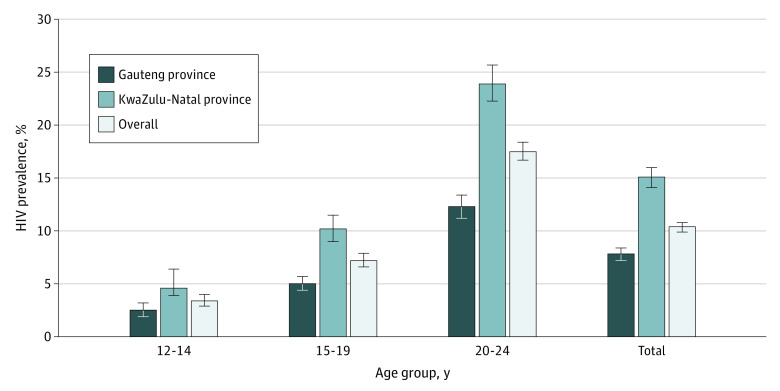
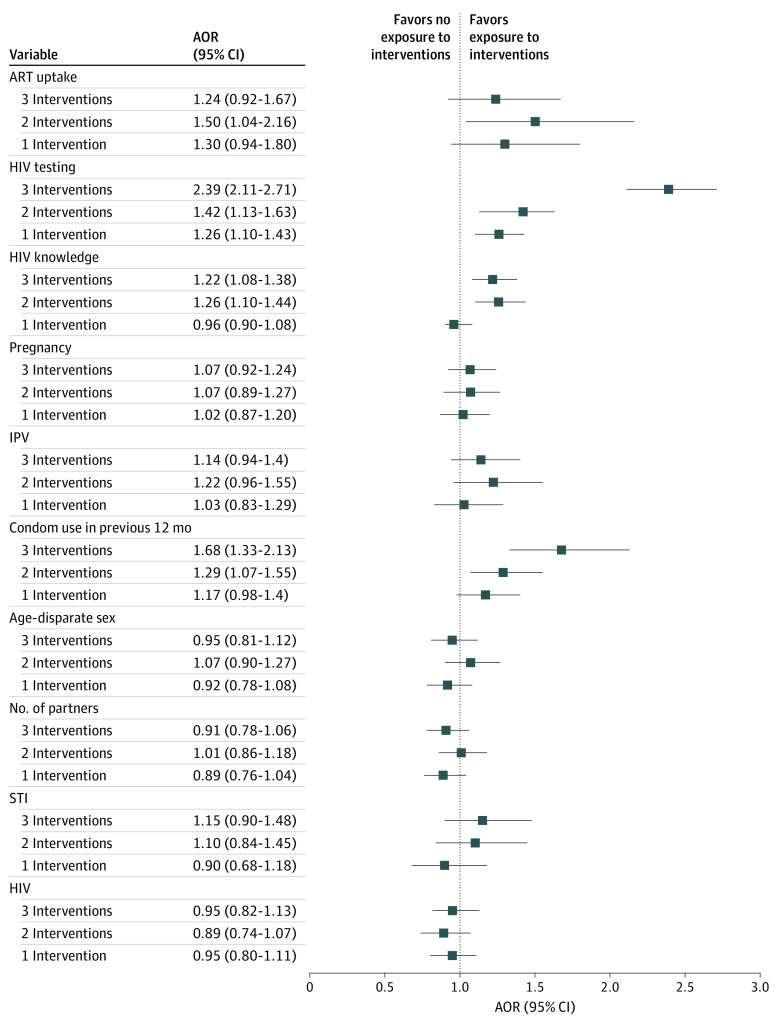
The final sample included 18 296 adolescent girls and young women (median [IQR] age, 19 [15-21] years) in 10 642 households. Approximately half of participants (49.9%; n = 8414) reported engaging in sexual activity, and 48.1% (n = 3946) reported condom use at the most recent sexual encounter. KwaZulu-Natal province had a higher HIV prevalence than Gauteng province (15.1% vs 7.8%; P < .001). Approximately one-fifth of participants (17.6%; n = 3291) were not exposed to any interventions, whereas 43.7% (n = 8144) were exposed to 3 or more interventions. There was no association between exposure to DREAMS-like interventions and HIV status. Adolescent girls and young women who accessed 3 or more interventions were more likely to have undergone HIV testing (adjusted odds ratio, 2.39; 95% CI, 2.11-2.71; P < .001) and to have used condoms consistently in the previous 12 months (adjusted odds ratio, 1.68; 95% CI, 1.33-2.12; P < .001) than those who were not exposed to any interventions.
Results of this study suggest that self-reported exposures to multiple or layered DREAMS-like interventions were associated with favorable behavioral outcomes. The beneficial aspects of layering HIV interventions warrant further research to support the sexual and reproductive health of adolescent girls and young women.
在南非,15 至 24 岁的少女和年轻女性是感染艾滋病毒风险最高的群体之一。在该人群中减少艾滋病毒发病率的进展一直很缓慢。
描述在一个少女和年轻女性样本中艾滋病毒的流行情况和艾滋病毒风险行为,并建立模型,以评估暴露于多种或分层干预措施与关键的艾滋病毒生物学和行为结果之间的关联。
设计、地点和参与者:这是一项横断面调查,于 2017 年 3 月 13 日至 2018 年 6 月 22 日在南非豪登省和夸祖鲁-纳塔尔省的 2 个地区进行。采用分层聚类随机抽样方法。参与者包括居住在每个抽样家庭中的 12 至 24 岁的少女和年轻女性。共有 10384 名参与者在豪登省和 7912 名参与者在夸祖鲁-纳塔尔省被纳入研究。每个家庭都有一名家长或照顾者接受访谈。数据分析于 2021 年 3 月 12 日至 2022 年 3 月 1 日进行。
类似 DREAMS(有决心、坚韧、有能力、无艾滋病、有指导和安全)的干预措施。
主要结果是艾滋病毒流行率。艾滋病毒状况是通过对外周血样本进行实验室检测获得的。次要结果包括艾滋病毒检测和抗逆转录病毒治疗的采用,以及 DREAMS 项目试图改善的许多艾滋病毒风险变量,如怀孕、性传播感染、亲密伴侣暴力和年龄差异的性行为。
最终样本包括来自 10642 户家庭的 18296 名少女和年轻女性(中位数[IQR]年龄,19 [15-21]岁)。大约一半的参与者(49.9%,n=8414)报告有过性行为,48.1%(n=3946)报告在最近一次性行为中使用了避孕套。夸祖鲁-纳塔尔省的艾滋病毒流行率高于豪登省(15.1%比 7.8%;P<.001)。大约五分之一的参与者(17.6%,n=3291)未接触任何干预措施,而 43.7%(n=8144)接触了 3 种或更多干预措施。接触类似 DREAMS 的干预措施与艾滋病毒状况之间没有关联。接触 3 种或更多干预措施的少女和年轻女性更有可能接受艾滋病毒检测(调整后的优势比,2.39;95%置信区间,2.11-2.71;P<.001),并且在过去 12 个月中更有可能持续使用避孕套(调整后的优势比,1.68;95%置信区间,1.33-2.12;P<.001),而与未接触任何干预措施的人相比。
这项研究的结果表明,自我报告的接触多种或分层的类似 DREAMS 的干预措施与有利的行为结果有关。艾滋病毒干预措施分层的有益方面值得进一步研究,以支持少女和年轻女性的性健康和生殖健康。