Helan Martin, Malaska Jan, Tomandl Josef, Jarkovsky Jiri, Helanova Katerina, Benesova Klara, Sitina Michal, Dastych Milan, Ondrus Tomas, Pavkova Goldbergova Monika, Gal Roman, Lokaj Petr, Tomandlova Marie, Parenica Jiri
Department of Anaesthesiology and Intensive Care, St. Anne's University Hospital Brno, 656 91 Brno, Czech Republic.
International Clinical Research Center (ICRC), St. Anne's University Hospital Brno, 656 91 Brno, Czech Republic.
Antioxidants (Basel). 2022 Mar 26;11(4):640. doi: 10.3390/antiox11040640.
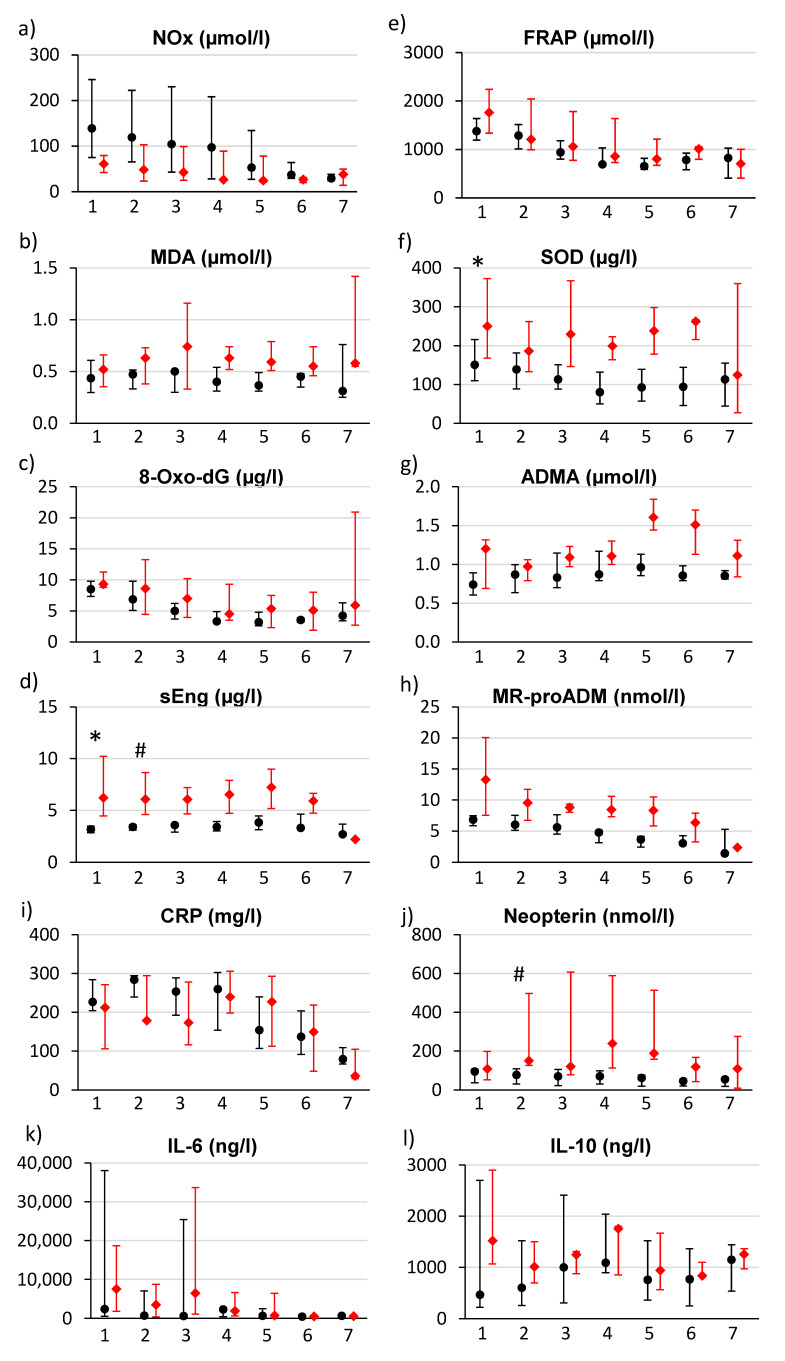
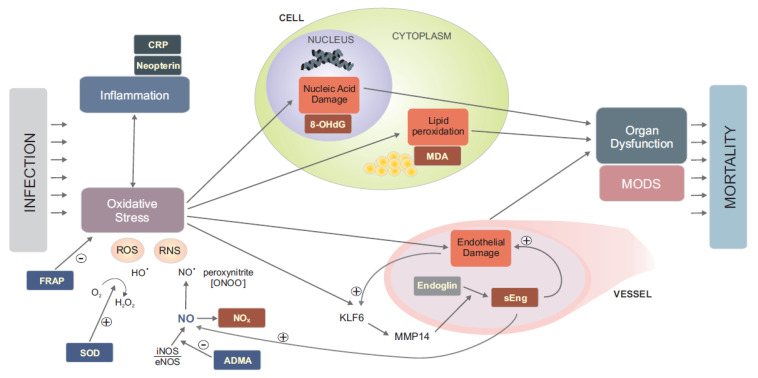
Septic shock is a major cause of mortality in ICU patients, its pathophysiology is complex and not properly understood. Oxidative stress seems to be one of the most important mechanisms of shock progression to multiple organ failure. In the present pilot study, we have analysed eight oxidative-stress-related biomarkers in seven consecutive time points (i.e., the first seven days) in 21 septic shock patients admitted to the ICU. Our objective was to describe the kinetics of four biomarkers related to pro-oxidative processes (nitrite/nitrate, malondialdehyde, 8-oxo-2'-deoxyguanosine, soluble endoglin) compared to four biomarkers of antioxidant processes (the ferric reducing ability of plasma, superoxide dismutase, asymmetric dimethylarginine, mid-regional pro-adrenomedullin) and four inflammatory biomarkers (CRP, IL-6, IL-10 and neopterin). Furthermore, we analysed each biomarker's ability to predict mortality at the time of admission and 12 h after admission. Although a small number of study subjects were recruited, we have identified four promising molecules for further investigation: soluble endoglin, superoxide dismutase, asymmetric dimethylarginine and neopterin.
脓毒性休克是重症监护病房(ICU)患者死亡的主要原因,其病理生理学复杂且尚未完全明确。氧化应激似乎是休克进展为多器官功能衰竭的最重要机制之一。在本初步研究中,我们分析了21例入住ICU的脓毒性休克患者在连续七个时间点(即前七天)的八种与氧化应激相关的生物标志物。我们的目的是描述与促氧化过程相关的四种生物标志物(亚硝酸盐/硝酸盐、丙二醛、8-氧代-2'-脱氧鸟苷、可溶性内皮糖蛋白)与抗氧化过程的四种生物标志物(血浆铁还原能力、超氧化物歧化酶、不对称二甲基精氨酸、中段肾上腺髓质素前体)以及四种炎症生物标志物(C反应蛋白、白细胞介素-6、白细胞介素-10和新蝶呤)的变化规律。此外,我们分析了每种生物标志物在入院时和入院后12小时预测死亡率的能力。尽管招募的研究对象数量较少,但我们已确定了四种有进一步研究价值的有前景分子:可溶性内皮糖蛋白、超氧化物歧化酶、不对称二甲基精氨酸和新蝶呤。