Pekarek Leonel, Fraile-Martinez Oscar, Garcia-Montero Cielo, Saez Miguel A, Barquero-Pozanco Ines, Del Hierro-Marlasca Laura, de Castro Martinez Patricia, Romero-Bazán Adoración, Alvarez-Mon Miguel A, Monserrat Jorge, García-Honduvilla Natalio, Buján Julia, Alvarez-Mon Melchor, Guijarro Luis G, Ortega Miguel A
Department of Medicine and Medical Specialities, Faculty of Medicine and Health Sciences, University of Alcalá, 28801 Alcala de Henares, Spain.
Ramón y Cajal Institute of Sanitary Research (IRYCIS), 28034 Madrid, Spain.
Cancers (Basel). 2022 Apr 7;14(8):1866. doi: 10.3390/cancers14081866.
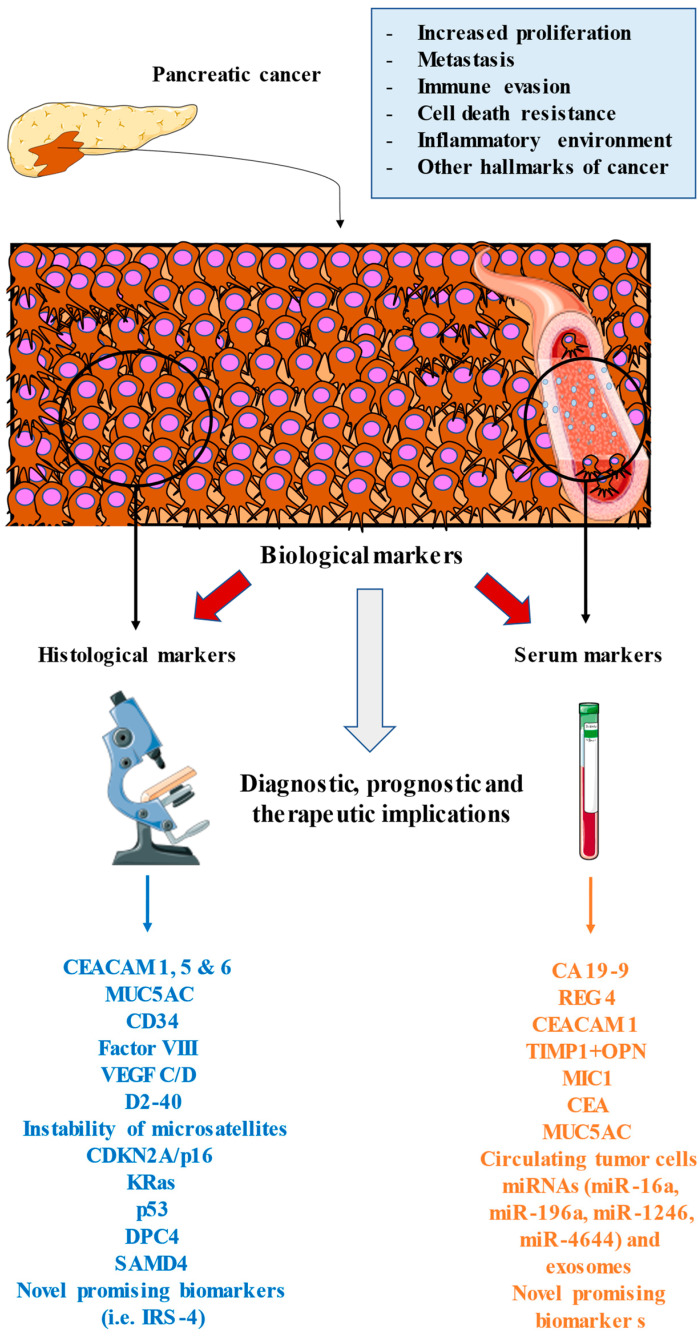
The incidence and prevalence of pancreatic adenocarcinoma have increased in recent years. Pancreatic cancer is the seventh leading cause of cancer death, but it is projected to become the second leading cause of cancer-related mortality by 2040. Most patients are diagnosed in an advanced stage of the disease, with very limited 5-year survival. The discovery of different tissue markers has elucidated the underlying pathophysiology of pancreatic adenocarcinoma and allowed stratification of patient risk at different stages and assessment of tumour recurrence. Due to the invasive capacity of this tumour and the absence of screening markers, new immunohistochemical and serological markers may be used as prognostic markers for recurrence and in the study of possible new therapeutic targets because the survival of these patients is low in most cases. The present article reviews the currently used main histopathological and serological markers and discusses the main characteristics of markers under development.
近年来,胰腺腺癌的发病率和患病率有所上升。胰腺癌是癌症死亡的第七大主要原因,但预计到2040年将成为癌症相关死亡率的第二大主要原因。大多数患者在疾病晚期被诊断出来,5年生存率非常有限。不同组织标志物的发现阐明了胰腺腺癌的潜在病理生理学,并能够对不同阶段的患者风险进行分层以及评估肿瘤复发情况。由于这种肿瘤的侵袭能力以及缺乏筛查标志物,新的免疫组化和血清学标志物可用作复发的预后标志物,并用于研究可能的新治疗靶点,因为在大多数情况下这些患者的生存率较低。本文综述了目前使用的主要组织病理学和血清学标志物,并讨论了正在研发的标志物的主要特征。