Endocrine and Metabolic Diseases Research Center, School of Medicine, University of Zulia, Maracaibo 4004, Venezuela.
Facultad de Ciencias Jurídicas y Sociales, Universidad Simón Bolívar, Cúcuta 540006, Colombia.
Int J Mol Sci. 2022 Apr 11;23(8):4196. doi: 10.3390/ijms23084196.
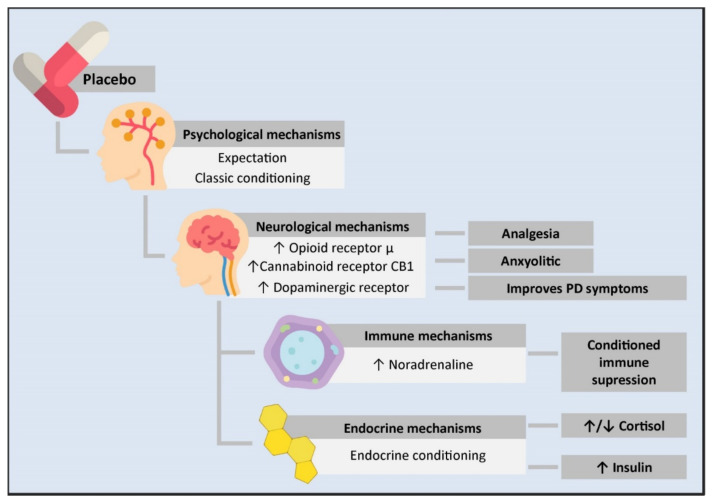
The placebo effect can be defined as the improvement of symptoms in a patient after the administration of an innocuous substance in a context that induces expectations regarding its effects. During recent years, it has been discovered that the placebo response not only has neurobiological functions on analgesia, but that it is also capable of generating effects on the immune and endocrine systems. The possible integration of changes in different systems of the organism could favor the well-being of the individuals and go hand in hand with conventional treatment for multiple diseases. In this sense, classic conditioning and setting expectations stand out as psychological mechanisms implicated in the placebo effect. Recent advances in neuroimaging studies suggest a relationship between the placebo response and the opioid, cannabinoid, and monoaminergic systems. Likewise, a possible immune response conditioned by the placebo effect has been reported. There is evidence of immune suppression conditioned through the insular cortex and the amygdala, with noradrenalin as the responsible neurotransmitter. Finally, a conditioned response in the secretion of different hormones has been determined in different studies; however, the molecular mechanisms involved are not entirely known. Beyond studies about its mechanism of action, the placebo effect has proved to be useful in the clinical setting with promising results in the management of neurological, psychiatric, and immunologic disorders. However, more research is needed to better characterize its potential use. This review integrates current knowledge about the psycho-neuro-endocrine-immune basis of the placebo effect and its possible clinical applications.
安慰剂效应可以被定义为在一种诱导对其效果产生期望的背景下,给患者服用无害物质后症状的改善。近年来,人们发现安慰剂反应不仅对镇痛具有神经生物学功能,而且还能够对免疫和内分泌系统产生影响。不同生物体系统的变化的可能整合可以促进个体的健康,并与多种疾病的常规治疗齐头并进。在这个意义上,经典条件作用和设定预期被认为是安慰剂效应所涉及的心理机制。神经影像学研究的最新进展表明,安慰剂反应与阿片类、大麻素和单胺能系统之间存在关系。同样,也有报道称安慰剂效应可能会引起免疫反应。有证据表明,通过岛叶皮质和杏仁核进行的免疫抑制是通过条件作用产生的,去甲肾上腺素是负责的神经递质。最后,在不同的研究中已经确定了不同激素分泌的条件反应;然而,涉及的分子机制尚不完全清楚。除了关于其作用机制的研究外,安慰剂效应已被证明在临床环境中有用,在治疗神经、精神和免疫疾病方面取得了有希望的结果。然而,还需要更多的研究来更好地描述其潜在用途。这篇综述综合了目前关于安慰剂效应的心理神经内分泌免疫基础及其可能的临床应用的知识。