Sidney Kimmel Medical School, Thomas Jefferson University, Philadelphia, PA 19107, USA.
Department of Medical Oncology, Fox Chase Cancer Center, Philadelphia, PA 19111, USA.
Int J Mol Sci. 2022 Apr 18;23(8):4441. doi: 10.3390/ijms23084441.
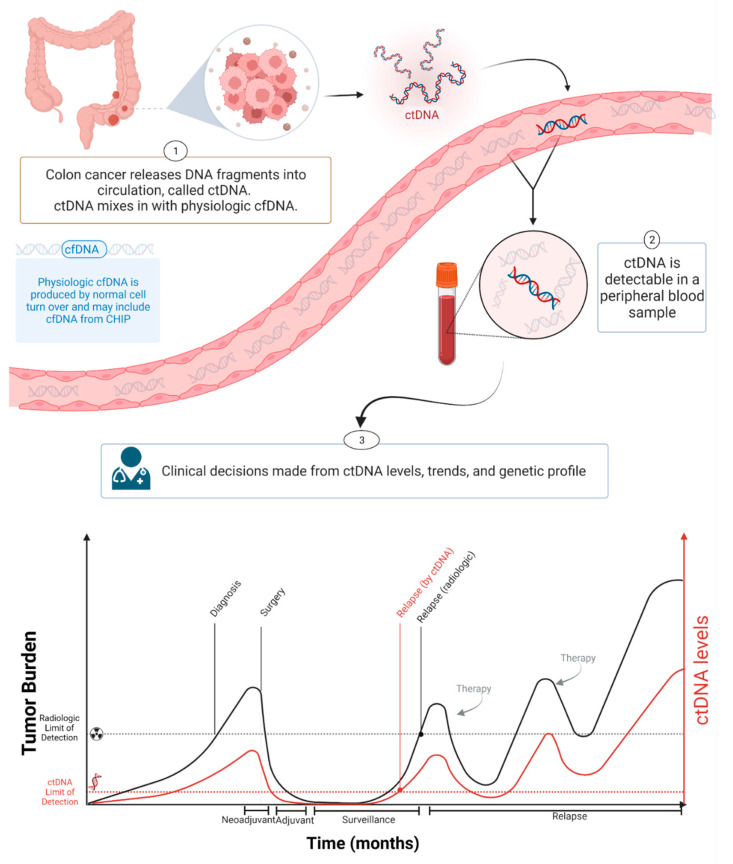
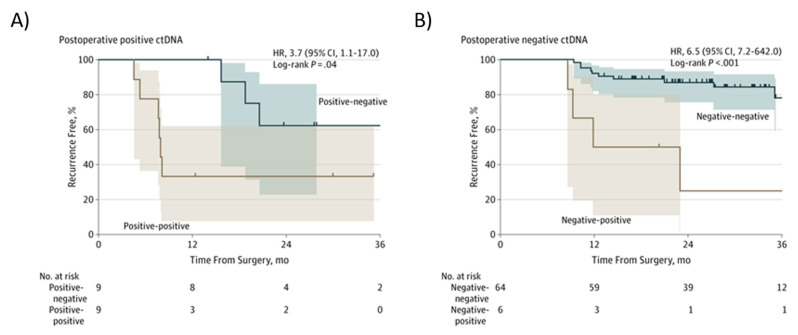
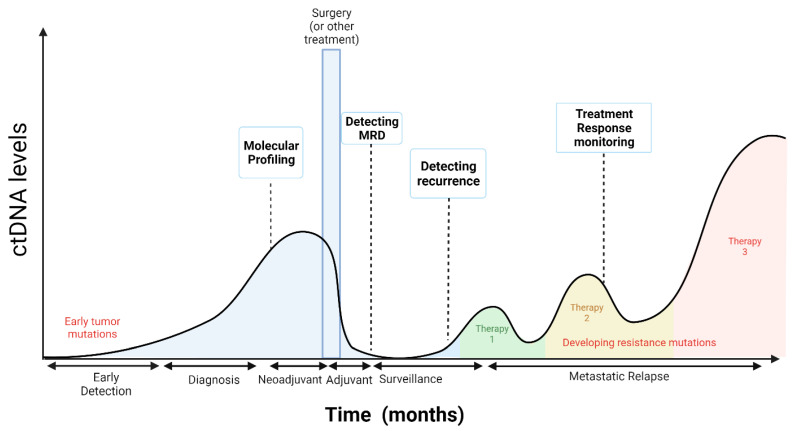
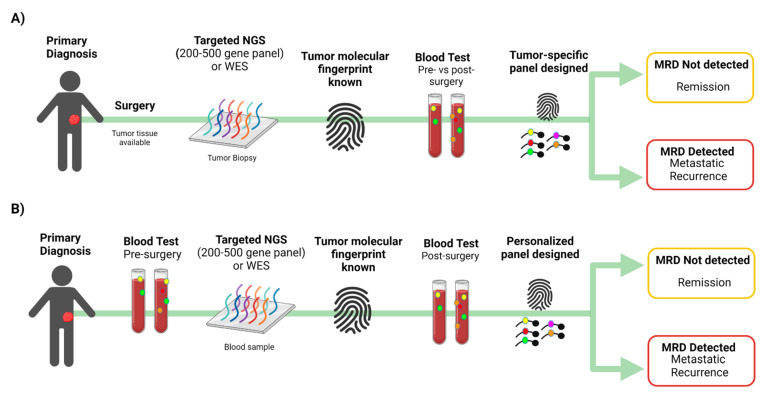
Circulating tumor DNA (ctDNA) is a component of cell-free DNA (cfDNA) that is shed by malignant tumors into the bloodstream and other bodily fluids. ctDNA can comprise up to 10% of a patient's cfDNA depending on their tumor type and burden. The short half-life of ctDNA ensures that its detection captures tumor burden in real-time and offers a non-invasive method of repeatedly evaluating the genomic profile of a patient's tumor. A challenge in ctDNA detection includes clonal hematopoiesis of indeterminate potential (CHIP), which can be distinguished from tumor variants using a paired whole-blood control. Most assays for ctDNA quantification rely on measurements of somatic variant allele frequency (VAF), which is a mutation-dependent method. Patients with certain types of solid tumors, including colorectal cancer (CRC), can have levels of cfDNA 50 times higher than healthy patients. ctDNA undergoes a precipitous drop shortly after tumor resection and therapy, and rising levels can foreshadow radiologic recurrence on the order of months. The amount of tumor bulk required for ctDNA detection is lower than that for computed tomography (CT) scan detection, with ctDNA detection preceding radiologic recurrence in many cases. cfDNA/ctDNA can be used for tumor molecular profiling to identify resistance mutations when tumor biopsy is not available, to detect minimal residual disease (MRD), to monitor therapy response, and for the detection of tumor relapse. Although ctDNA is not yet implemented in clinical practice, studies are ongoing to define the appropriate way to use it as a tool in the clinic. In this review article, we examine the general aspects of ctDNA, its status as a biomarker, and its role in the management of early (II-III) and late (IV; mCRC) stage colorectal cancer (CRC).
循环肿瘤 DNA(ctDNA)是无细胞 DNA(cfDNA)的一个组成部分,由恶性肿瘤释放到血液和其他体液中。根据肿瘤类型和负担,ctDNA 可占患者 cfDNA 的 10%。ctDNA 的半衰期较短,可确保其检测实时捕获肿瘤负担,并提供一种非侵入性方法,反复评估患者肿瘤的基因组特征。ctDNA 检测的一个挑战是不确定潜能的克隆性造血(CHIP),可以使用配对全血对照将其与肿瘤变异区分开来。大多数 ctDNA 定量检测方法都依赖于体细胞变异等位基因频率(VAF)的测量,这是一种依赖于突变的方法。某些类型的实体瘤患者,包括结直肠癌(CRC),cfDNA 水平可高于健康患者 50 倍。ctDNA 在肿瘤切除和治疗后不久急剧下降,水平升高预示着影像学复发的时间为几个月。ctDNA 检测所需的肿瘤体积比计算机断层扫描(CT)检测少,在许多情况下,ctDNA 检测先于影像学复发。cfDNA/ctDNA 可用于肿瘤分子谱分析,当肿瘤活检不可用时,可识别耐药突变,检测微小残留病(MRD),监测治疗反应,并检测肿瘤复发。尽管 ctDNA 尚未在临床实践中实施,但正在进行研究以确定将其作为临床工具使用的适当方法。在这篇综述文章中,我们研究了 ctDNA 的一般方面、作为生物标志物的地位以及在早期(II-III 期)和晚期(IV;mCRC)结直肠癌(CRC)管理中的作用。