Zala Urvi, Patel Rushi, Panchal Viraj, Chaudhari Joy, Shah Vedant, Shah Abhi
Dept. of Medicine, Smt. N.H.L. Municipal Medical College and SVPISMR, Ahmedabad, Gujarat, India.
J Liq Biopsy. 2023 Nov 10;2:100127. doi: 10.1016/j.jlb.2023.100127. eCollection 2023 Dec.
One of the main techniques for diagnosing lung cancer is still tissue biopsy. The more recent liquid biopsy technique includes the assessment of fragments of cfDNA, ctDNA, and CTCs, which are released by tumour cells and act as biomarkers. After compiling information from the existing literature, we conducted a statistical analysis to evaluate the prognosis and recurrence of NSCLC post-treatment using ctDNA levels.
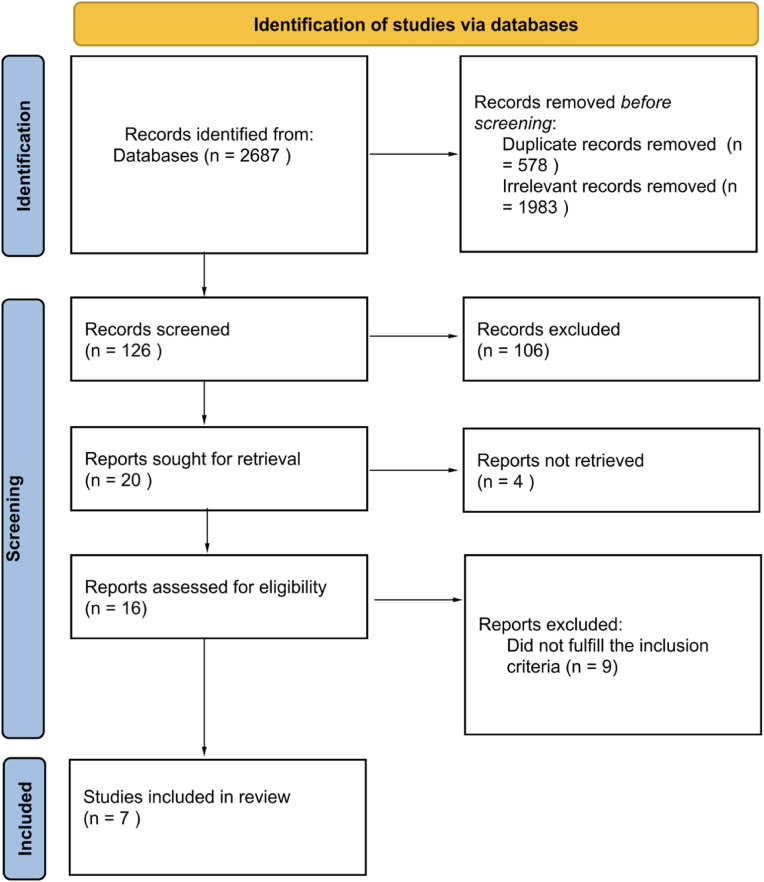
Based on predefined inclusion and exclusion criteria, published studies between 2000 and 2022 from electronic databases with statistical data on ctDNA levels for NSCLC were included. Then, using PRISMA guidelines, we carried out a systematic review of those studies.
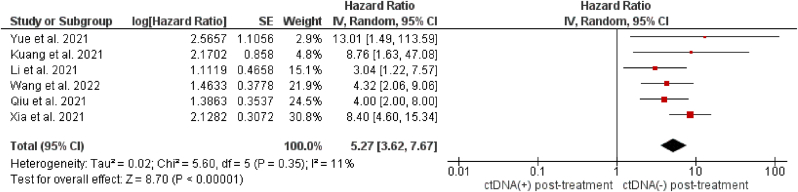
A total of 7 studies were included in the analysis, and we found a correlation of ctDNA levels for determination of prognosis and recurrence after treatment in NSCLC. Meta-analysis was performed using RevMan version 5.4. A P-value of less than 0.05 was considered significant. Studies were divided into three groups: <1 week post-surgery, one week to 3 months post-surgery, and > three months post-surgery. Analysis showed that in <1-week post-surgery group, ctDNA-negative post-treatment detection had an HR of 4.85 (95 % CI: 2.41 to 9.77; p=<0.0001, I2 = 0 %) for recurrence-free survival compared to ctDNA-positive post-treatment detection. Similar findings were obtained for one week to 3 months and > three months group, with HR of 5.27 (95 % CI: 3.62 to 7.67; p=<0.00001, I2 = 11 %) and HR of 6.62 (95 % CI: 2.85 to 15.35; p=<0.0001, I2 = 64 %) respectively.
According to our meta-analysis, patients with NSCLC who were ctDNA negative after surgery had a significantly longer recurrence-free survival than those who were ctDNA positive. As a result, liquid biopsy used to measure ctDNA levels is a useful non-invasive technique to assess the prognosis in such patients. The early detection of recurrence may also allow timely therapeutic intervention, leading to better outcomes.
组织活检仍是诊断肺癌的主要技术之一。最新的液体活检技术包括评估循环游离DNA(cfDNA)、循环肿瘤DNA(ctDNA)和循环肿瘤细胞(CTC)的片段,这些由肿瘤细胞释放并作为生物标志物。在汇总现有文献信息后,我们进行了一项统计分析,以评估使用ctDNA水平预测非小细胞肺癌(NSCLC)治疗后的预后和复发情况。
根据预先定义的纳入和排除标准,纳入2000年至2022年电子数据库中发表的、包含NSCLC患者ctDNA水平统计数据的研究。然后,按照PRISMA指南,对这些研究进行系统评价。
分析共纳入7项研究,我们发现ctDNA水平与NSCLC治疗后的预后和复发情况相关。使用RevMan 5.4版本进行Meta分析。P值小于0.05被认为具有统计学意义。研究分为三组:术后<1周、术后1周至3个月、术后>3个月。分析表明,在术后<1周组中,与治疗后ctDNA阳性检测相比,治疗后ctDNA阴性检测的无复发生存期的风险比(HR)为4.85(95%置信区间:2.41至9.77;p<0.0001,I² = 0%)。在术后1周至3个月组和术后>3个月组也获得了类似结果,HR分别为5.27(95%置信区间:3.62至7.67;p<0.00001,I² = 11%)和6.62(95%置信区间:2.85至15.35;p<0.0001,I² = 64%)。
根据我们的Meta分析,术后ctDNA阴性的NSCLC患者的无复发生存期显著长于ctDNA阳性患者。因此,用于测量ctDNA水平的液体活检是评估此类患者预后的一种有用的非侵入性技术。复发的早期检测还可实现及时的治疗干预,从而带来更好的治疗效果。