State Key Laboratory of Tree Genetics and Breeding, Chinese Academy of Forestry, Beijing 100091, China.
Forestry Faculty, Nanjing Forestry University, Nanjing 210037, China.
Int J Mol Sci. 2022 Apr 18;23(8):4463. doi: 10.3390/ijms23084463.
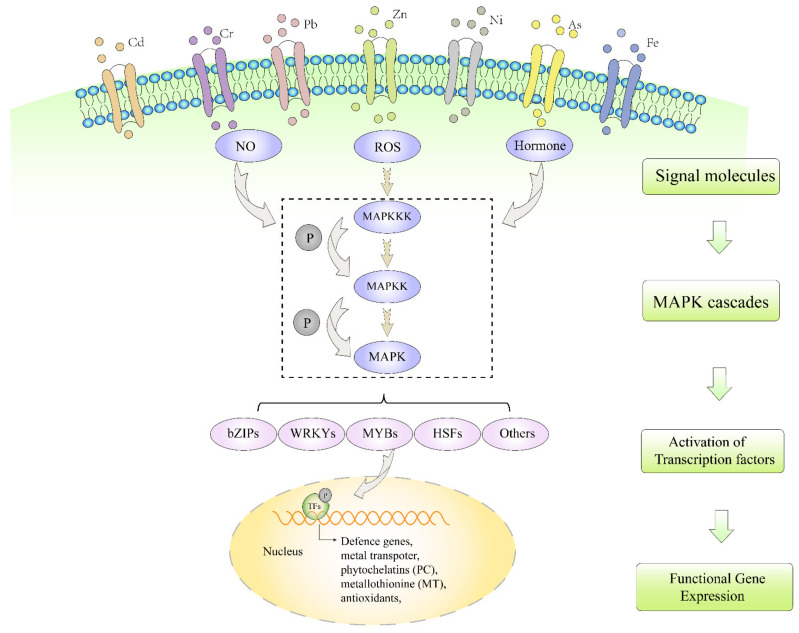
In nature, heavy metal (HM) stress is one of the most destructive abiotic stresses for plants. Heavy metals produce toxicity by targeting key molecules and important processes in plant cells. The mitogen-activated protein kinase (MAPK) cascade transfers the signals perceived by cell membrane surface receptors to cells through phosphorylation and dephosphorylation and targets various effector proteins or transcriptional factors so as to result in the stress response. Signal molecules such as plant hormones, reactive oxygen species (ROS), and nitric oxide (NO) can activate the MAPK cascade through differentially expressed genes, the activation of the antioxidant system and synergistic crosstalk between different signal molecules in order to regulate plant responses to HMs. Transcriptional factors, located downstream of MAPK, are key factors in regulating plant responses to heavy metals and improving plant heavy metal tolerance and accumulation. Thus, understanding how HMs activate the expression of the genes related to the MAPK cascade pathway and then phosphorylate those transcriptional factors may allow us to develop a regulation network to increase our knowledge of HMs tolerance and accumulation. This review highlighted MAPK pathway activation and responses under HMs and mainly focused on the specificity of MAPK activation mediated by ROS, NO and plant hormones. Here, we also described the signaling pathways and their interactions under heavy metal stresses. Moreover, the process of MAPK phosphorylation and the response of downstream transcriptional factors exhibited the importance of regulating targets. It was conducive to analyzing the molecular mechanisms underlying heavy metal accumulation and tolerance.
在自然界中,重金属(HM)胁迫是植物面临的最具破坏性的非生物胁迫之一。重金属通过靶向植物细胞中的关键分子和重要过程产生毒性。丝裂原活化蛋白激酶(MAPK)级联通过磷酸化和去磷酸化将细胞膜表面受体感知的信号传递到细胞中,并靶向各种效应蛋白或转录因子,从而导致应激反应。植物激素、活性氧(ROS)和一氧化氮(NO)等信号分子可以通过差异表达基因、抗氧化系统的激活以及不同信号分子之间的协同串扰来激活 MAPK 级联,从而调节植物对 HMs 的响应。位于 MAPK 下游的转录因子是调节植物对重金属响应和提高植物重金属耐受性和积累能力的关键因素。因此,了解 HMs 如何激活与 MAPK 级联途径相关的基因的表达,然后磷酸化这些转录因子,可能有助于我们开发一个调控网络,以增加我们对 HMs 耐受性和积累的认识。本综述强调了 MAPK 途径在 HMs 下的激活和响应,主要集中在 ROS、NO 和植物激素介导的 MAPK 激活的特异性上。在这里,我们还描述了重金属胁迫下的信号通路及其相互作用。此外,MAPK 磷酸化的过程和下游转录因子的响应表明了调节靶标的重要性。这有助于分析重金属积累和耐受性的分子机制。