Lohani Neeta, Singh Mohan B, Bhalla Prem L
Plant Molecular Biology and Biotechnology Laboratory, Faculty of Veterinary and Agricultural Sciences, The University of Melbourne, Parkville, VIC 3010, Australia.
Biodes Res. 2022 Jan 21;2022:9819314. doi: 10.34133/2022/9819314. eCollection 2022.
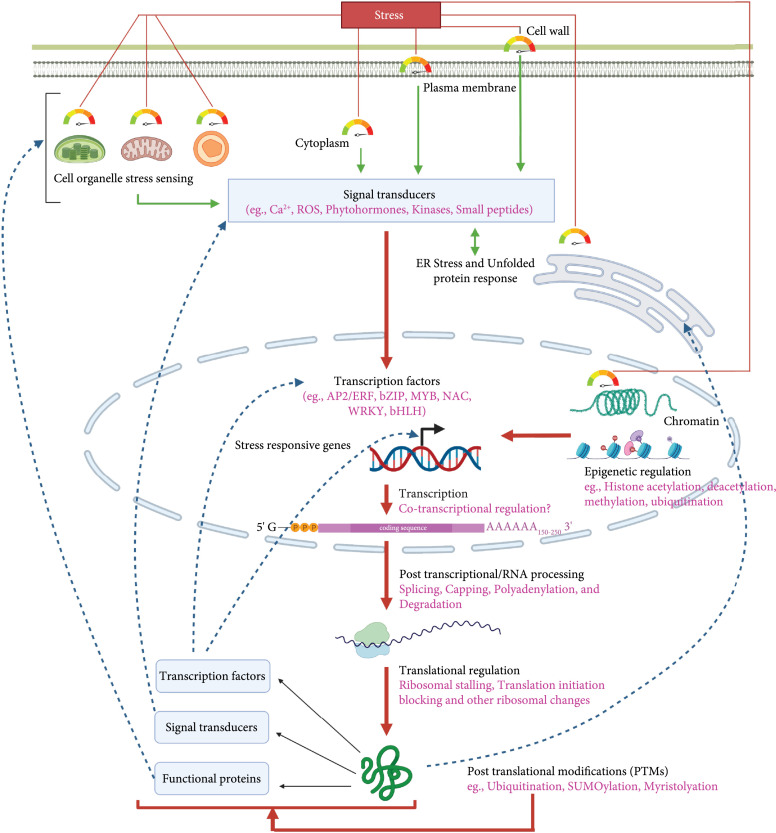
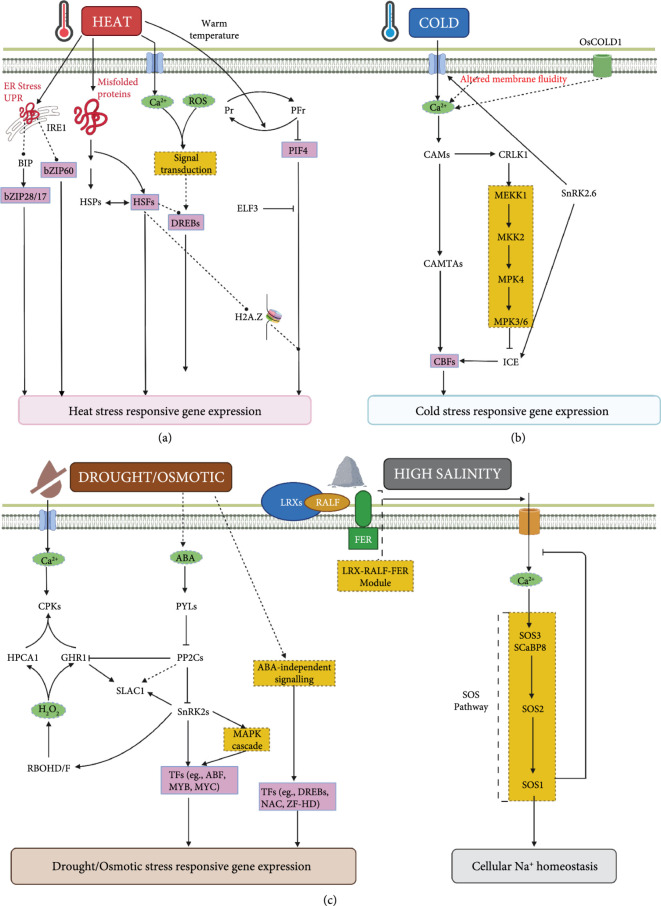
It is vital to ramp up crop production dramatically by 2050 due to the increasing global population and demand for food. However, with the climate change projections showing that droughts and heatwaves becoming common in much of the globe, there is a severe threat of a sharp decline in crop yields. Thus, developing crop varieties with inbuilt genetic tolerance to environmental stresses is urgently needed. Selective breeding based on genetic diversity is not keeping up with the growing demand for food and feed. However, the emergence of contemporary plant genetic engineering, genome-editing, and synthetic biology offer precise tools for developing crops that can sustain productivity under stress conditions. Here, we summarize the systems biology-level understanding of regulatory pathways involved in perception, signalling, and protective processes activated in response to unfavourable environmental conditions. The potential role of noncoding RNAs in the regulation of abiotic stress responses has also been highlighted. Further, examples of imparting abiotic stress tolerance by genetic engineering are discussed. Additionally, we provide perspectives on the rational design of abiotic stress tolerance through synthetic biology and list various bioparts that can be used to design synthetic gene circuits whose stress-protective functions can be switched on/off in response to environmental cues.
由于全球人口增长以及对食物的需求不断增加,到2050年大幅提高作物产量至关重要。然而,气候变化预测显示,干旱和热浪在全球大部分地区正变得越来越普遍,作物产量急剧下降的严重威胁存在。因此,迫切需要培育具有内在遗传耐受性以应对环境胁迫的作物品种。基于遗传多样性的选择性育种已无法满足对粮食和饲料日益增长的需求。然而,当代植物基因工程、基因组编辑和合成生物学的出现,为培育能够在胁迫条件下维持生产力的作物提供了精确工具。在此,我们总结了在系统生物学层面上对感知、信号传导以及响应不利环境条件而激活的保护过程中所涉及的调控途径的理解。非编码RNA在非生物胁迫响应调控中的潜在作用也得到了强调。此外,还讨论了通过基因工程赋予非生物胁迫耐受性的实例。此外,我们提供了通过合成生物学合理设计非生物胁迫耐受性的观点,并列出了各种生物部件,可用于设计合成基因电路,其胁迫保护功能可根据环境信号开启/关闭。