Cheung Yik-Kin, Zhao Zuofeng, Yu Hongyu
Department of Mechanical and Aerospace Engineering, The Hong Kong University of Science and Technology, Hong Kong, China.
School of Earth and Space Exploration, Arizona State University, Tempe, AZ 85281, USA.
Micromachines (Basel). 2022 Mar 27;13(4):530. doi: 10.3390/mi13040530.
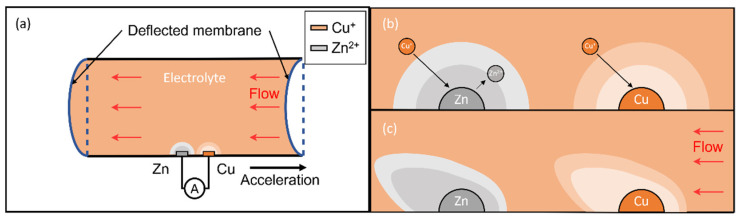
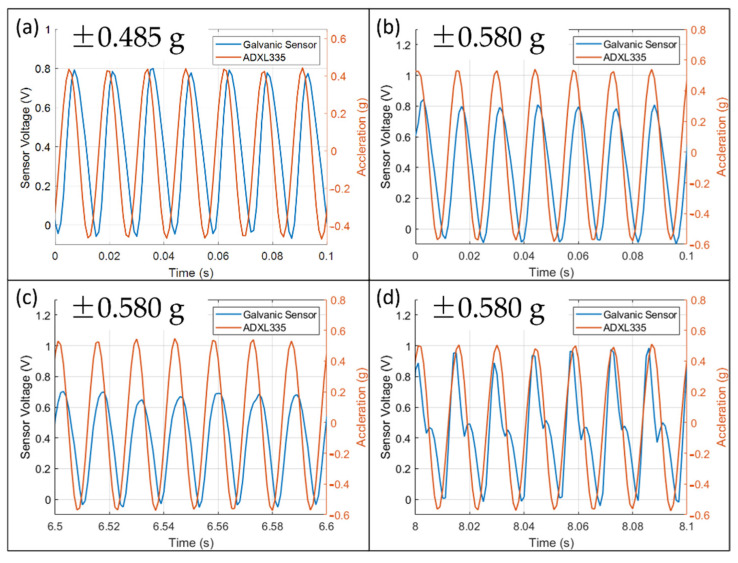
The development of the IoT demands small, durable, remote sensing systems that have energy harvesters and storage. Various energy harvesters are developed, including piezoelectric, triboelectric, electromagnetic, and reverse-electrowetting-on-dielectric. However, integrating energy storage and sensing functionality receives little attention. This paper presents an electrochemical vibration sensor with a galvanic cell (Zn-Cu cell) as energy storage and a vibration transducer. The frequency response, scale factor, long-term response, impedance study, and discharge characteristics are given. This study proved the possibility of integrating energy storage and vibration sensing functionality with promising performance. The performance of the sensor halved within 74 min. The longevity of the sensor is short due to the spontaneous reactions and ions drained. The sensitivity can be restored after refilling the electrolyte. The sensor could be rechargeable by changing to a reversible electrochemical system such as a lead-acid cell in the future.
物联网的发展需要具备能量收集器和存储功能的小型、耐用的遥感系统。人们开发了各种能量收集器,包括压电式、摩擦电式、电磁式和介电层上电润湿反向式。然而,将能量存储和传感功能集成起来却很少受到关注。本文介绍了一种电化学振动传感器,它以原电池(锌 - 铜电池)作为能量存储装置,并配备一个振动传感器。文中给出了频率响应、比例因子、长期响应、阻抗研究和放电特性。这项研究证明了将能量存储和振动传感功能集成起来并具有良好性能的可能性。该传感器的性能在74分钟内减半。由于自发反应和离子耗尽,传感器的使用寿命较短。补充电解质后,灵敏度可以恢复。未来通过更换为可逆电化学系统,如铅酸电池,该传感器有望实现可充电。