Laboratory of Animal Histology, Faculty of Biology, "Alexandru Ioan Cuza" University of Iasi, Carol I bvd. No. 22, 700505 Iasi, Romania.
Biochemistry & Proteomics Group, Department of Chemistry and Biomolecular Science, Clarkson University, 8 Clarkson Avenue, Potsdam, NY 13699, USA.
Molecules. 2022 Apr 8;27(8):2411. doi: 10.3390/molecules27082411.
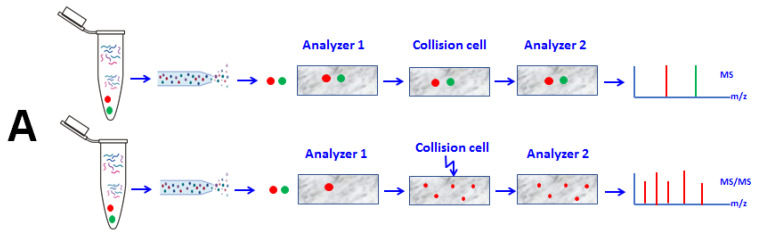
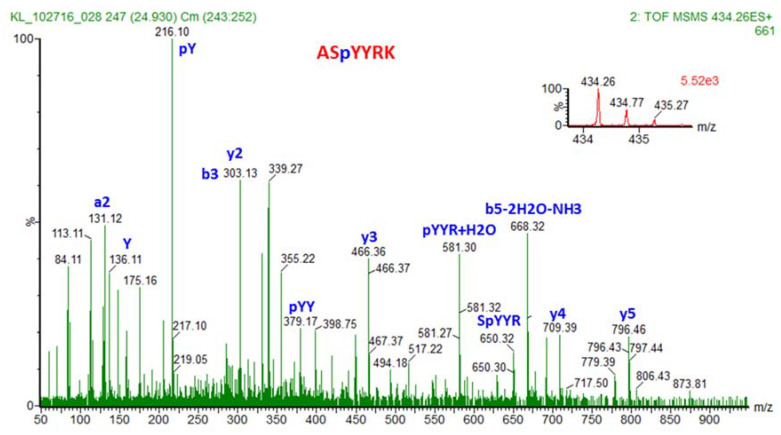
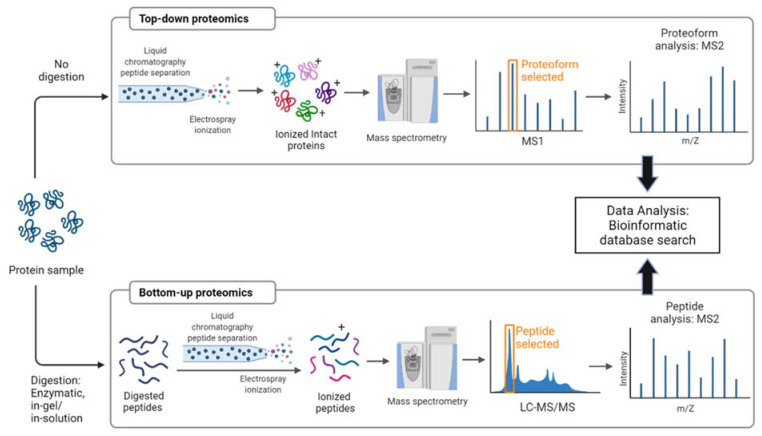
Mass Spectrometry (MS) allows the analysis of proteins and peptides through a variety of methods, such as Electrospray Ionization-Mass Spectrometry (ESI-MS) or Matrix-Assisted Laser Desorption Ionization-Mass Spectrometry (MALDI-MS). These methods allow identification of the mass of a protein or a peptide as intact molecules or the identification of a protein through peptide-mass fingerprinting generated upon enzymatic digestion. Tandem mass spectrometry (MS/MS) allows the fragmentation of proteins and peptides to determine the amino acid sequence of proteins (top-down and middle-down proteomics) and peptides (bottom-up proteomics). Furthermore, tandem mass spectrometry also allows the identification of post-translational modifications (PTMs) of proteins and peptides. Here, we discuss the application of MS/MS in biomedical research, indicating specific examples for the identification of proteins or peptides and their PTMs as relevant biomarkers for diagnostic and therapy.
质谱(MS)允许通过多种方法分析蛋白质和肽,例如电喷雾电离-质谱(ESI-MS)或基质辅助激光解吸电离-质谱(MALDI-MS)。这些方法允许鉴定蛋白质或肽的质量,无论是完整分子还是通过酶消化产生的肽质量指纹图谱鉴定蛋白质。串联质谱(MS/MS)允许蛋白质和肽的片段化,以确定蛋白质的氨基酸序列(自上而下和中间向下的蛋白质组学)和肽(自下而上的蛋白质组学)。此外,串联质谱还允许鉴定蛋白质和肽的翻译后修饰(PTMs)。在这里,我们讨论了 MS/MS 在生物医学研究中的应用,指出了用于鉴定蛋白质或肽及其 PTMs 作为诊断和治疗相关生物标志物的具体示例。