Department of Virology, College of Health Sciences, Noguchi Memorial Institute for Medical Research, University of Ghana, P. O. Box, LG 581, Legon Accra, Ghana.
Department of Medical Biochemistry, University of Ghana Medical School, University of Ghana, Accra, Ghana.
Virol J. 2022 Apr 22;19(1):73. doi: 10.1186/s12985-022-01797-z.
Hepatitis C virus (HCV) infection is a blood borne infection that remains potentially transmissible through blood transfusions. Sickle cell disease (SCD) is a common inheritable haemoglobinopathy in Ghana that requires multiple blood transfusions as part of its management. The SCD patient is therefore at a high risk of HCV infection; however, data on the occurrence of HCV in SCD patients has not been documented in Ghana. This study sought to determine the prevalence and genotypes of HCV infection in SCD patients.
This was a cross-sectional study which enrolled 141 sickle-cell disease patients from the Ghana Institute for Clinical Genetics, Korle-Bu Teaching Hospital (KBTH). Patient information was obtained through a structured questionnaire. Aliquots of the plasma obtained was used for both serology with Advanced Quality Rapid Anti-HCV Test Strip and molecular testing by RT-PCR with primers targeting the HCV core gene. The amplified DNA were purified and subjected to phylogenetic analysis to characterize HCV genotypes.
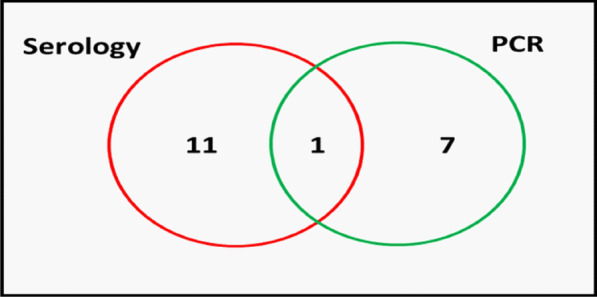
Twelve (9%) out of the 141 patients were sero-positive for HCV total antibodies. HCV RNA was amplified from 8 (6%) out of the total number of patients' samples. One of the 12 sero-positives was HCV RNA positive. Five (63%) out of the 8 HCV RNA positive samples were successfully sequenced. The phylogenetic tree constructed with the study and GenBank reference sequences, clustered all five study sequences into HCV genotype 1.
The HCV seroprevalence of 9% among sickle cell disease patients is higher than reported for the general Ghanaian population which is 3%. Genotype 1 is the common HCV genotype infecting SCD patients. Sickle cell disease is likely to be a high-risk group for HCV inapparent infections in Ghana as seroprevalence does not correlate with viremia. However, even with higher seroprevalence, the group must be given priority in resource allocation for preventive, diagnostic and therapeutic strategies.
丙型肝炎病毒(HCV)感染是一种血液传播感染,通过输血仍然具有潜在的传染性。镰状细胞病(SCD)是加纳常见的遗传性血红蛋白病,作为其治疗的一部分需要多次输血。因此,SCD 患者感染 HCV 的风险很高;然而,加纳尚未记录 SCD 患者 HCV 感染的发生数据。本研究旨在确定 SCD 患者 HCV 感染的流行率和基因型。
这是一项横断面研究,共纳入来自加纳临床遗传学研究所、科勒布教学医院(KBTH)的 141 名镰状细胞病患者。通过结构化问卷获取患者信息。从获得的血浆等分试样中,同时使用高级质量快速抗 HCV 测试条进行血清学检测和使用针对 HCV 核心基因的 RT-PCR 进行分子检测。扩增的 DNA 经纯化后进行系统发育分析,以鉴定 HCV 基因型。
在 141 名患者中,有 12 名(9%)血清抗 HCV 总抗体阳性。从总共 8 名患者的样本中扩增出 HCV RNA。在 12 名血清阳性者中,有 1 名 HCV RNA 阳性。从 8 名 HCV RNA 阳性样本中成功测序了 5 个(63%)。用研究和 GenBank 参考序列构建的系统发育树将所有 5 个研究序列聚类到 HCV 基因型 1 中。
镰状细胞病患者 HCV 血清流行率为 9%,高于加纳一般人群的 3%报告率。基因型 1 是感染 SCD 患者的常见 HCV 基因型。由于血清流行率与病毒血症不相关,因此镰状细胞病在加纳可能是 HCV 隐匿性感染的高危人群。然而,即使血清流行率较高,也必须优先为该群体分配资源,以制定预防、诊断和治疗策略。