Choi Bongkun, Kim Ji-Eun, Park Si-On, Kim Eun-Young, Oh Soyoon, Choi Hyuksu, Yoon Dohee, Min Hyo-Jin, Kim Hyung-Ryong, Chang Eun-Ju
Department of Biomedical Sciences, Asan Medical Center, University of Ulsan College of Medicine, Seoul, 05505, Korea.
Stem Cell Immunomodulation Research Center, Asan Medical Center, University of Ulsan College of Medicine, Seoul, Korea.
Int J Oral Sci. 2022 Apr 22;14(1):21. doi: 10.1038/s41368-022-00173-5.
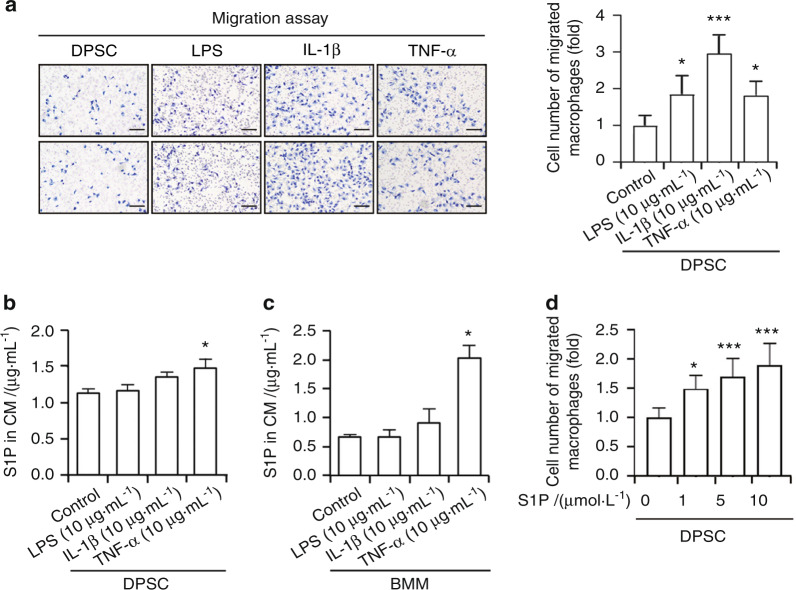
Sphingosine-1-phosphate (S1P) is an important lipid mediator that regulates a diverse range of intracellular cell signaling pathways that are relevant to tissue engineering and regenerative medicine. However, the precise function of S1P in dental pulp stem cells (DPSCs) and its osteogenic differentiation remains unclear. We here investigated the function of S1P/S1P receptor (S1PR)-mediated cellular signaling in the osteogenic differentiation of DPSCs and clarified the fundamental signaling pathway. Our results showed that S1P-treated DPSCs exhibited a low rate of differentiation toward the osteogenic phenotype in association with a marked reduction in osteogenesis-related gene expression and AKT activation. Of note, both S1PR1/S1PR3 and S1PR2 agonists significantly downregulated the expression of osteogenic genes and suppressed AKT activation, resulting in an attenuated osteogenic capacity of DPSCs. Most importantly, an AKT activator completely abrogated the S1P-mediated downregulation of osteoblastic markers and partially prevented S1P-mediated attenuation effects during osteogenesis. Intriguingly, the pro-inflammatory TNF-α cytokine promoted the infiltration of macrophages toward DPSCs and induced S1P production in both DPSCs and macrophages. Our findings indicate that the elevation of S1P under inflammatory conditions suppresses the osteogenic capacity of the DPSCs responsible for regenerative endodontics.
鞘氨醇-1-磷酸(S1P)是一种重要的脂质介质,可调节多种与组织工程和再生医学相关的细胞内信号通路。然而,S1P在牙髓干细胞(DPSC)中的精确功能及其成骨分化仍不清楚。我们在此研究了S1P/S1P受体(S1PR)介导的细胞信号在DPSC成骨分化中的作用,并阐明了基本信号通路。我们的结果表明,S1P处理的DPSC向成骨表型的分化率较低,同时成骨相关基因表达和AKT激活显著降低。值得注意的是,S1PR1/S1PR3和S1PR2激动剂均显著下调成骨基因的表达并抑制AKT激活,导致DPSC的成骨能力减弱。最重要的是,一种AKT激活剂完全消除了S1P介导的成骨细胞标志物下调,并部分阻止了S1P介导的成骨过程中的衰减效应。有趣的是,促炎细胞因子TNF-α促进巨噬细胞向DPSC浸润,并诱导DPSC和巨噬细胞中S1P的产生。我们的研究结果表明,炎症条件下S1P的升高会抑制负责再生性牙髓病学的DPSC的成骨能力。