Chung Mu-Chi, Hsu Hui-Tsung, Mao Yan-Chiao, Wu Chin-Ching, Ho Chih-Te, Liu Chiu-Shong, Chung Chi-Jung
Division of Nephrology, Department of Medicine, Taichung Veterans General Hospital, Taichung, Taiwan.
Department of Public Health, College of Public Health, China Medical University, No. 100, Sec. 1, Jingmao Rd., Beitun Dist, Taichung City, 406040, Taiwan.
Environ Health. 2022 Apr 23;21(1):44. doi: 10.1186/s12940-022-00855-x.
Chronic kidney disease (CKD) is increasing, with heavy metal exposure an important risk factor. Additionally, the antioxidant folic acid has been studied for reducing blood arsenic levels and related tissue damage. Therefore, we explored the association and mediation effects among various heavy metal levels in blood, plasma folate, other CKD risk factors, and impaired estimated glomerular filtration rate (eGFR).
We constructed a community-based cross-sectional study from the Human Biomonitoring and Environmental Health Program in central Taiwan. A total of 1643 participants had lived locally for > 5 years, > 40 years old, and completely received health examinations and biospecimen collections. Impaired eGFR was defined as one single eGFR < 60 mL/min/1.73 m. Plasma folate and metal levels in blood were determined, as well as urinary 8-hydroxy-2'-deoxyguanosine as an oxidative stress marker. Generalized weighted quantile sum (WQS) regression analysis was used to calculate a WQS score, reflecting overall body-burden of multiple metals (arsenic, cadmium, chromium, nickel, and lead) in blood.
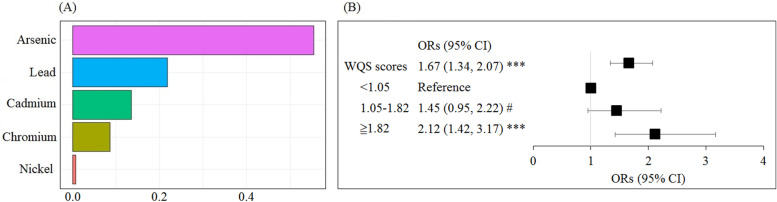
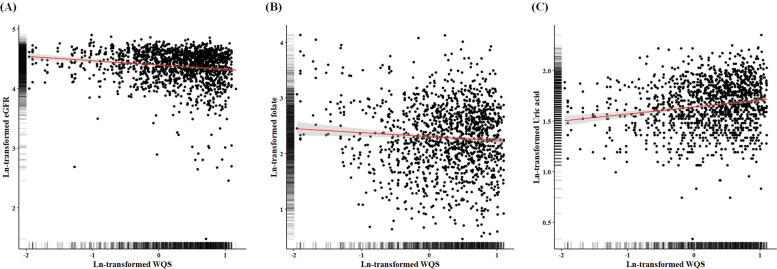
Impaired eGFR was identified in 225 participants. Participants with high WQS scores had increased risk of impaired eGFR (odds ratio = 1.67; 95% confidence interval [CI]: 1.34, 2.07). Of five metals, arsenic, lead, and cadmium were weighted highly in impaired eGFR. Participants with high WQS and folate insufficiency (< 6 ng/mL) had 2.38-fold risk of impaired eGFR compared to those with low WQS and high folate (≥6 ng/mL) (95% CI: 1.55, 5.17). Similar increased 4.16-fold risk of impaired eGFR was shown in participants with high WQS and uric acid levels (95% CI: 2.63, 6.58). However, there were no significant WQS-folate (p = 0.87) or WQS-uric acid (p = 0.38) interactions on impaired eGFR risk. As a mediator, uric acid contributed 24% of the association between WQS score and impaired eGFR risk (p < 0.0001). However, no mediation effect of plasma folate was observed.
WQS analysis could be applied to evaluate the joint effects of multiple metals exposure. High WQS scores may influence impaired eGFR risk through increased uric acid levels. A large-scale and prospective cohort study is necessary to validate these results and demonstrate any causal relationship.
慢性肾脏病(CKD)的发病率正在上升,重金属暴露是一个重要的风险因素。此外,已对抗氧化剂叶酸进行研究,以降低血液中的砷水平及相关组织损伤。因此,我们探讨了血液中各种重金属水平、血浆叶酸、其他CKD风险因素与估计肾小球滤过率(eGFR)受损之间的关联及中介作用。
我们从台湾中部的人体生物监测与环境卫生项目构建了一项基于社区的横断面研究。共有1643名参与者在当地居住超过5年,年龄超过40岁,并且全部接受了健康检查和生物样本采集。eGFR受损定义为单次eGFR<60 mL/min/1.73 m²。测定了血浆叶酸和血液中的金属水平,以及作为氧化应激标志物的尿8-羟基-2'-脱氧鸟苷。采用广义加权分位数和(WQS)回归分析来计算WQS评分,反映血液中多种金属(砷、镉、铬、镍和铅)的总体身体负担。
225名参与者被确定为eGFR受损。WQS评分高的参与者eGFR受损风险增加(比值比=1.67;95%置信区间[CI]:1.34,2.07)。在五种金属中,砷、铅和镉在eGFR受损中权重较高。与WQS评分低且叶酸水平高(≥6 ng/mL)的参与者相比,WQS评分高且叶酸不足(<6 ng/mL)的参与者eGFR受损风险高2.38倍(95% CI:1.55,5.17)。WQS评分高且尿酸水平高的参与者eGFR受损风险也增加了4.16倍(95% CI:2.63,6.58)。然而,在eGFR受损风险方面,WQS与叶酸(p = 0.87)或WQS与尿酸(p = 0.38)之间没有显著的相互作用。作为中介因素,尿酸在WQS评分与eGFR受损风险之间的关联中占24%(p < 0.0001)。然而,未观察到血浆叶酸的中介作用。
WQS分析可用于评估多种金属暴露的联合效应。高WQS评分可能通过增加尿酸水平影响eGFR受损风险。有必要进行大规模的前瞻性队列研究来验证这些结果并证明任何因果关系。