Department of Health & Society, University of Toronto Scarborough, 1265 Military Trail, c/o Highland Hall Rm. 220, Toronto, ON, M1C 1A4, Canada.
Graduate Department of English, University of Toronto, Toronto, Canada.
J Med Humanit. 2022 Dec;43(4):615-637. doi: 10.1007/s10912-022-09735-4. Epub 2022 Apr 25.
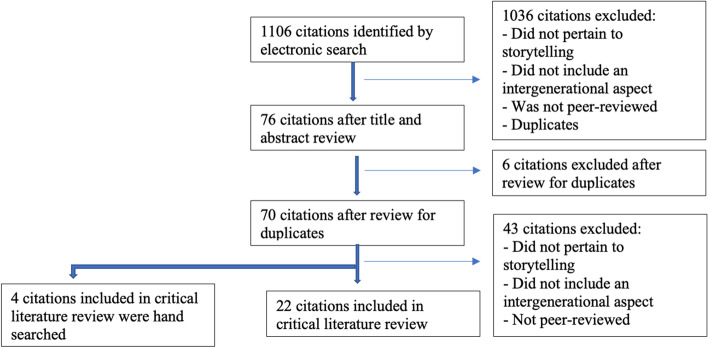
Intergenerational storytelling (IGS) has recently emerged as an arts- and humanities-focused approach to aging research. Despite growing appeal and applications, however, IGS methods, practices, and foundational concepts remain indistinct. In response to such heterogeneity, our objective was to comprehensively describe the state of IGS in aging research and assess the critical (e.g., conceptual, ethical, and social justice) issues raised by its current practice. Six databases (PsycINFO, MEDLINE, PubMed, Scopus, AgeLine, and Sociological Abstracts) were searched using search terms relating to age, intergenerational, story, and storytelling. Peer-reviewed, English-language studies conducted with participants residing in non-clinical settings were included. One thousand one hundred six (1106) studies were initially retrieved; 70 underwent full review, and 26 fulfilled all inclusion criteria. Most studies characterized IGS as a practice involving older adults (> 50 years old) and conventionally-aged postsecondary/college students (17-19 years old). Typical methodologies included oral and, in more recent literature, digital storytelling. Critical issues included inconsistently reported participant data, vast variations in study design and methods, undefined key concepts, including younger vs. older cohorts, generation, storytelling, and whether IGS comprised an intentional research method or a retrospective outcome. While IGS holds promise as an emerging field of arts- and humanities-based aging research, current limitations include a lack of shared data profiles and comparable study designs, limited cross-cultural representation, and insufficiently intersectional analysis of widespread IGS practices. To encourage more robust standards for future study design, data collection, and researcher reflexivity, we propose seven evidence-based recommendations for evolving IGS as a humanities-based approach to research in aging and intergenerational relations.
代际叙事(IGS)最近作为一种以艺术和人文学科为重点的老龄化研究方法出现。然而,尽管越来越受欢迎和应用,IGS 方法、实践和基础概念仍然不明确。针对这种异质性,我们的目标是全面描述 IGS 在老龄化研究中的现状,并评估其当前实践所引发的关键问题(例如,概念、伦理和社会公正)。使用与年龄、代际、故事和叙事相关的搜索词,在六个数据库(PsycINFO、MEDLINE、PubMed、Scopus、AgeLine 和 Sociological Abstracts)中进行了搜索。纳入了在非临床环境中居住的参与者进行的同行评审的英语研究。最初检索到 1106 项研究;26 项研究进行了全面审查,26 项研究符合所有纳入标准。大多数研究将 IGS 描述为一种涉及老年人(>50 岁)和传统年龄的大学生/大学生(17-19 岁)的实践。典型的方法包括口头叙事,在最近的文献中还包括数字叙事。关键问题包括参与者数据报告不一致、研究设计和方法差异巨大、关键概念未定义,包括年轻与年长群体、代际、叙事以及 IGS 是否构成一种有意的研究方法或回顾性结果。虽然 IGS 作为一个新兴的艺术和人文学科老龄化研究领域具有潜力,但目前的局限性包括缺乏共享的数据概况和可比的研究设计、有限的跨文化代表性以及对广泛的 IGS 实践的交叉分析不足。为了鼓励未来研究设计、数据收集和研究人员反思更严格的标准,我们提出了七个基于证据的建议,以将 IGS 作为一种基于人文科学的老龄化和代际关系研究方法进行发展。