Wu Yu-Hsien, Wu Chih-Da, Chung Mu-Chi, Chen Cheng-Hsu, Wu Laing-You, Chung Chi-Jung, Hsu Hui-Tsung
School of Medicine, China Medical University, Taichung, Taiwan.
Department of Geomatics, National Cheng Kung University, Tainan, Taiwan.
Front Public Health. 2022 Apr 8;10:858655. doi: 10.3389/fpubh.2022.858655. eCollection 2022.
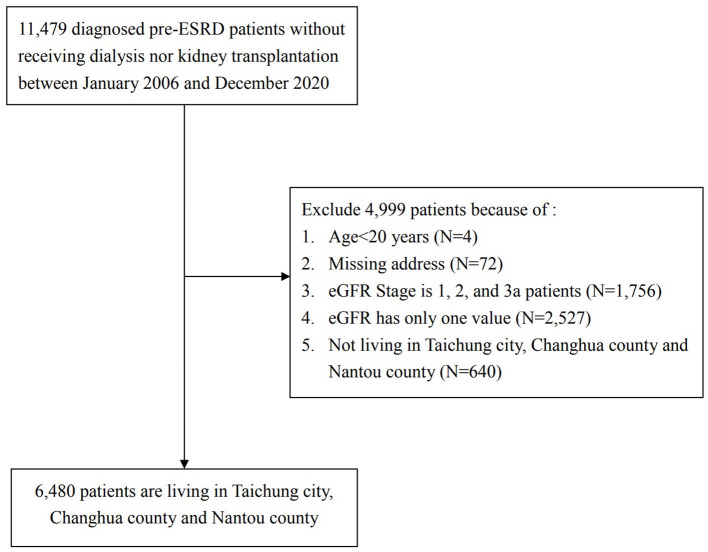
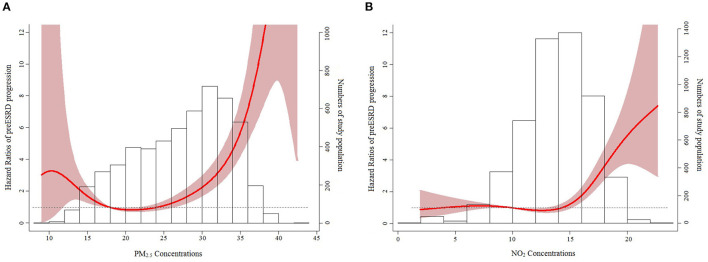
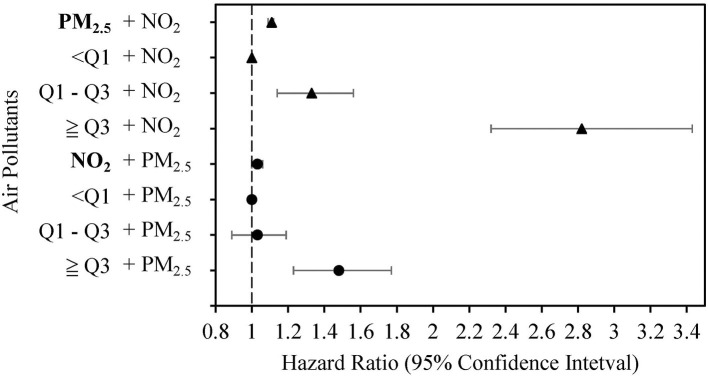
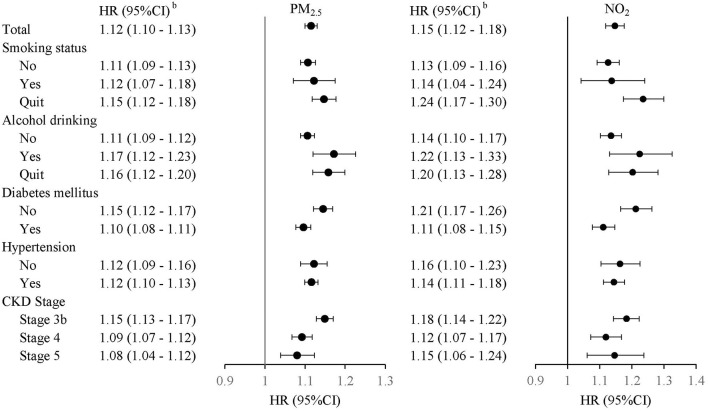
Limited literature has explored the effect of air pollutants on chronic kidney disease (CKD) progression, especially for patients with pre-end-stage renal disease (pre-ESRD). In this study, we reported the linear and nonlinear relationships of air pollutants of particles with diameter <2.5 μm (PM) and nitrogen dioxide (NO) with estimated glomerular filtration rate (eGFR) deterioration after adjusting for smoking status and other traditional clinical factors. This study adopted a retrospective cohort of patients with stage 3b to stage 5 CKD ( = 11,479) from Taichung Veterans General Hospital during January 2006 to December 2020. The eGFR deterioration was defined as a decline in eGFR > 5 ml/min/1.73 m/year. Hybrid kriging/land-use regression models were used to estimate the individual exposure levels of PM and NO. The relationships of air pollutants with eGFR deterioration were evaluated using Cox proportional hazard models. After adjusting for smoking status, baseline eGFR stages, and other traditional clinical factors, the risk of eGFR deterioration was found to increase with increasing PM and NO level ( < 0.0001 and = 0.041, respectively), especially for those exposed to PM ≥ 31.44 μg/m or NO ≥ 15.00 ppb. Similar results were also found in the two-pollutant models. Nonlinear dose-response relationships of eGFR deterioration were observed for concentrations of 26.11 μg/m for PM and 15.06 ppb for NO. In conclusion, linear and nonlinear associations between PM and NO levels and the incidence risk of eGFR deterioration were observed in patients with pre-ESRD.
仅有有限的文献探讨了空气污染物对慢性肾脏病(CKD)进展的影响,尤其是对终末期肾病前期(pre-ESRD)患者的影响。在本研究中,我们报告了在调整吸烟状况和其他传统临床因素后,直径<2.5μm的颗粒物(PM)和二氧化氮(NO)等空气污染物与估计肾小球滤过率(eGFR)恶化之间的线性和非线性关系。本研究采用了台中荣民总医院2006年1月至2020年12月期间3b至5期CKD患者的回顾性队列(n = 11479)。eGFR恶化定义为eGFR下降>5 ml/min/1.73 m²/年。使用混合克里金/土地利用回归模型来估计PM和NO的个体暴露水平。使用Cox比例风险模型评估空气污染物与eGFR恶化之间的关系。在调整吸烟状况、基线eGFR分期和其他传统临床因素后,发现eGFR恶化的风险随着PM和NO水平的升高而增加(分别为P<0.0001和P = 0.041),尤其是对于暴露于PM≥31.44μg/m³或NO≥15.00 ppb的患者。在双污染物模型中也发现了类似的结果。观察到PM浓度为26.11μg/m³和NO浓度为15.06 ppb时,eGFR恶化存在非线性剂量反应关系。总之,在pre-ESRD患者中观察到PM和NO水平与eGFR恶化的发病风险之间存在线性和非线性关联。