Papa Fabrice, Crétaux Jean-François, Grippa Manuela, Robert Elodie, Trigg Mark, Tshimanga Raphael M, Kitambo Benjamin, Paris Adrien, Carr Andrew, Fleischmann Ayan Santos, de Fleury Mathilde, Gbetkom Paul Gerard, Calmettes Beatriz, Calmant Stephane
LEGOS, Université de Toulouse, IRD, CNES, CNRS, UPS, 31400 Toulouse, France.
Institute of Geosciences, Universidade de Brasília (UnB), 70910-900 Brasília, Brazil.
Surv Geophys. 2023;44(1):43-93. doi: 10.1007/s10712-022-09700-9. Epub 2022 Apr 20.
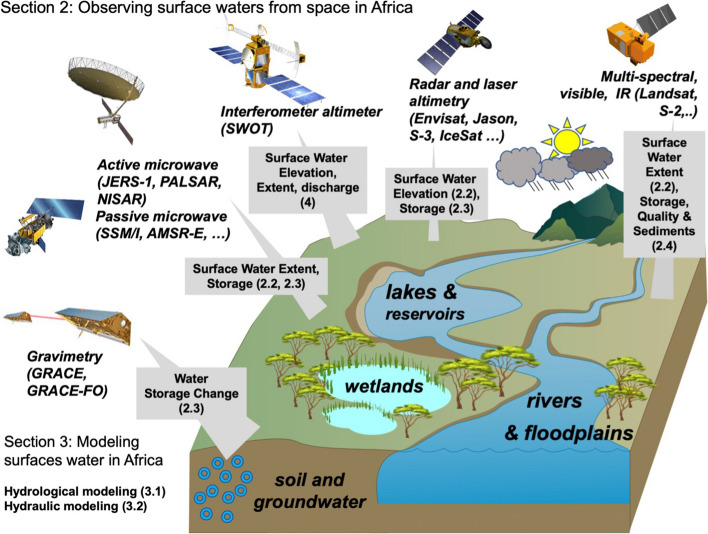
The African continent hosts some of the largest freshwater systems worldwide, characterized by a large distribution and variability of surface waters that play a key role in the water, energy and carbon cycles and are of major importance to the global climate and water resources. Freshwater availability in Africa has now become of major concern under the combined effect of climate change, environmental alterations and anthropogenic pressure. However, the hydrology of the African river basins remains one of the least studied worldwide and a better monitoring and understanding of the hydrological processes across the continent become fundamental. Earth Observation, that offers a cost-effective means for monitoring the terrestrial water cycle, plays a major role in supporting surface hydrology investigations. Remote sensing advances are therefore a game changer to develop comprehensive observing systems to monitor Africa's land water and manage its water resources. Here, we review the achievements of more than three decades of advances using remote sensing to study surface waters in Africa, highlighting the current benefits and difficulties. We show how the availability of a large number of sensors and observations, coupled with models, offers new possibilities to monitor a continent with scarce gauged stations. In the context of upcoming satellite missions dedicated to surface hydrology, such as the Surface Water and Ocean Topography (SWOT), we discuss future opportunities and how the use of remote sensing could benefit scientific and societal applications, such as water resource management, flood risk prevention and environment monitoring under current global change.
The hydrology of African surface water is of global importance, yet it remains poorly monitored and understoodComprehensive review of remote sensing and modeling advances to monitor Africa's surface water and water resourcesFuture opportunities with upcoming satellite missions and to translate scientific advances into societal applications.
非洲大陆拥有全球一些最大的淡水系统,其地表水分布广泛且变化多样,在水、能量和碳循环中发挥着关键作用,对全球气候和水资源至关重要。在气候变化、环境变化和人为压力的共同影响下,非洲的淡水供应如今已成为主要关切问题。然而,非洲流域的水文学仍是全球研究最少的领域之一,更好地监测和理解整个非洲大陆的水文过程变得至关重要。地球观测为监测陆地水循环提供了一种经济高效的手段,在支持地表水文学研究方面发挥着重要作用。因此,遥感技术的进步是开发综合观测系统以监测非洲陆地水和管理其水资源的关键因素。在此,我们回顾了三十多年来利用遥感研究非洲地表水的进展所取得的成果,突出了当前的益处和困难。我们展示了大量传感器和观测数据与模型相结合,如何为监测站点稀少的大陆提供了新的可能性。在即将开展的致力于地表水文学的卫星任务(如地表水和海洋地形任务(SWOT))的背景下,我们讨论了未来的机遇以及遥感技术的应用如何能惠及科学和社会应用,如在当前全球变化背景下的水资源管理、洪水风险预防和环境监测。
非洲地表水文学具有全球重要性,但仍监测不足且了解有限
对监测非洲地表水和水资源的遥感与建模进展进行全面综述
即将开展的卫星任务带来的未来机遇以及将科学进展转化为社会应用。