Gao Sheng, Li Yichen, Wu Dingfeng, Jiao Na, Yang Li, Zhao Rui, Xu Zhifeng, Chen Wanning, Lin Xutao, Cheng Sijing, Zhu Lixin, Lan Ping, Zhu Ruixin
Department of Bioinformatics, Putuo People's Hospital, Tongji University, Shanghai, China.
Guangdong Provincial Key Laboratory of Colorectal and Pelvic Floor Diseases, Department of Colorectal Surgery, The Sixth Affiliated Hospital, Guangdong Institute of Gastroenterology, Sun Yat-sen University, Guangzhou, China.
Front Pharmacol. 2022 Apr 6;13:869200. doi: 10.3389/fphar.2022.869200. eCollection 2022.
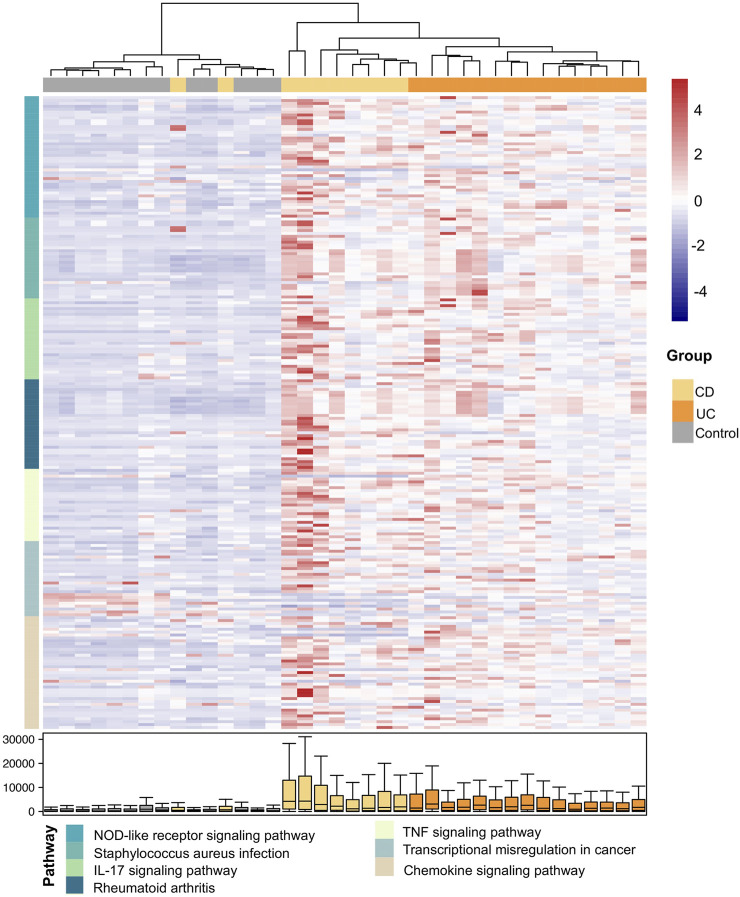
The pathological differences between Crohn's disease (CD) and ulcerative colitis (UC) are substantial and unexplained yet. Here, we aimed to identify potential regulators that drive different pathogenesis of CD and UC by causal inference analysis of transcriptome data. Kruskal-Wallis and Dunnett's tests were performed to identify differentially expressed genes (DEGs) among CD patients, UC patients, and controls. Subsequently, differentially expressed pathways (DEPs) between CD and UC were identified and used to construct the interaction network of DEPs. Causal inference was performed to identify IBD subtype-regulators. The expression of the subtype-regulators and their downstream genes was validated by qRT-PCR with an independent cohort. Compared with the control group, we identified 1,352 and 2,081 DEGs in CD and UC groups, respectively. Multiple DEPs between CD and UC were closely related to inflammation-related pathways, such as NOD-like receptor signaling, IL-17 signaling, and chemokine signaling pathways. Based on the priori interaction network of DEPs, causal inference analysis identified and as IBD subtype-regulators. The results with the discovery cohort showed that the expression level of , , and was significantly higher in the CD group than that in the UC group. The regulation relationships among , , and were confirmed with transcriptome data from an independent cohort and validated by qRT-PCR. Our study suggests that and were IBD subtype-regulators that trigger more intense innate immunity and inflammatory responses in CD than those in UC. Our findings reveal pathomechanical differences between CD and UC that may contribute to personalized treatment for CD and UC.
克罗恩病(CD)和溃疡性结肠炎(UC)之间的病理差异很大且尚未得到解释。在此,我们旨在通过对转录组数据进行因果推断分析,确定驱动CD和UC不同发病机制的潜在调节因子。进行了Kruskal-Wallis检验和Dunnett检验,以确定CD患者、UC患者和对照组之间的差异表达基因(DEG)。随后,确定了CD和UC之间的差异表达通路(DEP),并用于构建DEP的相互作用网络。进行因果推断以确定IBD亚型调节因子。通过对一个独立队列进行qRT-PCR验证了亚型调节因子及其下游基因的表达。与对照组相比,我们在CD组和UC组中分别鉴定出1352个和2081个DEG。CD和UC之间的多个DEP与炎症相关通路密切相关,如NOD样受体信号通路、IL-17信号通路和趋化因子信号通路。基于DEP的先验相互作用网络,因果推断分析确定 和 为IBD亚型调节因子。发现队列的结果表明,CD组中 、 和 的表达水平显著高于UC组。通过一个独立队列的转录组数据证实了 、 和 之间的调控关系,并通过qRT-PCR进行了验证。我们的研究表明, 和 是IBD亚型调节因子,它们在CD中引发的固有免疫和炎症反应比在UC中更强烈。我们的发现揭示了CD和UC之间的病理力学差异,这可能有助于CD和UC的个性化治疗。