Duan Xueru, Zheng Murui, Zhao Wenjing, Huang Jun, Lao Lixian, Li Haiyi, Lu Jiahai, Chen Weiqing, Liu Xudong, Deng Hai
Department of Epidemiology, School of Public Health, Sun Yat-sen University, Guangzhou, China.
School of Public Health, Guangdong Pharmaceutical University, Guangzhou, China.
Front Med (Lausanne). 2022 Apr 7;9:799792. doi: 10.3389/fmed.2022.799792. eCollection 2022.
Psychological problems are prevalent in the general population, and their impacts on sleep health deserve more attention. This study was to examine the associations of OSA risk with depression, anxiety, and life events in a Chinese population.
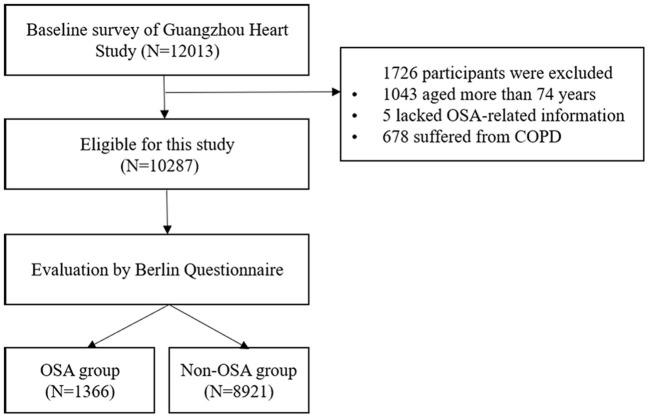
A total of 10,287 subjects were selected from the Guangzhou Heart Study. Berlin Questionnaire (BQ) was used to ascertain the OSA. The Center for Epidemiologic Studies Depression Scale (CES-D) and Zung's self-rating anxiety scale (SAS) were used to define depression and anxiety. A self-designed questionnaire was used to assess life events. Odds ratio (OR) with 95% confidence interval (95% CI) was calculated by using the logistic regression model.
There were 1,366 subjects (13.28%) classified into the OSA group. After adjusting for potential confounders, subjects with anxiety (OR: 2.60, 95% CI: 1.63-4.04) and depression (OR: 1.91, 95% CI: 1.19-2.97) were more likely to have OSA. Subjects suffering from both anxiety and depression were associated with a 3.52-fold (95% CI: 1.88-6.31) risk of OSA. Every 1-unit increment of CES-D score and SAS index score was associated with 13% (95% CI: 1.11-1.15) and 4% (95% CI: 1.03-1.06) increased risk of OSA. Neither positive life events nor adverse life events were associated with OSA.
The results indicate that depression and anxiety, especially co-occurrence of both greatly, were associated with an increased risk of OSA. Neither adverse life events nor positive life events were associated with any risk of OSA. Screening for interventions to prevent and manage OSA should pay more attention to depression and anxiety.
心理问题在普通人群中普遍存在,其对睡眠健康的影响值得更多关注。本研究旨在探讨中国人群中阻塞性睡眠呼吸暂停(OSA)风险与抑郁、焦虑及生活事件之间的关联。
从广州心脏研究中选取了10287名受试者。采用柏林问卷(BQ)确定OSA。使用流行病学研究中心抑郁量表(CES-D)和zung自评焦虑量表(SAS)定义抑郁和焦虑。采用自行设计的问卷评估生活事件。使用逻辑回归模型计算比值比(OR)及95%置信区间(95%CI)。
1366名受试者(13.28%)被归类为OSA组。在调整潜在混杂因素后,患有焦虑(OR:2.60,95%CI:1.63 - 4.04)和抑郁(OR:1.91,95%CI:1.19 - 2.97)的受试者更易患OSA。同时患有焦虑和抑郁的受试者患OSA的风险增加3.52倍(95%CI:1.88 - 6.31)。CES-D评分和SAS指数评分每增加1个单位,患OSA的风险分别增加13%(95%CI:1.11 - 1.15)和4%(95%CI:1.03 - 1.06)。无论是积极生活事件还是消极生活事件均与OSA无关。
结果表明,抑郁和焦虑,尤其是两者同时存在,与OSA风险增加有关。积极或消极生活事件均与OSA风险无关。预防和管理OSA的筛查干预应更多关注抑郁和焦虑。