Department of Epidemiology, School of Public Health, Sun Yat-Sen University, 7/F, Public Health Building, No.74, Zhongshan Second Road, Guangzhou, 510080, China.
School of Public Health, Guangdong Pharmaceutical University, No. 283 Jianghai Avenue, Haizhu District, Guangzhou, 510310, China.
BMC Pulm Med. 2022 Jan 11;22(1):33. doi: 10.1186/s12890-021-01818-7.
No studies investigated the whole effect of modifiable lifestyle factors on OSA risk. This study aimed to examine the individual and combined effects of lifestyle factors on OSA risk among Chinese adults.
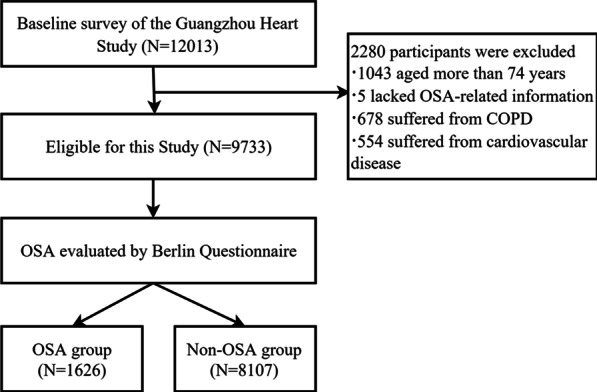
This cross-sectional study included 9733 participants aged 35 to 74 years from the baseline survey of Guangzhou Heart Study. OSA was evaluated by Berlin Questionnaire. The healthy lifestyle score (HLS), representing the overall effect of lifestyles, was derived from seven lifestyle factors: active smoking, passive smoking, alcohol, diet, waist-hip ratio, leisure-time physical activity, and mental status. Odds ratio (OR) with 95% confidence interval (CI) was calculated using the multivariate logistic regression model.
8107 participants were divided into the non-OSA group and 1626 participants into the OSA group. No passive smoking (OR 0.83, 95% CI 0.74-0.94), healthy waist-hip ratio (OR 0.67, 95% CI 0.58-0.77) and healthy mental status (OR 0.45, 95% CI 0. 29-0.73) were associated with a reduced risk of OSA after adjusting for confounders, while others not. Participants with higher HLS were negatively associated with OSA risk (P < 0.001). In comparison to the participants with 0-3 HLS, the OR for participants with 4, 5, 6, and 7 HLS was 0.68 (95% CI 0.56-0.84), 0.71 (95% CI 0.59-0.86), 0.62 (95% CI 0.51-0.76) and 0.49 (95% CI 0.37-0.65) after adjusting for confounders. Every 1-score increment of HLS was associated with a 13% lower risk of OSA.
The results suggest that HLS reflecting the combined effect of multiple-dimensional lifestyle factors was inversely associated with OSA risk. Preventive strategies integrating multiple lifestyle factors may provide a more feasible approach for OSA prevention.
目前尚无研究探讨可改变的生活方式因素对阻塞性睡眠呼吸暂停(OSA)风险的整体影响。本研究旨在探讨生活方式因素对中国成年人 OSA 风险的单独和联合影响。
这是一项横断面研究,共纳入了来自广州心脏研究基线调查的 9733 名年龄在 35 至 74 岁的参与者。OSA 采用柏林问卷进行评估。健康生活方式评分(HLS)代表生活方式的整体效果,由七个生活方式因素组成:主动吸烟、被动吸烟、饮酒、饮食、腰臀比、休闲时间体力活动和精神状态。使用多变量 logistic 回归模型计算比值比(OR)和 95%置信区间(CI)。
8107 名参与者被分为非 OSA 组,1626 名参与者被分为 OSA 组。在校正混杂因素后,无被动吸烟(OR 0.83,95%CI 0.74-0.94)、健康的腰臀比(OR 0.67,95%CI 0.58-0.77)和健康的精神状态(OR 0.45,95%CI 0.29-0.73)与 OSA 风险降低相关,而其他因素则没有。HLS 较高的参与者与 OSA 风险呈负相关(P<0.001)。与 HLS 为 0-3 分的参与者相比,HLS 为 4、5、6 和 7 分的参与者的 OR 分别为 0.68(95%CI 0.56-0.84)、0.71(95%CI 0.59-0.86)、0.62(95%CI 0.51-0.76)和 0.49(95%CI 0.37-0.65),校正混杂因素后。HLS 每增加 1 分,OSA 的风险就会降低 13%。
结果表明,反映多维生活方式因素综合效应的 HLS 与 OSA 风险呈负相关。整合多种生活方式因素的预防策略可能为 OSA 预防提供更可行的方法。