Zheng Guo, Yingli Zhang, Shengli Chen, Zhifeng Zhou, Bo Peng, Gangqiang Hou, Yingwei Qiu
Department of Hematology and Oncology, International Cancer Center, Shenzhen Key Laboratory, Hematology Institution of Shenzhen University, Shenzhen University General Hospital, Shenzhen University Health Science Center, Shenzhen University, Shenzhen, China.
Department of Depressive Disorder, Shenzhen Kangning Hospital, Shenzhen Mental Health Center, Shenzhen, China.
Front Neurol. 2022 Apr 8;13:852330. doi: 10.3389/fneur.2022.852330. eCollection 2022.
Inter-hemispheric network dysconnectivity has been well-documented in patients with recurrent major depressive disorder (MDD). However, it has remained unclear how structural networks between bilateral hemispheres relate to inter-hemispheric functional dysconnectivity and depression severity in MDD. Our study attempted to investigate the alterations in corpus callosum macrostructural and microstructural as well as inter-hemispheric homotopic functional connectivity (FC) in patients with recurrent MDD and to determine how these alterations are related with depressive severity.
Resting-state functional MRI (fMRI), T1WI anatomical images and diffusion tensor MRI of the whole brain were performed in 140 MDD patients and 44 normal controls matched for age, sex, years of education. We analyzed the macrostructural and microstructural integrity as well as voxel-mirrored homotopic functional connectivity (VMHC) of corpus callosum (CC) and its five subregion. Two-sample -test was used to investigate the differences between the two groups. Significant subregional metrics were correlated with depression severity by spearman's correlation analysis, respectively.
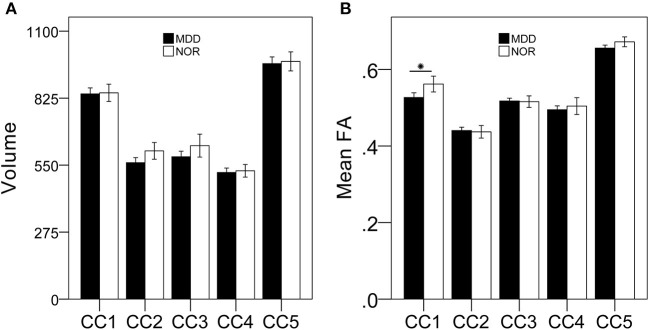
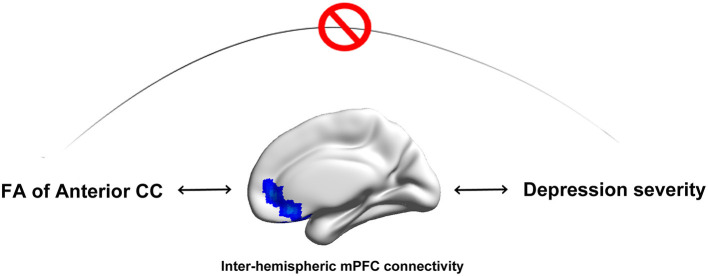
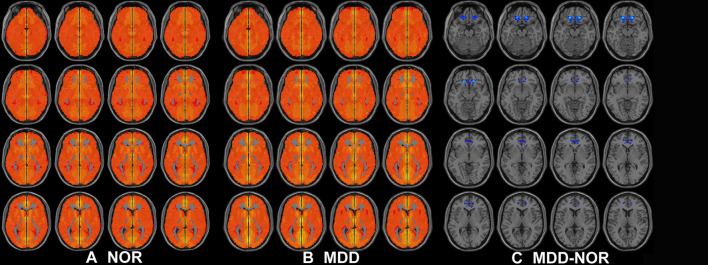
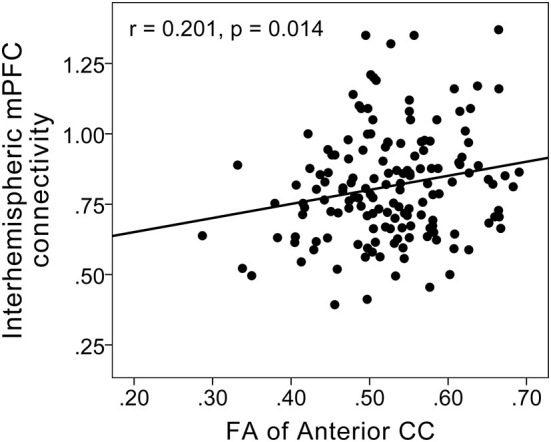
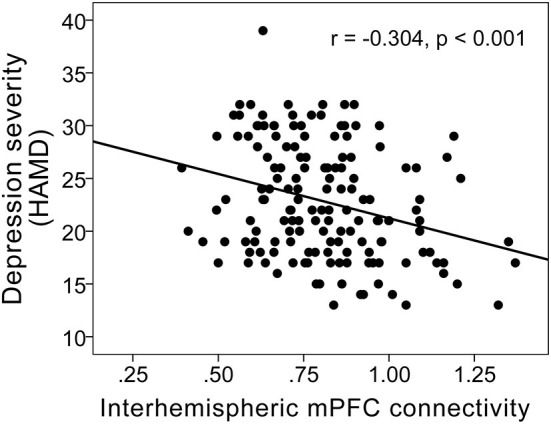
Compared with control subjects, MDD patients had significantly attenuated inter-hemispheric homotopic FC in the bilateral medial prefrontal cortex, and impaired anterior CC microstructural integrity (each comparison had a corrected < 0.05), whereas CC macrostructural measurements remained stable. In addition, disruption of anterior CC microstructural integrity correlated with a reduction in FC in the bilateral medial prefrontal cortex, which correlated with depression severity in MDD patients. Furthermore, disruption of anterior CC integrity exerted an indirect influence on depression severity in MDD patients through an impairment of inter-hemispheric homotopic FC.
These findings may help to advance our understanding of the neurobiological basis of depression by identifying region-specific interhemispheric dysconnectivity.
复发性重度抑郁症(MDD)患者的半球间网络连接障碍已有充分记录。然而,双侧半球之间的结构网络如何与MDD中的半球间功能连接障碍及抑郁严重程度相关仍不清楚。我们的研究试图调查复发性MDD患者胼胝体的宏观结构和微观结构以及半球间同位功能连接(FC)的改变,并确定这些改变如何与抑郁严重程度相关。
对140例MDD患者和44名年龄、性别、受教育年限匹配的正常对照者进行静息态功能磁共振成像(fMRI)、全脑T1WI解剖图像和扩散张量磁共振成像检查。我们分析了胼胝体(CC)及其五个亚区的宏观结构和微观结构完整性以及体素镜像同位功能连接(VMHC)。采用两样本t检验研究两组之间的差异。分别通过Spearman相关分析将显著的亚区指标与抑郁严重程度相关联。
与对照组相比,MDD患者双侧内侧前额叶皮质的半球间同位FC显著减弱,前CC微观结构完整性受损(每次比较校正后P<0.05),而CC宏观结构测量保持稳定。此外,前CC微观结构完整性的破坏与双侧内侧前额叶皮质FC的降低相关,而这又与MDD患者的抑郁严重程度相关。此外,前CC完整性的破坏通过损害半球间同位FC对MDD患者的抑郁严重程度产生间接影响。
这些发现可能有助于通过识别区域特异性半球间连接障碍来推进我们对抑郁症神经生物学基础的理解。