Tayanç Mete, Sezen İsmail, Ünal Alper, Flores Rosa M, Karanfil Salih
Department of Environmental Eng., Marmara University, Goztepe Campus, Istanbul, Turkey.
Eurasia Institute of Earth Sciences, Istanbul Technical University, Istanbul, Turkey.
Air Qual Atmos Health. 2022;15(6):951-965. doi: 10.1007/s11869-022-01200-4. Epub 2022 Apr 19.
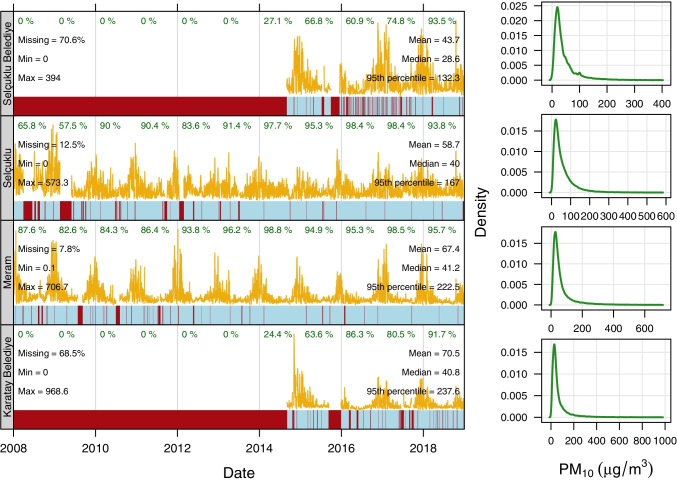
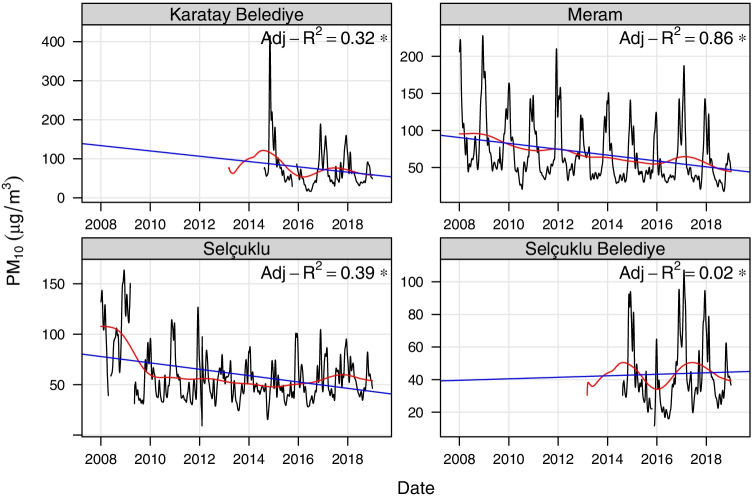
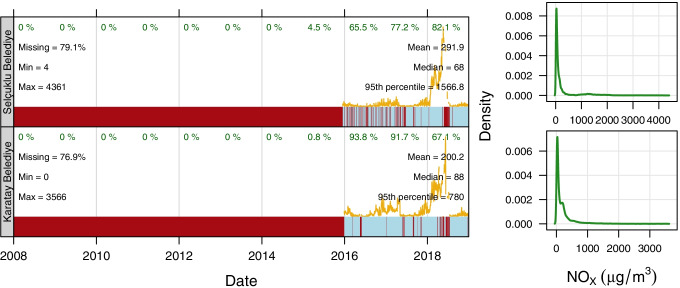
Considering an integrated approach to assess all of the measured pollutants in a diurnal, monthly, seasonal, and annual time scales and understanding the mechanisms hidden under low air quality conditions are essential for tackling potential air pollution issues. Konya, located in central Anatolia, is the largest province of Turkey with a surface area of 40,838 km and has different industrial activities. The lack of recent detailed studies limits our information on the underlying air pollution levels in Konya and obscuring policymakers to develop applicable mitigation measures. In this study, we used hourly monitored air quality data of CO, NO, NO, PM, PM, and SO from five stations in Konya and investigated the temporal and spatial variabilities for the 2008-2018 period via statistical analysis. Upon analysis, particulate matter was found to be the dominant pollutant deteriorating the air quality of Konya. The highest 2008-2018 periodic mean value of PM was found in Karatay Belediye as 70.5 µg/m, followed by 67.4 µg/m in Meram, 58.7 µg/m in Selçuklu, and 43.7 µg/m in Selçuklu Belediye. The 24-h limit value of PM given as 50 µg/m in the legislation was violated in all of the stations, mainly during winter and autumn. High positive correlations were found among the stations, and the highest correlation was obtained between Selçuklu Belediye and Karatay Belediye with a Pearson correlation coefficient of 0.77. Long-term data showed a decreasing trend in PM concentrations. Diurnal variability is found to be more pronounced than weekly variability. For almost all of the pollutants, except for photochemical pollutants like O, a prominent result was the nighttime and morning rush hours high-pollutant levels. A case study done for the January 29, 2018 to February 05, 2018 episode showed the importance of meteorology and topography on the high levels of pollution. Limitation of the pollutant transport and dilution by meteorological conditions and the location of Konya on a plain surrounded by high hills are believed to be the main reasons for having low air quality in the region.
采用综合方法在日、月、季节和年时间尺度上评估所有测量的污染物,并了解低空气质量条件下隐藏的机制对于解决潜在的空气污染问题至关重要。科尼亚位于安纳托利亚中部,是土耳其最大的省份,面积40838平方公里,有不同的工业活动。缺乏近期详细研究限制了我们对科尼亚潜在空气污染水平的了解,也使政策制定者难以制定适用的缓解措施。在本研究中,我们使用了科尼亚五个站点每小时监测的一氧化碳、一氧化氮、二氧化氮、细颗粒物、可吸入颗粒物和二氧化硫空气质量数据,并通过统计分析研究了2008 - 2018年期间的时空变化。经分析,颗粒物被发现是恶化科尼亚空气质量的主要污染物。2008 - 2018年期间细颗粒物的最高周期性平均值在卡拉泰市为70.5微克/立方米,其次是梅拉姆的67.4微克/立方米、塞尔丘克卢的58.7微克/立方米和塞尔丘克卢市的43.7微克/立方米。立法中规定的细颗粒物24小时限值为50微克/立方米,所有站点均超标,主要在冬季和秋季。各站点之间发现高度正相关,塞尔丘克卢市和卡拉泰市之间的相关性最高,皮尔逊相关系数为0.77。长期数据显示细颗粒物浓度呈下降趋势。日变化比周变化更为明显。对于几乎所有污染物,除了像臭氧这样的光化学污染物,一个显著的结果是夜间和早高峰时段污染物水平较高。针对2018年1月29日至2018年2月5日事件进行的案例研究表明了气象和地形对高污染水平的重要性。气象条件对污染物传输和稀释的限制以及科尼亚位于被高山环绕的平原上的位置被认为是该地区空气质量低的主要原因。