School of Software, South China Normal University, Guangzhou 510641, China.
Pazhou Lab, Guangzhou 510330, China.
Comput Intell Neurosci. 2022 Apr 13;2022:3854513. doi: 10.1155/2022/3854513. eCollection 2022.
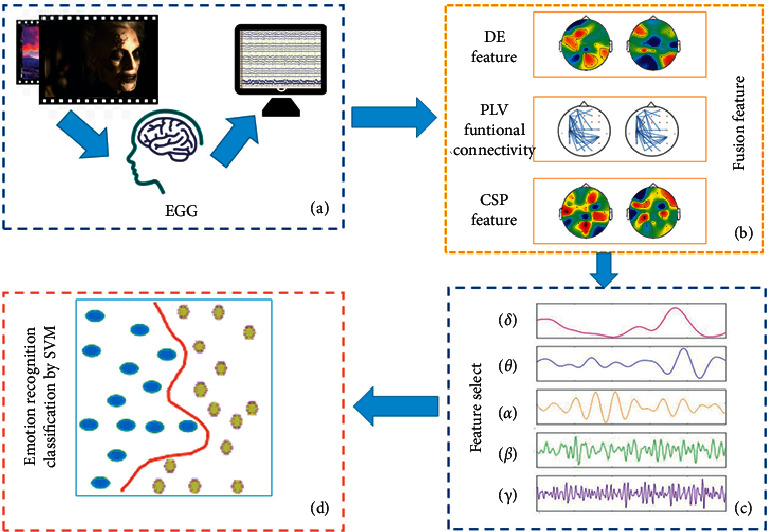
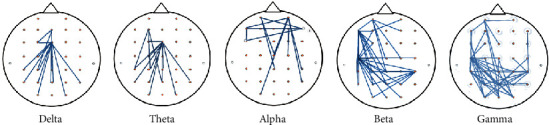
At present, emotion recognition based on electroencephalograms (EEGs) has attracted much more attention. Current studies of affective brain-computer interfaces (BCIs) focus on the recognition of happiness and sadness using brain activation patterns. Fear recognition involving brain activities in different spatial distributions and different brain functional networks has been scarcely investigated. In this study, we propose a multifeature fusion method combining energy activation, spatial distribution, and brain functional connection network (BFCN) features for fear emotion recognition. The affective brain pattern was identified by not only the power activation features of differential entropy (DE) but also the spatial distribution features of the common spatial pattern (CSP) and the EEG phase synchronization features of phase lock value (PLV). A total of 15 healthy subjects took part in the experiment, and the average accuracy rate was 85.00% ± 8.13%. The experimental results showed that the fear emotions of subjects were fully stimulated and effectively identified. The proposed fusion method on fear recognition was thus validated and is of great significance to the development of effective emotional BCI systems.
目前,基于脑电图(EEG)的情感识别引起了更多关注。当前的情感脑机接口(BCI)研究集中在使用大脑激活模式识别快乐和悲伤。涉及不同空间分布和不同脑功能网络的大脑活动的恐惧识别尚未得到充分研究。在这项研究中,我们提出了一种多特征融合方法,结合能量激活、空间分布和脑功能连接网络(BFCN)特征,用于恐惧情感识别。情感脑模式不仅通过差分熵(DE)的功率激活特征来识别,还通过共空间模式(CSP)的空间分布特征和锁相值(PLV)的脑电相位同步特征来识别。共有 15 名健康受试者参与了实验,平均准确率为 85.00%±8.13%。实验结果表明,充分激发了受试者的恐惧情绪,并有效地进行了识别。因此,所提出的融合方法在恐惧识别中得到了验证,对有效情感 BCI 系统的发展具有重要意义。