Wu Mingan, Zhai Yingying, Liang Xiaoyi, Chen Weichun, Lin Ruiyi, Ma Linlin, Huang Yi, Zhao Di, Liang Yong, Zhao Wei, Fang Jiansong, Fang Shuhuan, Chen Yunbo, Wang Qi, Li Weirong
Science and Technology Innovation Center, Guangzhou University of Chinese Medicine, Guangzhou, China.
Institute of Clinical Pharmacology, Guangzhou University of Chinese Medicine, Guangzhou, China.
Front Neurosci. 2022 Apr 7;16:842814. doi: 10.3389/fnins.2022.842814. eCollection 2022.
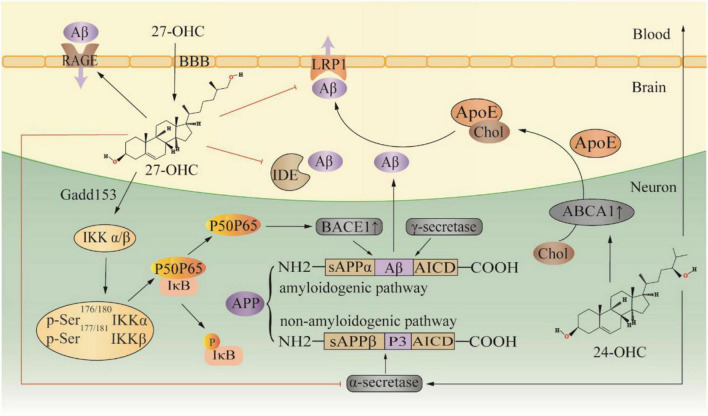
Alzheimer's disease (AD), the most common cause of dementia, is a complex and multifactorial disease involving genetic and environmental factors, with hypercholesterolemia considered as one of the risk factors. Numerous epidemiological studies have reported a positive association between AD and serum cholesterol levels, and experimental studies also provide evidence that elevated cholesterol levels accelerate AD pathology. However, the underlying mechanism of hypercholesterolemia accelerating AD pathogenesis is not clear. Here, we review the metabolism of cholesterol in the brain and focus on the role of oxysterols, aiming to reveal the link between hypercholesterolemia and AD. 27-hydroxycholesterol (27-OHC) is the major peripheral oxysterol that flows into the brain, and it affects β-amyloid (Aβ) production and elimination as well as influencing other pathogenic mechanisms of AD. Although the potential link between hypercholesterolemia and AD is well established, cholesterol-lowering drugs show mixed results in improving cognitive function. Nevertheless, drugs that target cholesterol exocytosis and conversion show benefits in improving AD pathology. Herbs and natural compounds with cholesterol-lowering properties also have a potential role in ameliorating cognition. Collectively, hypercholesterolemia is a causative risk factor for AD, and 27-OHC is likely a potential mechanism for hypercholesterolemia to promote AD pathology. Drugs that regulate cholesterol metabolism are probably beneficial for AD, but more research is needed to unravel the mechanisms involved in 27-OHC, which may lead to new therapeutic strategies for AD.
阿尔茨海默病(AD)是痴呆最常见的病因,是一种涉及遗传和环境因素的复杂多因素疾病,高胆固醇血症被认为是危险因素之一。大量流行病学研究报告了AD与血清胆固醇水平之间存在正相关,实验研究也提供证据表明胆固醇水平升高会加速AD病理进程。然而,高胆固醇血症加速AD发病机制的潜在机制尚不清楚。在此,我们综述大脑中胆固醇的代谢,并聚焦于氧化甾醇的作用,旨在揭示高胆固醇血症与AD之间的联系。27-羟基胆固醇(27-OHC)是流入大脑的主要外周氧化甾醇,它影响β-淀粉样蛋白(Aβ)的产生和清除,并影响AD的其他致病机制。尽管高胆固醇血症与AD之间的潜在联系已得到充分证实,但降胆固醇药物在改善认知功能方面的结果喜忧参半。然而,针对胆固醇胞吐作用和转化的药物在改善AD病理方面显示出益处。具有降胆固醇特性的草药和天然化合物在改善认知方面也可能发挥作用。总体而言,高胆固醇血症是AD的一个致病危险因素,27-OHC可能是高胆固醇血症促进AD病理的潜在机制。调节胆固醇代谢的药物可能对AD有益,但需要更多研究来阐明27-OHC涉及的机制,这可能会带来AD的新治疗策略。