Thompson Nicholas M, van Reekum Carien M, Chakrabarti Bhismadev
School of Psychology and Clinical Language Sciences, University of Reading, Reading, RG6 6AL UK.
Affect Sci. 2022;3(1):118-134. doi: 10.1007/s42761-021-00062-w. Epub 2021 Nov 15.
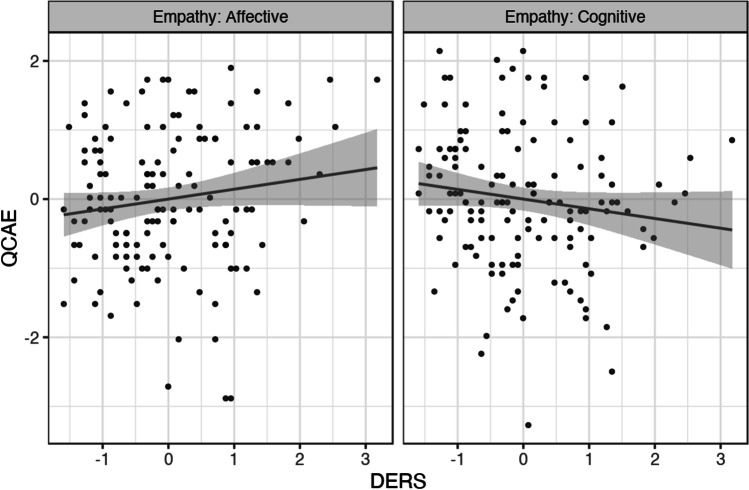
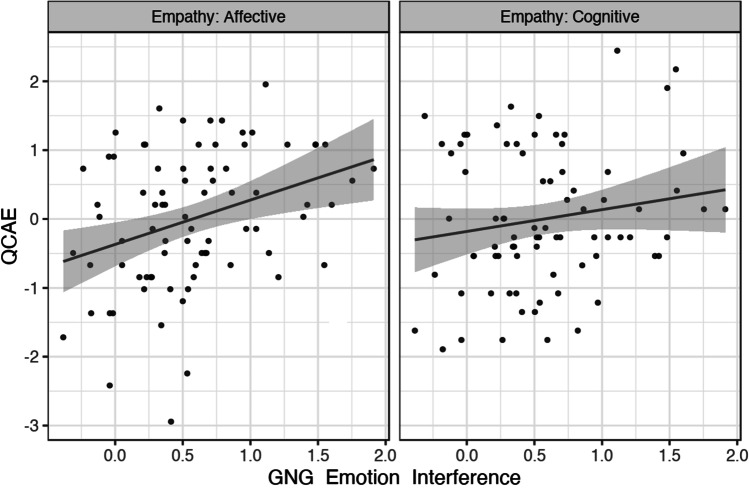
The constructs of empathy (i.e., understanding and/or sharing another's emotion) and emotion regulation (i.e., the processes by which one manages emotions) have largely been studied in relative isolation of one another. To better understand the interrelationships between their various component processes, this manuscript reports two studies that examined the relationship between empathy and emotion regulation using a combination of self-report and task measures. In study 1 ( = 137), trait cognitive empathy and affective empathy were found to share divergent relationships with self-reported emotion dysregulation. Trait emotion dysregulation was negatively related to cognitive empathy but did not show a significant relationship with affective empathy. In the second study ( = 92), the magnitude of emotion interference effects (i.e., the extent to which inhibitory control was impacted by emotional relative to neutral stimuli) in variants of a Go/NoGo and Stroop task were used as proxy measures of implicit emotion regulation abilities. Trait cognitive and affective empathy were differentially related to both task metrics. Higher affective empathy was associated with increased emotional interference in the Emotional Go/NoGo task; no such relationship was observed for trait cognitive empathy. In the Emotional Stroop task, higher cognitive empathy was associated with reduced emotional interference; no such relationship was observed for affective empathy. Together, these studies demonstrate that greater cognitive empathy was broadly associated with improved emotion regulation abilities, while greater affective empathy was typically associated with increased difficulties with emotion regulation. These findings point to the need for assessing the different components of empathy in psychopathological conditions marked by difficulties in emotion regulation.
The online version contains supplementary material available at 10.1007/s42761-021-00062-w.
共情的构成要素(即理解和/或分享他人情感)和情绪调节(即个体管理情绪的过程)在很大程度上是相互孤立进行研究的。为了更好地理解它们各个组成过程之间的相互关系,本手稿报告了两项研究,这些研究使用自我报告和任务测量相结合的方法来检验共情与情绪调节之间的关系。在研究1(n = 137)中,特质认知共情和情感共情与自我报告的情绪失调呈现出不同的关系。特质情绪失调与认知共情呈负相关,但与情感共情没有显著关系。在第二项研究(n = 92)中,Go/NoGo任务和Stroop任务变体中的情绪干扰效应大小(即抑制控制受到情绪刺激相对于中性刺激影响的程度)被用作内隐情绪调节能力的替代指标。特质认知共情和情感共情与这两个任务指标的关系存在差异。较高的情感共情与情绪Go/NoGo任务中情绪干扰的增加有关;特质认知共情则未观察到这种关系。在情绪Stroop任务中,较高的认知共情与情绪干扰的减少有关;情感共情则未观察到这种关系。总之,这些研究表明,较高的认知共情与情绪调节能力的改善广泛相关,而较高的情感共情通常与情绪调节困难的增加有关。这些发现表明,在以情绪调节困难为特征的精神病理状况中,需要评估共情的不同组成部分。
在线版本包含可在10.1007/s42761-021-00062-w获取的补充材料。