Wallace-Hadrill Sophie M A, Kamboj Sunjeev K
East London National Health Service Foundation TrustLondon, UK; Research Department of Clinical, Educational and Health Psychology, University College LondonLondon, UK.
Research Department of Clinical, Educational and Health Psychology, University College London London, UK.
Front Psychol. 2016 Nov 4;7:1715. doi: 10.3389/fpsyg.2016.01715. eCollection 2016.
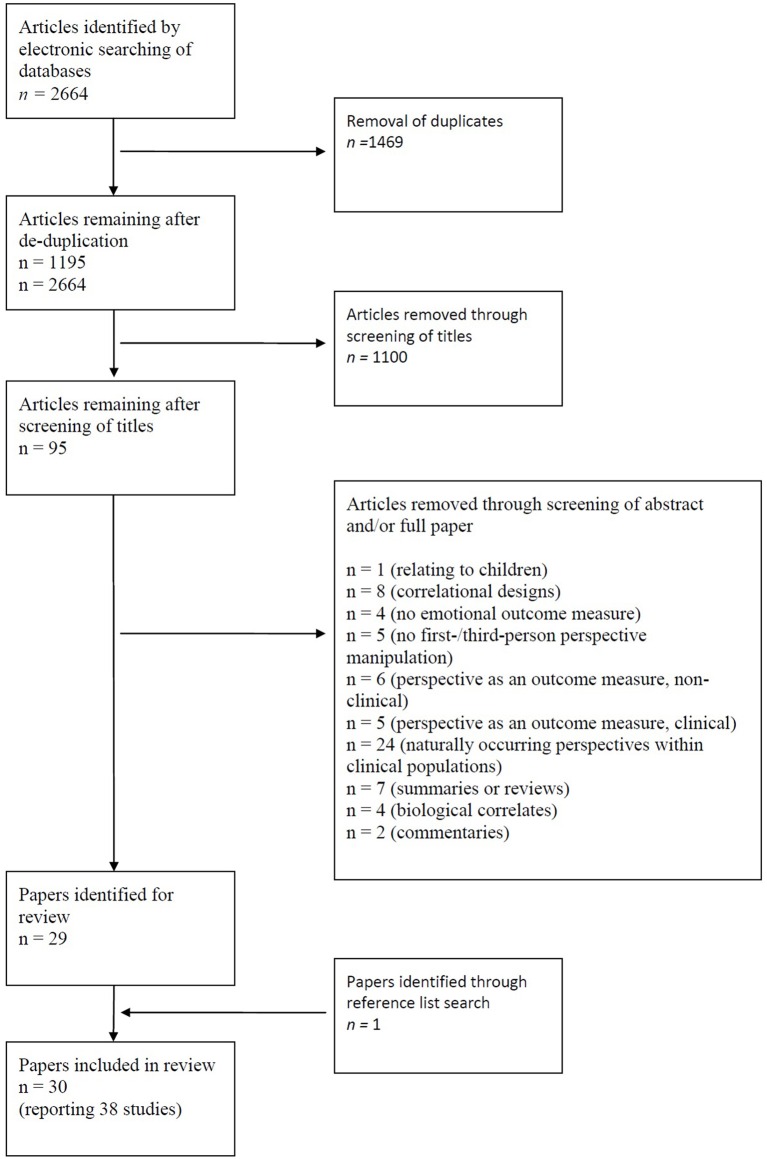
The strategic or adoption of a cognitively distanced, third-person perspective is proposed to adaptively regulate emotions. However, studies of psychological disorders suggest adoption of a third-person perspective reflects counter-productive avoidance. Here, we review studies that investigate the deliberate adoption of a third- or first-person vantage perspective and its impact on affect in healthy people, "sub-clinical" populations and those with psychological disorders. A systematic search was conducted across four databases. After exclusion criteria were applied, 38 studies were identified that investigated the impact of both imagery and verbal instructions designed to encourage adoption of a third-person perspective on self-reported affect. The identified studies examined a variety of outcomes related to recalling memories, imagining scenarios and mood induction. These were associated with specific negative emotions or mood states (dysphoria/sadness, anxiety, anger), mixed or neutral affect autobiographical memories, and self-conscious affect (e.g., guilt). Engaging a third-person perspective was generally associated with a reduction in the intensity of positive and negative affect. Studies that included measures of semantic change, suggested that this is a key mediator in reduction of affect following perspective change. Strategically adopting a "distanced," third-person perspective is linked to a reduction in affect intensity across valence, but in addition has the potential to introduce new information that regulates emotion via semantic change. Such reappraisal distinguishes deliberate adoption of a distanced perspective from the habitual and/or spontaneous shift in perspective that occurs in psychopathology.
有人提出,采用一种认知上有距离的第三人称视角能适应性地调节情绪。然而,对心理障碍的研究表明,采用第三人称视角反映出适得其反的回避行为。在此,我们回顾了一些研究,这些研究调查了在健康人群、“亚临床”人群以及患有心理障碍的人群中,刻意采用第三人称或第一人称视角及其对情感的影响。我们在四个数据库中进行了系统检索。在应用排除标准后,确定了38项研究,这些研究调查了旨在鼓励采用第三人称视角的意象和言语指令对自我报告情感的影响。所确定的研究考察了与回忆记忆、想象情景和情绪诱导相关的各种结果。这些结果与特定的负面情绪或情绪状态(烦躁/悲伤、焦虑、愤怒)、混合或中性情感的自传体记忆以及自我意识情感(如内疚)有关。采用第三人称视角通常与积极和消极情感强度的降低有关。包括语义变化测量的研究表明,这是视角变化后情感降低的关键中介因素。策略性地采用“有距离的”第三人称视角与跨效价情感强度的降低有关,但此外还有可能引入通过语义变化调节情绪的新信息。这种重新评价将刻意采用有距离的视角与心理病理学中发生的习惯性和/或自发的视角转变区分开来。