Park Shin-Eui, Kim Yun-Hyeon, Yang Jong-Chul, Jeong Gwang-Woo
Advanced Institute of Aging Science, Chonnam National University, Gwangju, Korea.
Department of Radiology, Chonnam National University Medical School, Gwangju, Korea.
Clin Psychopharmacol Neurosci. 2022 May 31;20(2):279-291. doi: 10.9758/cpn.2022.20.2.279.
To investigate not only differential patterns of functional connectivity of core brain regions between implicit and explicit verbal memory tasks underlying negatively evoked emotional condition, but also correlations of functional connectivity (FC) strength with clinical symptom severity in patients with generalized anxiety disorder (GAD).
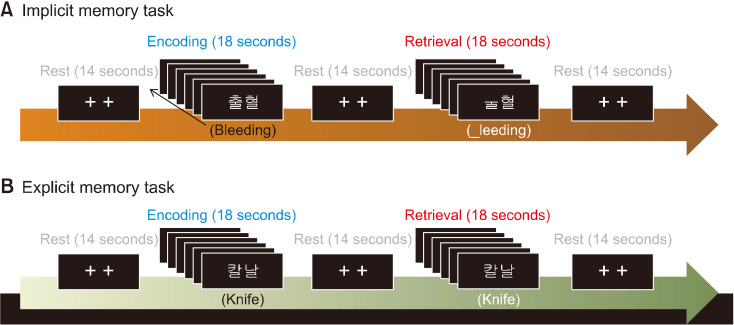
Thirteen patients with GAD and 13 healthy controls underwent functional magnetic resonance imaging for memory tasks with negative emotion words.
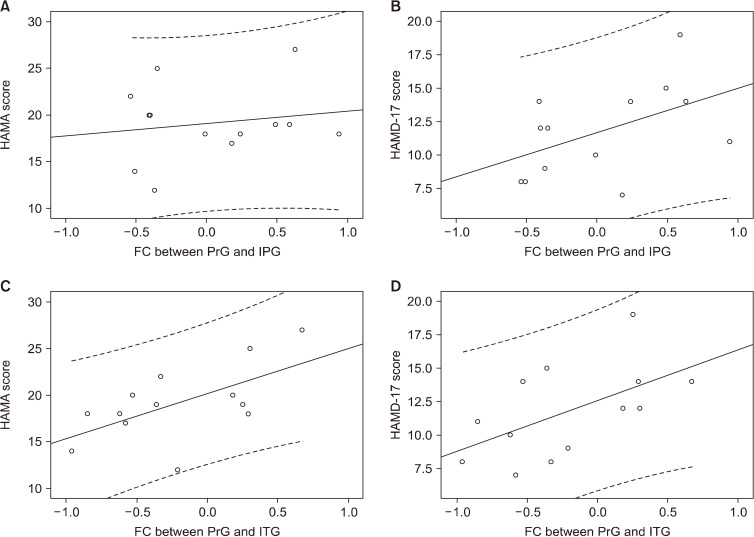
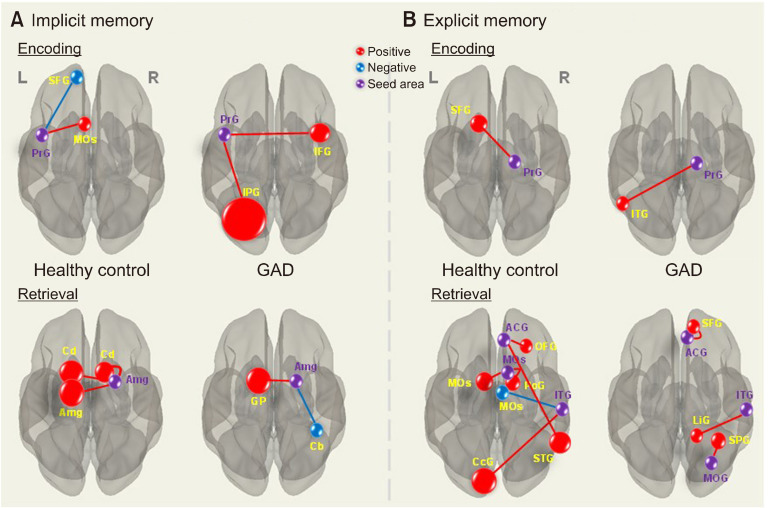
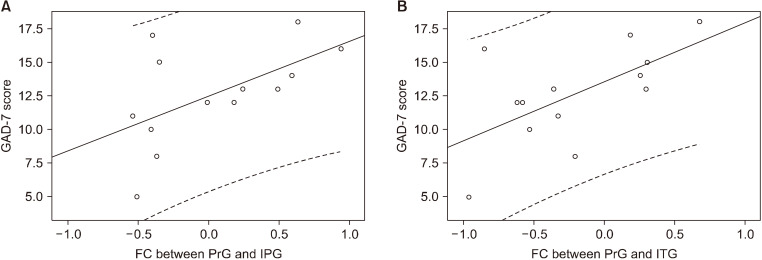
Clinical symptom and its severities of GAD were potentially associated with abnormalities of task-based FC with core brain regions and distinct FC patterns between implicit vs. explicit memory processing in GAD were potentially well discriminated. Outstanding FC in implicit memory task includes positive connections of precentral gyus (PrG) to inferior frontal gyrus and inferior parietal gyrus (IPG), respectively, in encoding period; a positive connection of amygdala (Amg) to globus pallidus as well as a negative connection of Amg to cerebellum in retrieval period. Meanwhile, distinct FC in explicit memory included a positive connection of PrG to inferior temporal gyrus (ITG) in encoding period; a positive connection of the anterior cingulate gyrus to superior frontal gyrus in retrieval period. Especially, there were positive correlation between GAD-7 scores and FC of PrG-IPG ( = 0.324, = 0.042) in implicit memory encoding, and FC of PrG-ITG ( = 0.378, = 0.025) in explicit memory encoding.
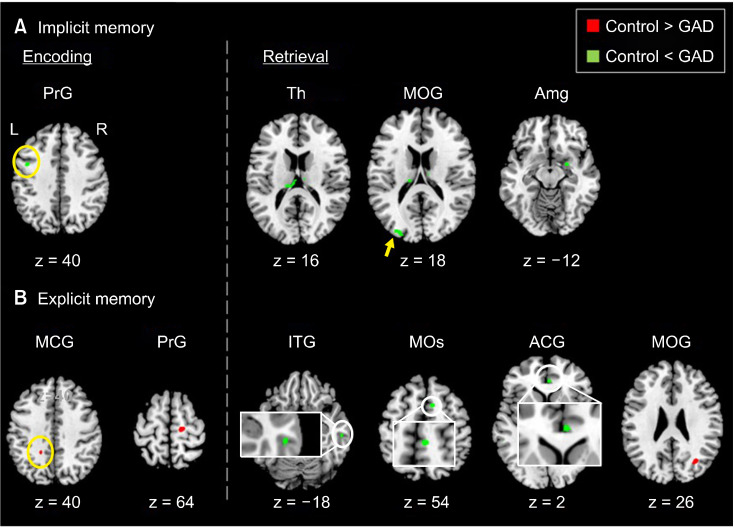
This study clarified differential patterns of brain activation and relevant FC between implicit and explicit verbal memory tasks underlying negative emotional feelings in GAD. These findings will be helpful for an understanding of distinct brain functional mechanisms associated with clinical symptom severities in GAD.
不仅要研究在负性诱发情绪状态下,内隐和外显言语记忆任务核心脑区功能连接的差异模式,还要研究广泛性焦虑障碍(GAD)患者功能连接(FC)强度与临床症状严重程度之间的相关性。
13例GAD患者和13名健康对照者接受了针对带有负性情绪词汇的记忆任务的功能磁共振成像检查。
GAD的临床症状及其严重程度可能与基于任务的核心脑区FC异常有关,并且GAD在内隐与外显记忆加工之间不同的FC模式可能得到很好的区分。内隐记忆任务中显著的FC包括,在编码期中央前回(PrG)分别与额下回和顶下小叶(IPG)的正性连接;在检索期杏仁核(Amg)与苍白球的正性连接以及Amg与小脑的负性连接。同时,外显记忆中不同的FC包括,在编码期PrG与颞下回(ITG)的正性连接;在检索期前扣带回与额上回的正性连接。特别地,在内隐记忆编码中,GAD-7评分与PrG-IPG的FC之间存在正相关(r = 0.324,P = 0.042),在外显记忆编码中,GAD-7评分与PrG-ITG的FC之间存在正相关(r = 0.378,P = 0.025)。
本研究阐明了GAD中负性情绪下内隐和外显言语记忆任务之间脑激活和相关FC的差异模式。这些发现将有助于理解与GAD临床症状严重程度相关的不同脑功能机制。