Department of Internal Medicine, National Cerebral and Cardiovascular Center, Osaka, Japan.
Center for Clinical Sciences, National Center for Global Health and Medicine, Tokyo, Japan.
J Cardiol. 2022 Oct;80(4):292-297. doi: 10.1016/j.jjcc.2022.04.001. Epub 2022 Apr 8.
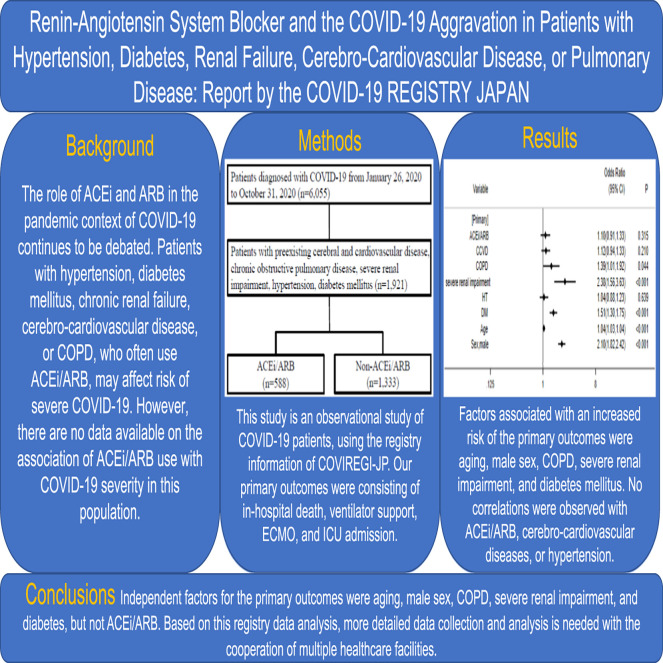
The role of angiotensin-converting enzyme inhibitors (ACEi) and angiotensin II receptor blockers (ARB) in the pandemic context of coronavirus disease 2019 (COVID-19) continues to be debated. Patients with hypertension, diabetes mellitus, chronic renal failure, cerebro-cardiovascular disease, or chronic obstructive pulmonary disease (COPD), who often use ACEi/ARB, may be at risk of severe COVID-19. However, there are no data available on the association of ACEi/ARB use with COVID-19 severity in this population.
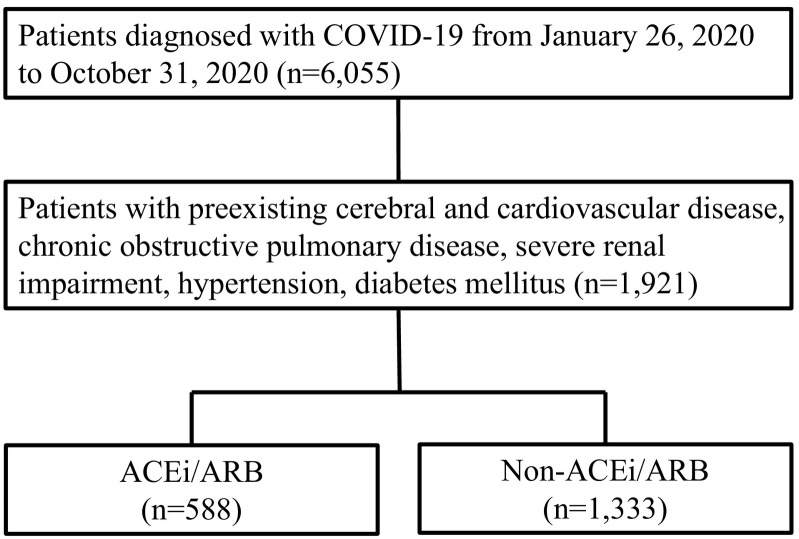
This study is an observational study of patients with a positive severe acute respiratory syndrome coronavirus 2 test and inpatient treatment at a healthcare facility, using the registry information of COVIREGI-JP. Our primary outcomes were in-hospital death, ventilator support, extracorporeal membrane oxygenation support, and intensive care unit admission. Out of the 6055 patients, 1921 patients with preexisting hypertension, diabetes mellitus, chronic renal failure, cerebro-cardiovascular disease, or COPD were enrolled.
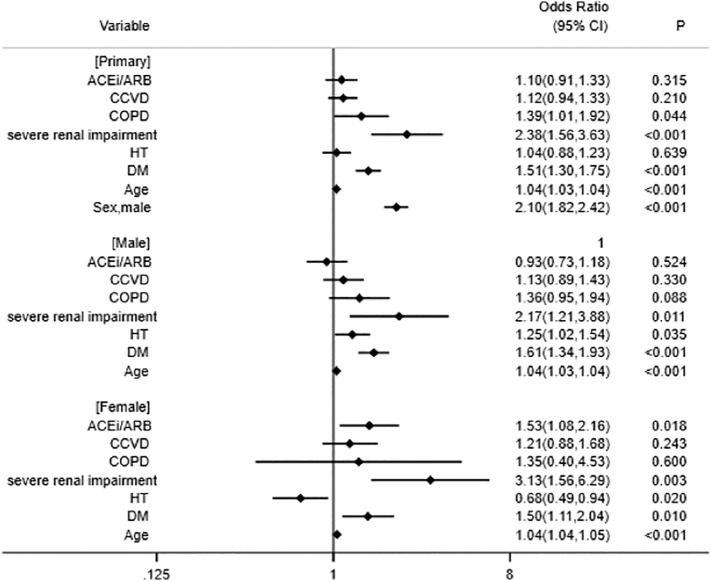
Factors associated with an increased risk of the primary outcomes were aging, male sex, COPD, severe renal impairment, and diabetes mellitus. No correlations were observed with ACEi/ARB, cerebro-cardiovascular diseases, or hypertension. Associated factors in male patients were aging, renal impairment, hypertension, and diabetes. In female patients, factors associated with an increased risk were aging, ACEi/ARB, renal impairment, and diabetes, whereas hypertension was associated with a lower risk of the primary outcomes.
Independent factors for the primary outcomes were aging, male sex, COPD, severe renal impairment, and diabetes, but not ACEi/ARB. Based on this registry data analysis, more detailed data collection and analysis is needed with the cooperation of multiple healthcare facilities.
血管紧张素转换酶抑制剂(ACEi)和血管紧张素 II 受体阻滞剂(ARB)在 2019 年冠状病毒病(COVID-19)大流行背景下的作用仍存在争议。患有高血压、糖尿病、慢性肾衰竭、心脑血管疾病或慢性阻塞性肺疾病(COPD)的患者,他们经常使用 ACEi/ARB,可能有患严重 COVID-19 的风险。然而,目前尚无该人群中 ACEi/ARB 使用与 COVID-19 严重程度相关的数据。
本研究是一项针对在医疗机构接受住院治疗的严重急性呼吸综合征冠状病毒 2 检测呈阳性患者的观察性研究,使用了 COVIREGI-JP 的登记信息。我们的主要结局是住院死亡、呼吸机支持、体外膜氧合支持和入住重症监护病房。在 6055 名患者中,纳入了 1921 名患有先前存在的高血压、糖尿病、慢性肾衰竭、心脑血管疾病或 COPD 的患者。
与主要结局风险增加相关的因素是年龄增长、男性、COPD、严重肾功能不全和糖尿病。与 ACEi/ARB、心脑血管疾病或高血压无相关性。男性患者的相关因素是年龄增长、肾功能不全、高血压和糖尿病。女性患者中,与风险增加相关的因素是年龄增长、ACEi/ARB、肾功能不全和糖尿病,而高血压与主要结局风险降低相关。
主要结局的独立因素是年龄增长、男性、COPD、严重肾功能不全和糖尿病,但不是 ACEi/ARB。基于本登记数据分析,需要在多个医疗机构的合作下,进行更详细的数据收集和分析。