Mehta Bella, Ho Kaylee, Bido Jennifer, Memtsoudis Stavros G, Parks Michael L, Russell Linda, Goodman Susan M, Ibrahim Said
From the Department of Medicine, Hospital for Special Surgery, New York, NY (Dr. Mehta, Dr. Russell, and Dr. Goodman); the Department of Medicine (Dr. Mehta, Dr. Memtsoudis, Dr. Parks, Dr. Russell, and Dr. Goodman), and the Department of Population Health Sciences (Dr. Ho), Weill Cornell Medicine, New York, NY; the Department of Orthopedics (Dr. Bido and Dr. Parks), and the Department of Anesthesiology (Dr. Memtsoudis), Hospital for Special Surgery, New York, NY; and the Department of Healthcare Policy & Research, Weill Cornell Medicine, New York, NY (Dr. Ibrahim).
J Am Acad Orthop Surg Glob Res Rev. 2022 Apr 1;6(4):e21.00016. doi: 10.5435/JAAOSGlobal-D-21-00016.
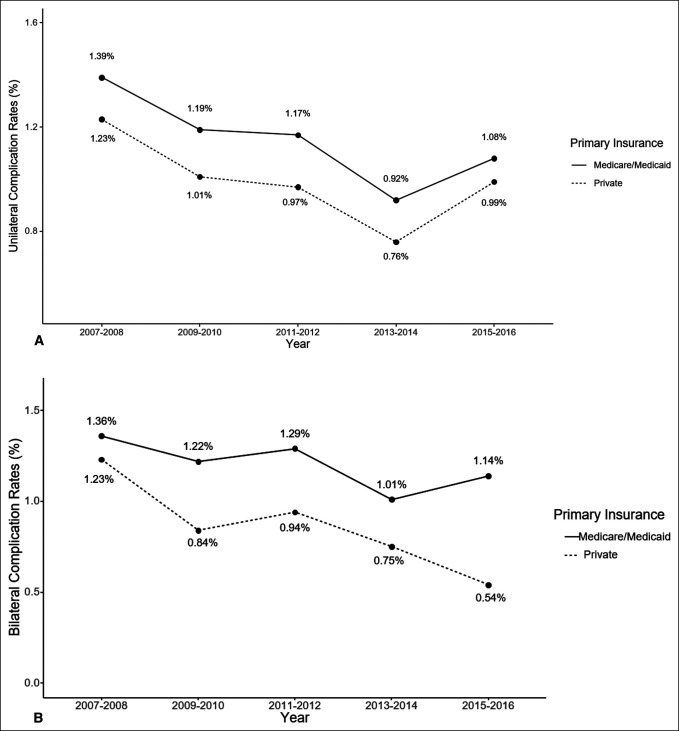
Whether to undergo bilateral total knee arthroplasty (BTKA) depends on patient and surgeon preferences. We used the National Inpatient Sample to compare temporal trends in BTKA utilization and in-hospital complication rates among TKA patients ≥50 with Medicare/Medicaid versus private insurance from 2007 to 2016. We used multivariable logistic regression to assess the association between insurance type and trends in utilization and complication rates adjusting for individual-, hospital-, and community-level covariates, using unilateral TKA (UTKA) for reference. Discharge weights were used for nationwide estimates. About 132,400 (49.5%) Medicare/Medicaid patients and 135,046 (50.5%) privately insured patients underwent BTKA. Among UTKA patients, 62.7% had Medicare/Medicaid, and 37.3% had private insurance. Over the study period, BTKA utilization rate decreased from 7.18% to 5.63% among privately insured patients and from 4.59% to 3.13% among Medicaid/Medicare patients (P trend difference <0.0001). In multivariable analysis, Medicare/Medicaid patients were less likely to receive BTKA than privately insured patients. Although Medicare/Medicaid patients were more likely to develop in-hospital complications after UTKA (adjusted odds ratio, 1.06; 95% confidence interval, 1.002 to 1.12; P = 0.04), this relationship was not statistically significant for BTKAs. In this nationwide sample of TKA patients, BTKA utilization rate was higher in privately insured patients compared with Medicare/Medicaid patients. Furthermore, privately insured patients had lower in-hospital complication rates than Medicare/Medicaid patients.
是否接受双侧全膝关节置换术(BTKA)取决于患者和外科医生的偏好。我们利用国家住院患者样本,比较了2007年至2016年期间年龄≥50岁、参加医疗保险/医疗补助计划(Medicare/Medicaid)的全膝关节置换术(TKA)患者与参加私人保险的TKA患者在BTKA使用情况和住院并发症发生率方面的时间趋势。我们使用多变量逻辑回归来评估保险类型与使用情况及并发症发生率趋势之间的关联,并对个体、医院和社区层面的协变量进行调整,以单侧全膝关节置换术(UTKA)作为对照。出院权重用于全国范围的估计。约132,400名(49.5%)医疗保险/医疗补助计划患者和135,046名(50.5%)参加私人保险的患者接受了BTKA。在UTKA患者中,62.7%参加医疗保险/医疗补助计划,37.3%参加私人保险。在研究期间,参加私人保险的患者中BTKA使用率从7.18%降至5.63%,医疗保险/医疗补助计划患者中从4.59%降至3.13%(P趋势差异<0.0001)。在多变量分析中,医疗保险/医疗补助计划患者接受BTKA的可能性低于参加私人保险的患者。虽然医疗保险/医疗补助计划患者在接受UTKA后发生住院并发症的可能性更高(调整后的优势比为1.06;95%置信区间为1.002至1.12;P = 0.04),但这种关系在BTKA中无统计学意义。在这个全国范围的TKA患者样本中,参加私人保险的患者BTKA使用率高于医疗保险/医疗补助计划患者。此外,参加私人保险的患者住院并发症发生率低于医疗保险/医疗补助计划患者。