Salvador Camilo A F, Maia Eloa L, Costa Fernando H, Escobar Julian D, Oliveira João P
COMARI Research & Innovations, Sorocaba, SP, Brazil.
Department of Materials and Chemistry, Research Group Electrochemical and Surface Engineering, Vrije Universiteit Brussel, Brussels, Belgium.
Sci Data. 2022 Apr 26;9(1):188. doi: 10.1038/s41597-022-01283-9.
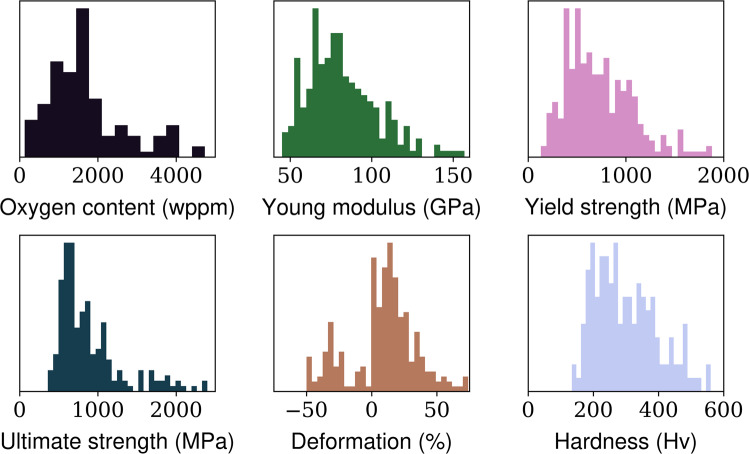
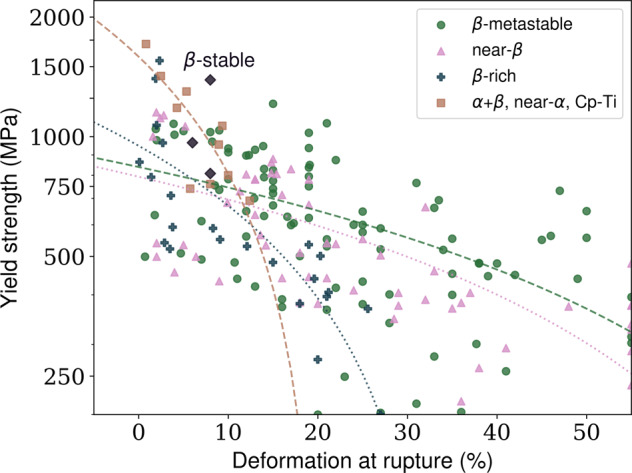
The present work depicts a compilation of mechanical properties of 282 distinct multicomponent Ti-based alloys and their respective microstructural features. The dataset includes the chemical composition (in at.%), phase constituents, Young modulus, hardness, yield strength, ultimate strength, and elongation. Each entry is associated with a high-quality experimental work containing a complete description of the processing route and testing setup. Furthermore, we incorporated flags to the dataset indicating (a) the use of high-resolution techniques for microstructural analysis and (b) the observation of non-linear elastic responses during mechanical testing. Oxygen content and average grain size are presented whenever available. The selected features can help material scientists to adjust the data to their needs concerning materials selection and discovery. Most alloys in the dataset were produced via an ingot metallurgy route, followed by solubilization and water quench (≈58%), which is considered a standard condition for β-Ti alloys. The database is hosted and maintained up to date in an open platform. For completeness, a few graphical representations of the dataset are included.
本研究描述了282种不同的多组分钛基合金的力学性能及其各自的微观结构特征。数据集包括化学成分(原子百分比)、相组成、杨氏模量、硬度、屈服强度、极限强度和伸长率。每个条目都与高质量的实验工作相关联,其中包含对加工路线和测试设置的完整描述。此外,我们在数据集中加入了标记,表明(a)使用高分辨率技术进行微观结构分析,以及(b)在力学测试过程中观察到非线性弹性响应。只要有可用数据,就会列出氧含量和平均晶粒尺寸。所选特征可帮助材料科学家根据材料选择和发现的需求调整数据。数据集中的大多数合金是通过铸锭冶金路线生产的,随后进行固溶处理和水淬(约58%),这被认为是β-Ti合金的标准条件。该数据库托管在一个开放平台上并保持更新。为了完整起见,还包括了数据集的一些图形表示。