
控制因测试液体而导致的表面能不均匀:以 UV/O3 处理的 PET 为例。
Controlling unequal surface energy results caused by test liquids: the case of UV/O3 Treated PET.
机构信息
College of Engineering Technology, Print and Graphic Media Science, Rochester Institute of Technology, Rochester, NY, 14623-5608, USA.
Chemical and Paper Engineering, Western Michigan University, Kalamazoo, MI, 49008-5462, USA.
出版信息
Sci Rep. 2022 Apr 26;12(1):6772. doi: 10.1038/s41598-022-10816-6.
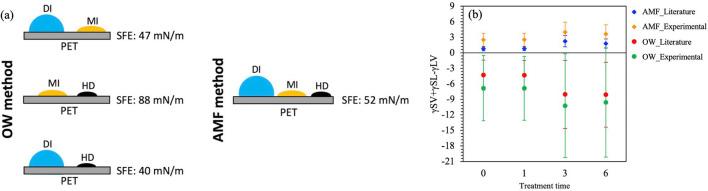
Ultraviolet/ozone (UV/O) treatment has been reported to be an effective method to modify properties such as wettability, adhesion or adsorption of plastic surfaces. The change in the surface is measured by contact angle analysis, which employs liquids and their surface tensions (ST) to estimate the surface energy (SE). We found two different practices in the scientific community: (1) the majority of researchers adopted the ST value of liquids from the literature, while (2) other researchers conducted real-time measurements in the lab under ambient conditions prior to SE estimation. To the best of our knowledge, there is no study that compares the difference between the two practices. One study was found to show different SE methods generating unequal SE values for the same substrate. However, there was no definitive conclusion backed by general thermodynamics rules. In this study, we presented (1) a statistical significance test that showed the literature and experimental ST values are significantly different, and studied (2) the effect of different liquid pairs on the SE estimation for UV/O treated poly(ethylene terephthalate) (PET) substrate. Modification techniques such as atmospheric pressure plasma or chemical modification were studied previously to examine PET's wettability and the SE. The UV/O treatment was studied to improve adhesion and to modify its chemical properties for adsorption. In contrast, we studied (3) the effect of UV/O on wettability at different timeframes and addressed (4) how to control unequal SE based on a method that was refined on a rigorous thermodynamic three-phase system. It must be noted that this method can be generalized to other types of solid surfaces to estimate thermodynamically self-consistent SE values. This work also provides (5) a web-based calculator that complements computational findings available to the readership in the data availability section.
紫外线/臭氧(UV/O)处理已被报道为一种有效方法,可以改变塑料表面的润湿性、附着力或吸附性能。表面的变化通过接触角分析来测量,该分析采用液体及其表面张力(ST)来估计表面能(SE)。我们在科学界发现了两种不同的做法:(1)大多数研究人员采用文献中的液体 ST 值,而(2)其他研究人员在环境条件下进行实时测量,然后再进行 SE 估计。据我们所知,没有研究比较这两种做法之间的差异。一项研究表明,不同的 SE 方法会对同一基底产生不等的 SE 值。然而,没有一个结论得到了普遍热力学规律的支持。在这项研究中,我们提出了(1)一个统计显著性检验,表明文献和实验 ST 值有显著差异,并研究了(2)不同液体对 UV/O 处理的聚对苯二甲酸乙二醇酯(PET)基底 SE 估计的影响。以前曾研究过大气压等离子体或化学改性等改性技术来研究 PET 的润湿性和 SE。研究 UV/O 处理是为了提高附着力,并改变其化学性质以进行吸附。相比之下,我们研究了(3)不同时间框架下 UV/O 对润湿性的影响,并解决了(4)如何根据一种在严格的热力学三相系统上得到改进的方法来控制不等的 SE。必须指出的是,这种方法可以推广到其他类型的固体表面,以估计热力学上一致的 SE 值。这项工作还提供了(5)一个基于网络的计算器,该计算器补充了在数据可用性部分提供给读者的计算结果。


 Zotero 插件