
用于微流控分析设备的紫外线/臭氧处理热塑性塑料在不同储存条件下的稳定性
Stability of UV/ozone-treated thermoplastics under different storage conditions for microfluidic analytical devices.
作者信息
Lin Tung-Yi, Pfeiffer Trey T, Lillehoj Peter B
机构信息
Department of Mechanical Engineering, Michigan State University, East Lansing, MI, USA. Email:
Department of Biomedical Engineering, Michigan State University, East Lansing, MI, USA.
出版信息
RSC Adv. 2017 Jul 29;7(59):37374-37379. doi: 10.1039/c7ra07435b. Epub 2017 Jul 28.
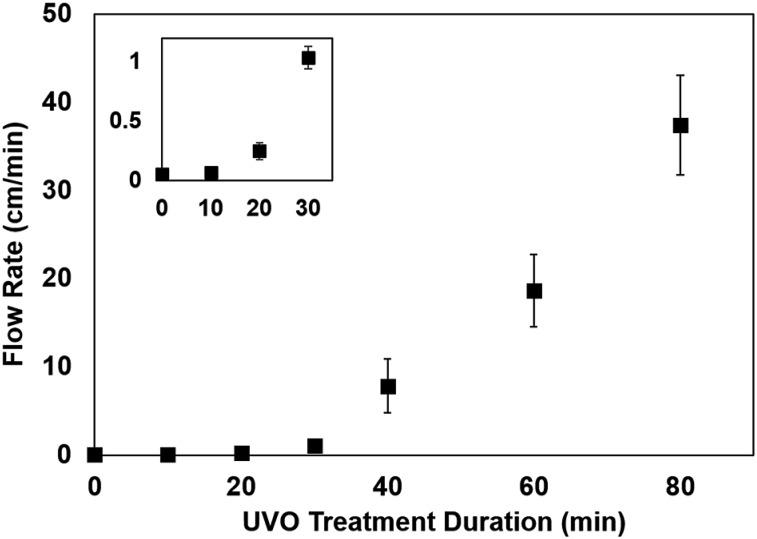
Thermoplastics are becoming a popular material for fabricating microfluidic devices and there is an increasing need for robust surface modification strategies. UV/ozone (UVO) treatment is a simple and effective method for making plastic surfaces more hydrophilic. Prior reports on the stability of UVO-treated plastics are limited to four weeks, which is not sufficient for applications requiring long-term storage. Here, we present new findings on the long-term stability of UVO-treated plastics for up to 16 weeks and show that the storage condition has a significant impact on the surface stability. Static contact angle measurements, X-ray photoelectron spectroscopy (XPS) and atomic force microscopy (AFM) were performed on UVO-treated cyclic olefin copolymer (COC), polycarbonate (PC) and poly(methyl methacrylate) (PMMA) stored in air, dehumidified and vacuum conditions. We found that the hydrophobic recovery of UVO-treated COC and PC can be inhibited by storing them in dehumidified or vacuum conditions, whereas the stability of PMMA is not significantly influenced by the storage condition. Protein adsorption studies were carried out and showed that there is a significant reduction in the amount of protein adsorption on UVO-treated plastics compared with untreated plastics. Lastly, UVO-treated PMMA microchannels were fabricated and used for capillary-driven flow, which revealed that longer treatment durations generate faster flow rates. These collective results offer new insights into the utility of UVO-treated plastics for microfluidic analytical applications.
热塑性塑料正成为制造微流控设备的一种流行材料,因此对强大的表面改性策略的需求日益增加。紫外线/臭氧(UVO)处理是一种使塑料表面更具亲水性的简单有效方法。先前关于UVO处理塑料稳定性的报道仅限于四周,这对于需要长期储存的应用来说是不够的。在此,我们展示了关于UVO处理塑料长达16周的长期稳定性的新发现,并表明储存条件对表面稳定性有重大影响。对储存在空气、除湿和真空条件下的UVO处理的环烯烃共聚物(COC)、聚碳酸酯(PC)和聚甲基丙烯酸甲酯(PMMA)进行了静态接触角测量、X射线光电子能谱(XPS)和原子力显微镜(AFM)分析。我们发现,将UVO处理的COC和PC储存在除湿或真空条件下可以抑制其疏水恢复,而PMMA的稳定性受储存条件的影响不显著。进行了蛋白质吸附研究,结果表明,与未处理的塑料相比,UVO处理的塑料上蛋白质吸附量显著减少。最后,制造了UVO处理的PMMA微通道并用于毛细管驱动流,结果表明较长的处理时间会产生更快的流速。这些综合结果为UVO处理的塑料在微流控分析应用中的实用性提供了新的见解。


 Zotero 插件