Gardener Hannah, Romano Leo A, Smith Eric E, Campo-Bustillo Iszet, Khan Yosef, Tai Sofie, Riley Nikesha, Sacco Ralph L, Khatri Pooja, Alger Heather M, Mac Grory Brian, Gulati Deepak, Sangha Navdeep S, Olds Karin E, Benesch Curtis G, Kelly Adam G, Brehaut Scott S, Kansara Amit C, Schwamm Lee H, Romano Jose G
Neurology, University of Miami Miller School of Medicine, Miami, Florida, USA
Neurology, University of Miami Miller School of Medicine, Miami, Florida, USA.
Stroke Vasc Neurol. 2022 Apr 26;7(5):375-80. doi: 10.1136/svn-2021-001333.
BACKGROUND/OBJECTIVE: This study compares the global disability status of patients who had a mild ischaemic stroke at 30 and 90 days poststroke, as measured by the modified Rankin Scale (mRS), and identifies predictors of change in disability status between 30 and 90 days.
The study population included 1339 patients who had a ischaemic stroke enrolled in the Mild and Rapidly Improving Stroke Study with National Institutes of Health (NIH) stroke score 0-5 and mRS measurements at 30 and 90 days. Outcomes were (1) Improvement defined as having mRS >1 at 30 days and mRS 0-1 at 90 days OR mRS >2 at 30 days and mRS 0-2 at 90 days and (2) Worsening defined as an increase of ≥2 points or a worsening from mRS of 1 at 30 days to 2 at 90 days. Demographic and clinical characteristics at hospital arrival were abstracted from medical records, and regression models were used to identify predictors of functional improvement and decline from 30 to 90 days post-stroke. Significant predictors were mutually adjusted in multivariable models that also included age and stroke severity.
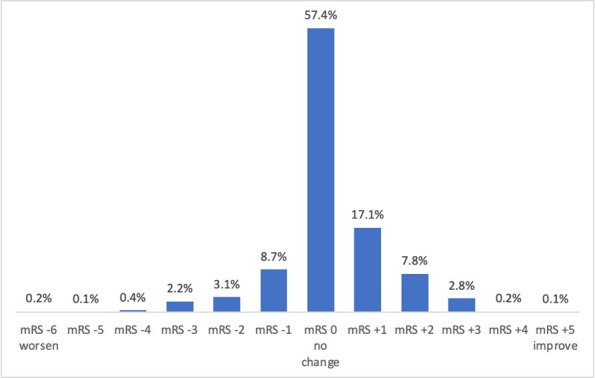
Fifty-seven per cent of study participants had no change in mRS value from 30 to 90 days. Overall, there was moderate agreement in mRS between the two time points (weighted kappa=0.59 (95% CI 0.56 to 0.62)). However, worsening on the mRS was observed in 7.54% of the study population from 30 to 90 days, and 17.33% improved. Participants of older age (per year OR 1.02, 95% CI 1.00 to 1.03), greater stroke severity (per NIH Stroke Scale (NIHSS) point at admission OR 1.17, 95% CI 1.03 to 1.34), and those with no alteplase treatment (OR 1.72, 95% CI 1.11 to 2.69) were more likely to show functional decline after mutual adjustment.
A quarter of all mild ischaemic stroke participants exhibited functional changes between 30 and 90 days, suggesting that the 30-day outcome may insufficiently represent long-term recovery in mild stroke and longer follow-up may be clinically necessary.
NCT02072681.
背景/目的:本研究比较了轻度缺血性卒中患者在卒中后30天和90天时的整体残疾状况(采用改良Rankin量表(mRS)进行测量),并确定了30天至90天期间残疾状况变化的预测因素。
研究人群包括1339例缺血性卒中患者,这些患者参与了轻度和快速改善卒中研究,美国国立卫生研究院(NIH)卒中评分0 - 5分,并在30天和90天时进行了mRS测量。结局指标为:(1)改善定义为30天时mRS>1且90天时mRS为0 - 1,或30天时mRS>2且90天时mRS为0 - 2;(2)恶化定义为mRS增加≥2分或从30天时的mRS 1恶化至90天时的mRS 2。从病历中提取入院时的人口统计学和临床特征,并使用回归模型确定卒中后30天至90天功能改善和下降的预测因素。在多变量模型中对显著预测因素进行相互调整,该模型还包括年龄和卒中严重程度。
57%的研究参与者mRS值在30天至90天之间没有变化。总体而言,两个时间点的mRS之间存在中度一致性(加权kappa = 0.59(95%CI 0.56至0.62))。然而,在30天至90天期间,7.54%的研究人群mRS恶化,17.33%的人群有所改善。年龄较大的参与者(每年OR 1.02,95%CI 1.00至1.03)、卒中严重程度较高(入院时每NIH卒中量表(NIHSS)评分1分OR 1.17,95%CI 1.03至1.34)以及未接受阿替普酶治疗的参与者(OR 1.72,95%CI 1.11至2.69)在相互调整后更有可能出现功能下降。
四分之一的轻度缺血性卒中参与者在30天至90天之间出现功能变化,这表明30天的结局可能不足以代表轻度卒中的长期恢复情况,临床上可能需要更长时间的随访。
NCT02072681。