Ando Satoshi, Kamei Jun, Yamazaki Masahiro, Sugihara Toru, Kameda Tomohiro, Fujisaki Akira, Kurokawa Shinsuke, Takayama Tatsuya, Fujimura Tetsuya
Department of Urology Jichi Medical University Shimotsuke Japan.
BJUI Compass. 2021 Nov 12;3(2):184-190. doi: 10.1002/bco2.128. eCollection 2022 Mar.
To assess the relationship between the surgical procedure of robot-assisted radical prostatectomy (RARP) and urinary continence recovery by reviewing the video database.
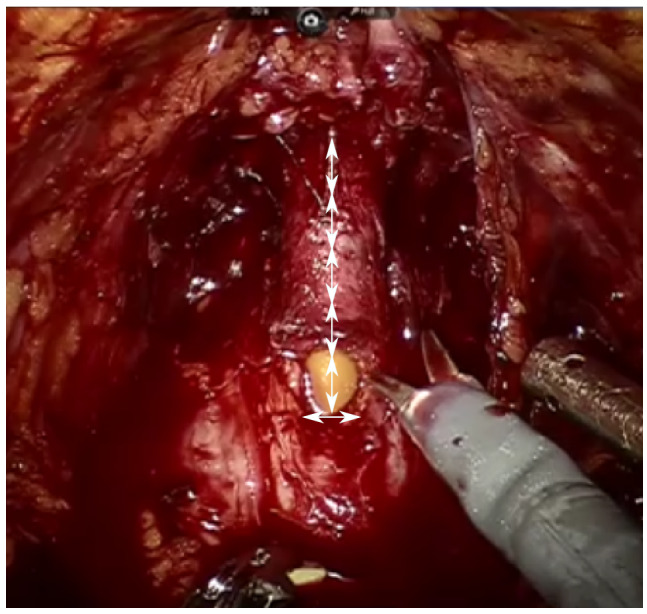
Video and data about men diagnosed with prostate cancer and underwent RARP were extracted and reviewed. Preserved urethral length (PUL) was semi-quantitatively measured using the lateral width of a 16-Fr urethral balloon catheter while cutting the urethra on a video screen. In addition, by reviewing intraoperative RARP video database, other surgical skill outcomes were also collected. Kaplan-Meier analysis with log-rank test was used to compare the urinary continence recovery rate, stratified by the PUL. Univariate and multivariate analyses were performed using the Cox proportional hazards model, and -values of <0.05 were considered significant.
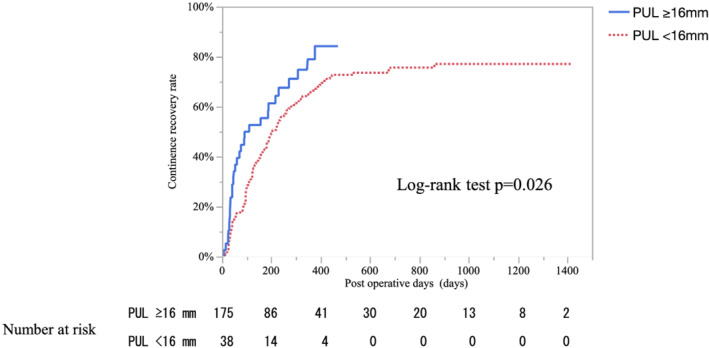
The number of patients included in this study was 213. In univariate analysis, a PUL of ≥16 mm, a body mass index of <23.1 kg/m and a resected prostate volume of <44.3 g were statistically significant factors that influenced urinary continence recovery [hazard ratio (HR) 1.58, = 0.036; HR 0.67, = 0.021; and HR 0.58, = 0.005, respectively]. Those factors also remained statistically significant in the multivariate analysis (HR 1.87, = 0.022; HR 0.54, = 0.001; and HR 0.57, = 0.005, respectively). One year post-operatively, the recovery rate from urinary continence was 79.0% for patients with a PUL of ≥16 mm and 66.5% for patients with a PUL of <16 mm.
These results suggest that patients with longer PUL in RARP have a significantly higher rate of post-operative urinary continence recovery.
通过回顾视频数据库,评估机器人辅助根治性前列腺切除术(RARP)的手术操作与尿失禁恢复之间的关系。
提取并回顾了诊断为前列腺癌且接受RARP手术的男性患者的视频和数据。在视频屏幕上切割尿道时,使用16F尿道球囊导管的横向宽度对保留尿道长度(PUL)进行半定量测量。此外,通过回顾术中RARP视频数据库,还收集了其他手术技能结果。采用Kaplan-Meier分析和对数秩检验比较按PUL分层的尿失禁恢复率。使用Cox比例风险模型进行单因素和多因素分析,P值<0.05被认为具有统计学意义。
本研究纳入患者213例。单因素分析中,PUL≥16mm、体重指数<23.1kg/m²和切除前列腺体积<44.3g是影响尿失禁恢复的统计学显著因素[风险比(HR)分别为1.58,P = 0.036;HR 0.67,P = 0.021;HR 0.58,P = 0.005]。这些因素在多因素分析中也具有统计学意义(HR分别为1.87,P = 0.022;HR 0.54,P = 0.001;HR 0.57,P = 0.005)。术后1年,PUL≥16mm的患者尿失禁恢复率为79.0%,PUL<16mm的患者为66.5%。
这些结果表明,RARP手术中PUL较长的患者术后尿失禁恢复率显著更高。