Division of Biomedical Engineering for Health and Welfare, Tohoku University Graduate School of Biomedical Engineering, Sendai, Japan.
Center for Human Movement Sciences, University of Groningen, University Medical Center Groningen, Groningen, The Netherlands.
Sports Med. 2022 Sep;52(9):2159-2175. doi: 10.1007/s40279-022-01681-4. Epub 2022 Apr 27.
The use of compression garments (CGs) during or after training and competition has gained popularity in the last few decades. However, the data concerning CGs' beneficial effects on muscle strength-related outcomes after physical exercise remain inconclusive.
The aim was to determine whether wearing CGs during or after physical exercise would facilitate the recovery of muscle strength-related outcomes.
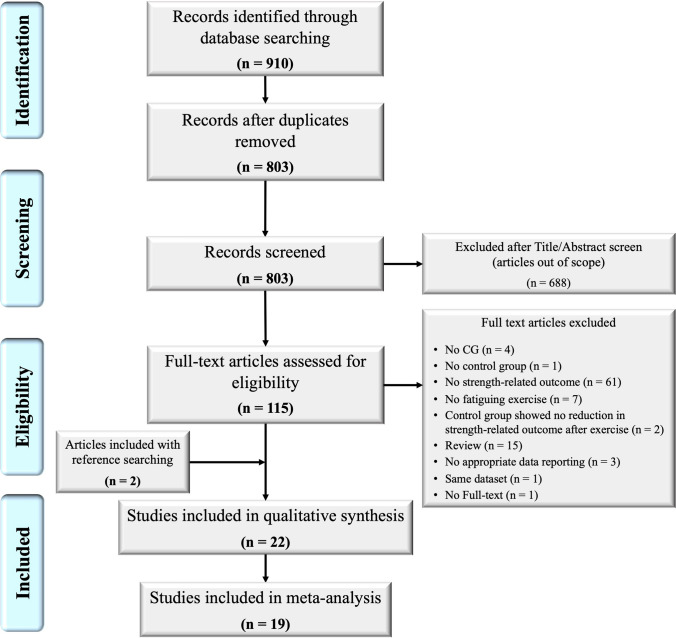
A systematic literature search was conducted across five databases (PubMed, SPORTDiscus, Web of Science, Scopus, and EBSCOhost). Data from 19 randomized controlled trials (RCTs) including 350 healthy participants were extracted and meta-analytically computed. Weighted between-study standardized mean differences (SMDs) with respect to their standard errors (SEs) were aggregated and corrected for sample size to compute overall SMDs. The type of physical exercise, the body area and timing of CG application, and the time interval between the end of the exercise and subsequent testing were assessed.
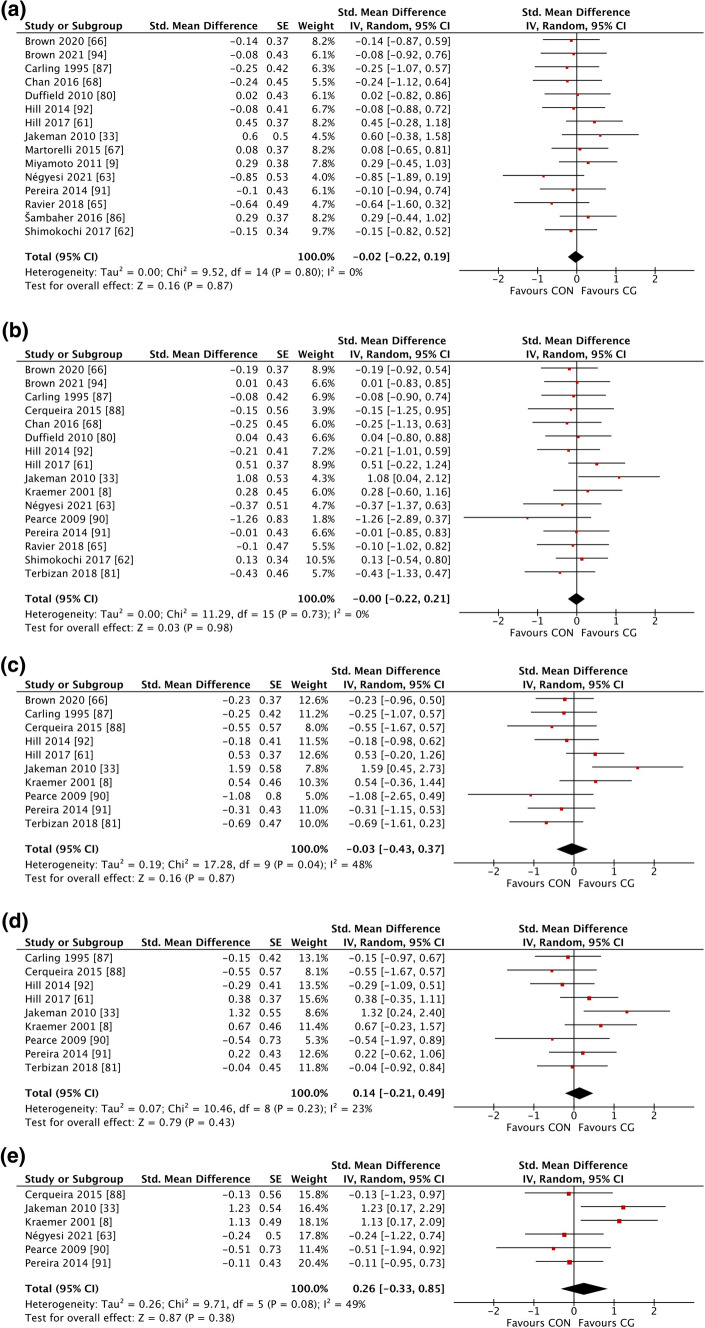
CGs produced no strength-sparing effects (SMD [95% confidence interval]) at the following time points (t) after physical exercise: immediately ≤ t < 24 h: - 0.02 (- 0.22 to 0.19), p = 0.87; 24 ≤ t < 48 h: - 0.00 (- 0.22 to 0.21), p = 0.98; 48 ≤ t < 72 h: - 0.03 (- 0.43 to 0.37), p = 0.87; 72 ≤ t < 96 h: 0.14 (- 0.21 to 0.49), p = 0.43; 96 h ≤ t: 0.26 (- 0.33 to 0.85), p = 0.38. The body area where the CG was applied had no strength-sparing effects. CGs revealed weak strength-sparing effects after plyometric exercise.
Meta-analytical evidence suggests that wearing a CG during or after training does not seem to facilitate the recovery of muscle strength following physical exercise. Practitioners, athletes, coaches, and trainers should reconsider the use of CG as a tool to reduce the effects of physical exercise on muscle strength.
PROSPERO CRD42021246753.
在过去几十年中,压缩服装(CGs)在训练和比赛期间或之后的使用变得越来越流行。然而,关于 CGs 对运动后与肌肉力量相关的结果的有益影响的数据仍存在争议。
目的是确定在运动期间或之后穿着 CG 是否有助于恢复与肌肉力量相关的结果。
对五个数据库(PubMed、SPORTDiscus、Web of Science、Scopus 和 EBSCOhost)进行了系统的文献检索。从 19 项随机对照试验(RCT)中提取了包含 350 名健康参与者的数据,并进行了荟萃分析计算。根据其标准误差(SE)汇总了关于加权组间标准化均数差异(SMD),并对样本量进行了校正,以计算总体 SMD。评估了运动类型、CG 应用的身体部位和时间以及运动结束与后续测试之间的时间间隔。
CG 在运动后以下时间点没有产生节省力量的效果(SMD[95%置信区间]):运动后立即≤t<24 小时:-0.02(-0.22 至 0.19),p=0.87;24 小时≤t<48 小时:-0.00(-0.22 至 0.21),p=0.98;48 小时≤t<72 小时:-0.03(-0.43 至 0.37),p=0.87;72 小时≤t<96 小时:0.14(-0.21 至 0.49),p=0.43;96 小时≤t:0.26(-0.33 至 0.85),p=0.38。CG 应用的身体部位没有节省力量的效果。CG 在进行增强式运动后显示出微弱的节省力量的效果。
荟萃分析证据表明,在训练或之后穿着 CG 似乎不会促进运动后肌肉力量的恢复。从业者、运动员、教练和培训师应重新考虑将 CG 作为一种工具来减少运动对肌肉力量的影响。
PROSPERO CRD42021246753。