IEEE Trans Biomed Eng. 2022 Nov;69(11):3449-3459. doi: 10.1109/TBME.2022.3170832. Epub 2022 Oct 19.
Diffuse intrinsic pontine glioma (DIPG) is the most common and deadliest brainstem tumor in children. Focused ultrasound combined with microbubble-mediated BBB opening (FUS-BBBO) is a promising technique for overcoming the frequently intact blood-brain barrier (BBB) in DIPG to enhance therapeutic drug delivery to the brainstem. Since DIPG is highly diffusive, large-volume FUS-BBBO is needed to cover the entire tumor region. The objective of this study was to determine the optimal treatment strategy to achieve efficient and homogeneous large-volume BBBO at the brainstem for the delivery of an immune checkpoint inhibitor, anti-PD-L1 antibody (aPD-L1).
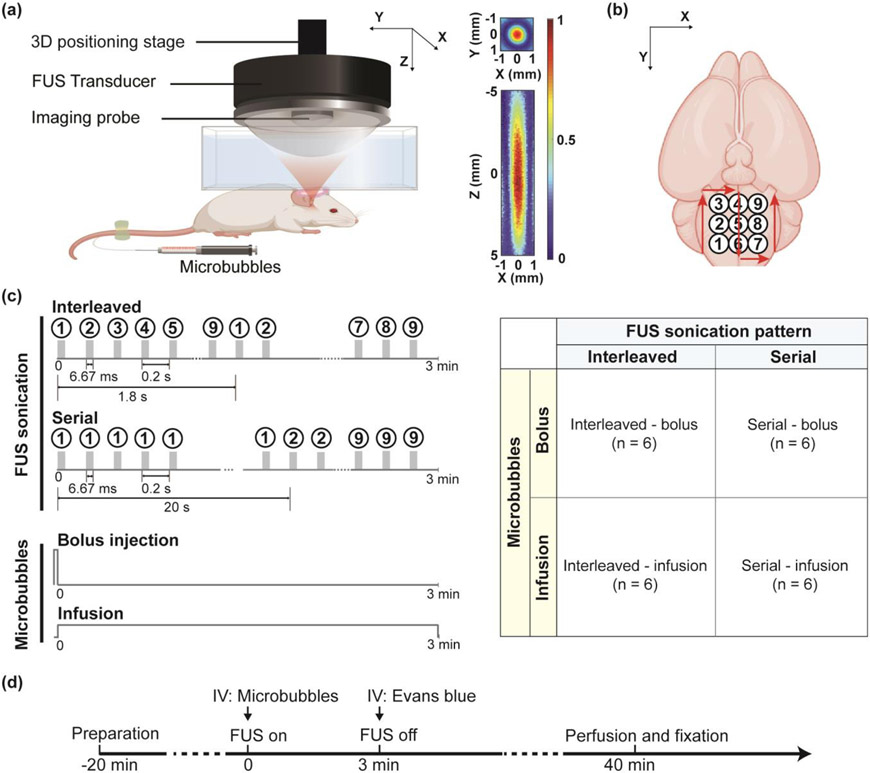
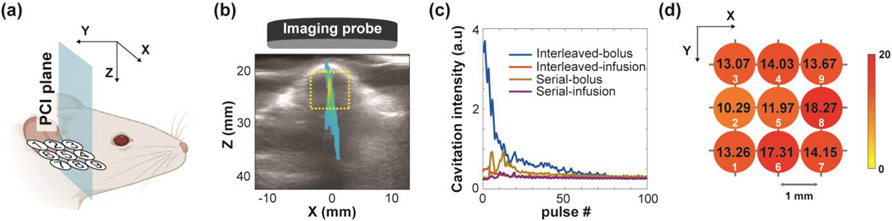
Two critical parameters for large-volume FUS-BBBO, multi-point sonication pattern (interleaved vs. serial) and microbubble injection method (bolus vs. infusion), were evaluated by treating mice with four combinations of these two parameters. 2D Passive cavitation imaging (PCI) was performed for monitoring the large-volume sonication.
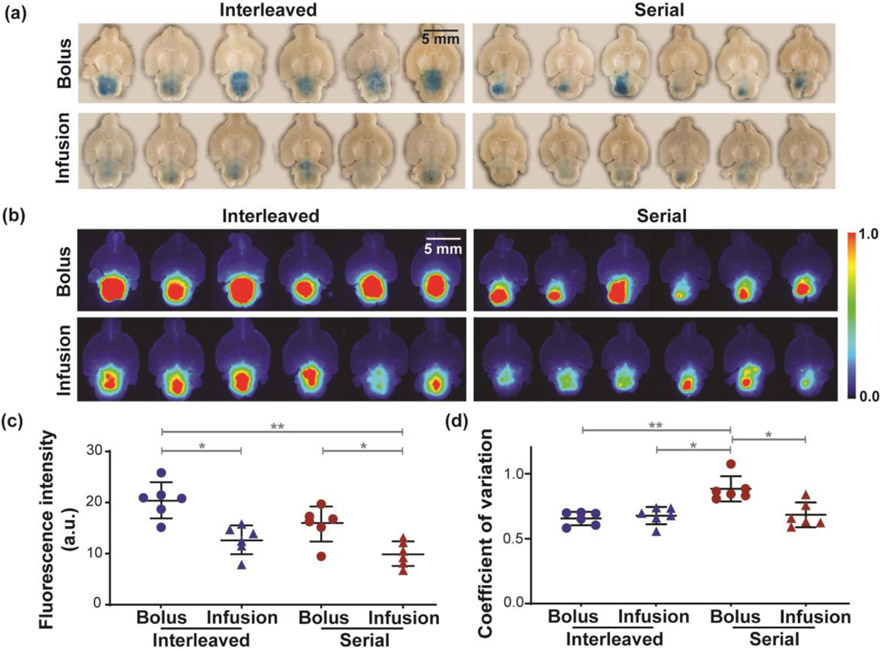
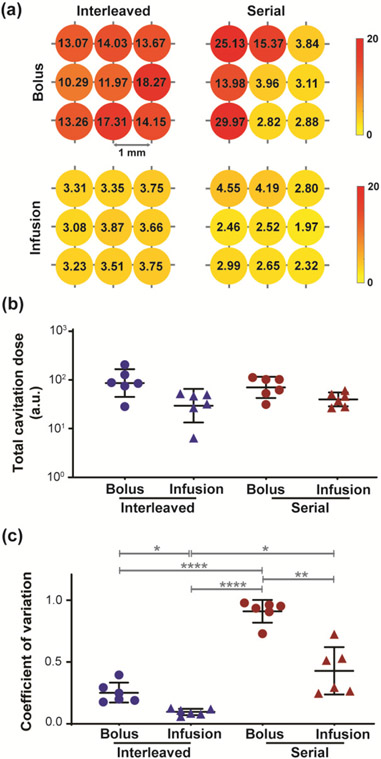
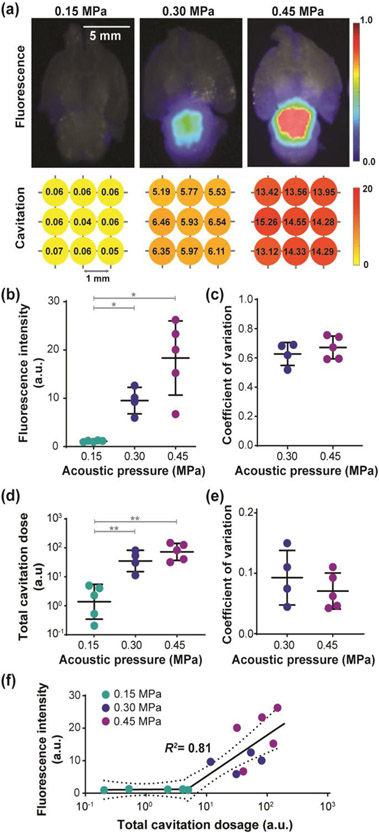
Interleaved sonication combined with bolus injection of microbubbles resulted in 1.29 to 2.06 folds higher efficiency than other strategies as evaluated by Evans blue extravasation. The average coefficient of variation of the Evans blue delivery was 0.66 for interleaved sonication with bolus injection, compared to 0.68-0.88 for all other strategies. Similar trend was also observed in the quantified total cavitation dose and coefficient of variance of the cavitation dose. This strategy was then applied to deliver fluorescently labeled aPD-L1 which was quantified using fluorescence imaging. A strong segmented linear correlation (R = 0.81) was found between the total cavitation dose and the total fluorescence intensity of aPD-L1 delivered at different sonication pressures (0.15 MPa, 0.30 MPa, and 0.45 MPa).
Findings from this study suggest that efficient and homogeneous large-volume FUS-BBBO can be achieved by interleaved sonication combined with bolus injection of microbubbles, and the efficiency and homogeneity can be monitored by PCI.
弥漫性内在脑桥神经胶质瘤(DIPG)是儿童中最常见和最致命的脑干肿瘤。聚焦超声联合微泡介导的 BBB 开放(FUS-BBBO)是一种有前途的技术,可以克服 DIPG 中经常完整的血脑屏障(BBB),以增强治疗药物向脑干的输送。由于 DIPG 具有高度弥散性,因此需要大体积 FUS-BBBO 覆盖整个肿瘤区域。本研究的目的是确定最佳的治疗策略,以实现高效、均匀的大体积 BBBO 在脑干,用于递送电免疫检查点抑制剂,抗 PD-L1 抗体(aPD-L1)。
通过用这两个参数的四种组合治疗小鼠,评估了大体积 FUS-BBBO 的两个关键参数,多点声空化模式(交错与连续)和微泡注射方法(团注与输注)。二维被动空化成像(PCI)用于监测大体积超声。
交错声空化联合微泡团注的方法比其他策略的效率提高了 1.29 至 2.06 倍,通过 Evans 蓝外渗评估。交错声空化联合微泡团注的 Evans 蓝传递的平均变异系数为 0.66,而所有其他策略的变异系数为 0.68-0.88。在量化的总空化剂量和空化剂量的变异系数中也观察到了类似的趋势。然后,该策略用于递荧光标记的 aPD-L1,并用荧光成像进行定量。在不同的超声压力(0.15 MPa、0.30 MPa 和 0.45 MPa)下,总空化剂量与递的 aPD-L1 的总荧光强度之间存在强烈的分段线性相关(R = 0.81)。
本研究结果表明,通过交错声空化联合微泡团注可以实现高效、均匀的大体积 FUS-BBBO,通过 PCI 可以监测其效率和均匀性。