MOE Key Laboratory of Molecular Biophysics, Hubei Key Laboratory of Bioinformatics and Molecular-imaging, Center of Artificial Intelligence Biology, Department of Bioinformatics and Systems Biology, College of Life Science and Technology, Huazhong University of Science and Technology, Wuhan 430074, China.
MOE Key Laboratory of Molecular Biophysics, Hubei Key Laboratory of Bioinformatics and Molecular-imaging, Center of Artificial Intelligence Biology, Department of Bioinformatics and Systems Biology, College of Life Science and Technology, Huazhong University of Science and Technology, Wuhan 430074, China.
Genomics Proteomics Bioinformatics. 2022 Oct;20(5):867-881. doi: 10.1016/j.gpb.2022.02.007. Epub 2022 Apr 26.
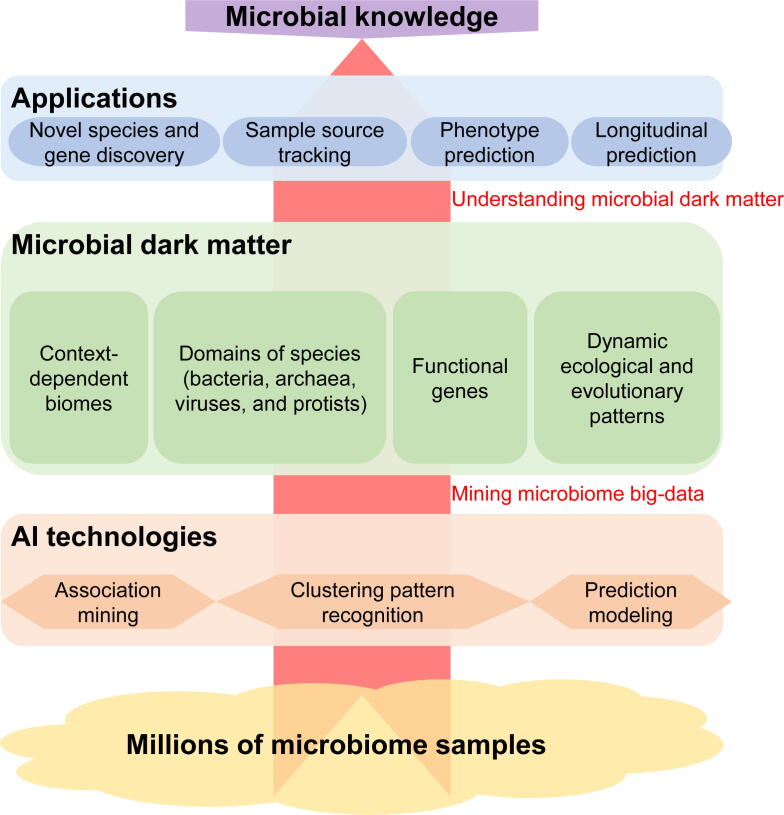
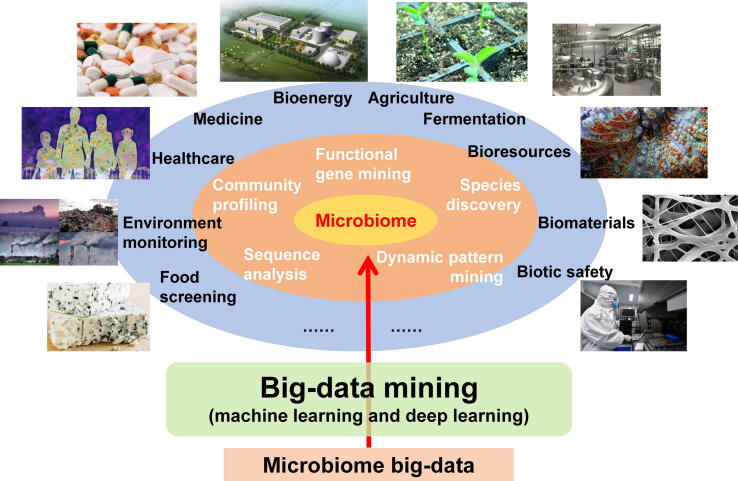
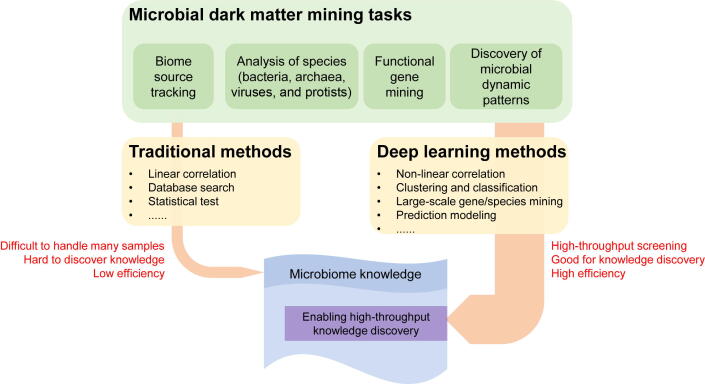
With the rapid increase of the microbiome samples and sequencing data, more and more knowledge about microbial communities has been gained. However, there is still much more to learn about microbial communities, including billions of novel species and genes, as well as countless spatiotemporal dynamic patterns within the microbial communities, which together form the microbial dark matter. In this work, we summarized the dark matter in microbiome research and reviewed current data mining methods, especially artificial intelligence (AI) methods, for different types of knowledge discovery from microbial dark matter. We also provided case studies on using AI methods for microbiome data mining and knowledge discovery. In summary, we view microbial dark matter not as a problem to be solved but as an opportunity for AI methods to explore, with the goal of advancing our understanding of microbial communities, as well as developing better solutions to global concerns about human health and the environment.
随着微生物组样本和测序数据的快速增加,人们对微生物群落的了解越来越多。然而,微生物群落还有很多未知的地方,包括数十亿种新的物种和基因,以及微生物群落内部无数的时空动态模式,这些共同构成了微生物暗物质。在这项工作中,我们总结了微生物组研究中的暗物质,并回顾了当前的数据挖掘方法,特别是人工智能 (AI) 方法,用于从微生物暗物质中发现不同类型的知识。我们还提供了使用 AI 方法进行微生物组数据挖掘和知识发现的案例研究。总之,我们认为微生物暗物质不是一个有待解决的问题,而是 AI 方法探索的机会,目的是增进我们对微生物群落的理解,并为解决人类健康和环境方面的全球关注问题开发更好的解决方案。