Research Centre for Experimental Orthopaedics, Heidelberg University Hospital, Schlierbacher Landstrasse 200a, 69118, Heidelberg, Germany.
Department of Orthopaedic and Trauma Surgery, Heidelberg University Hospital, Heidelberg, Germany.
Stem Cell Res Ther. 2022 Apr 27;13(1):168. doi: 10.1186/s13287-022-02843-x.
Fully functional regeneration of skeletal defects by multipotent progenitor cells requires that differentiating cells gain the specific mechano-competence needed in the target tissue. Using cartilage neogenesis as an example, we asked whether proper phenotypic differentiation of mesenchymal stromal cells (MSC) into chondrocytes in vitro will install the adequate biological mechano-competence of native articular chondrocytes (AC).
The mechano-competence of human MSC- and AC-derived neocartilage was compared during differentiation for up to 35 days. The neocartilage layer was subjected to physiologic dynamic loading in a custom-designed bioreactor and assayed for mechano-sensitive gene and pathway activation, extracellular matrix (ECM) synthesis by radiolabel incorporation, nitric oxide (NO) and prostaglandin E (PGE) production. Input from different pathways was tested by application of agonists or antagonists.
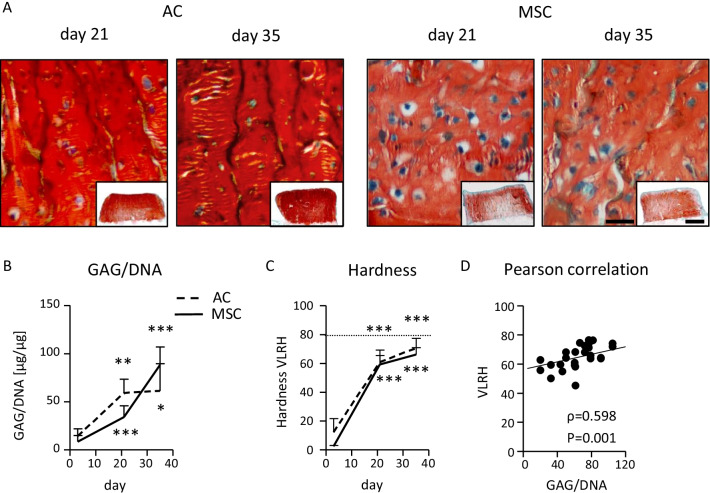
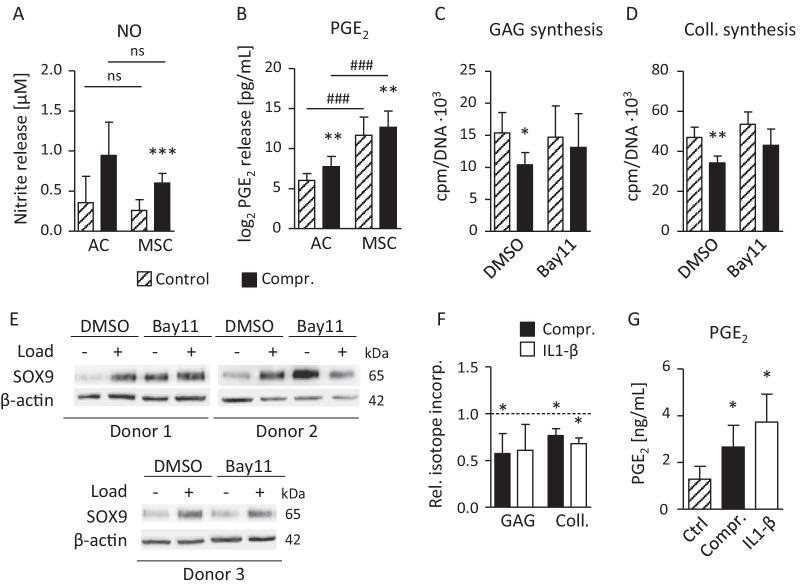
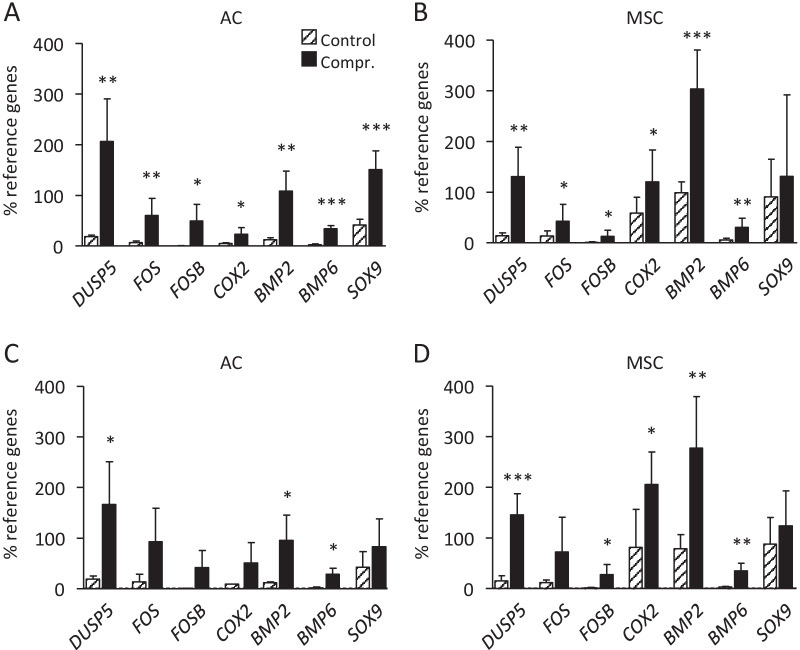
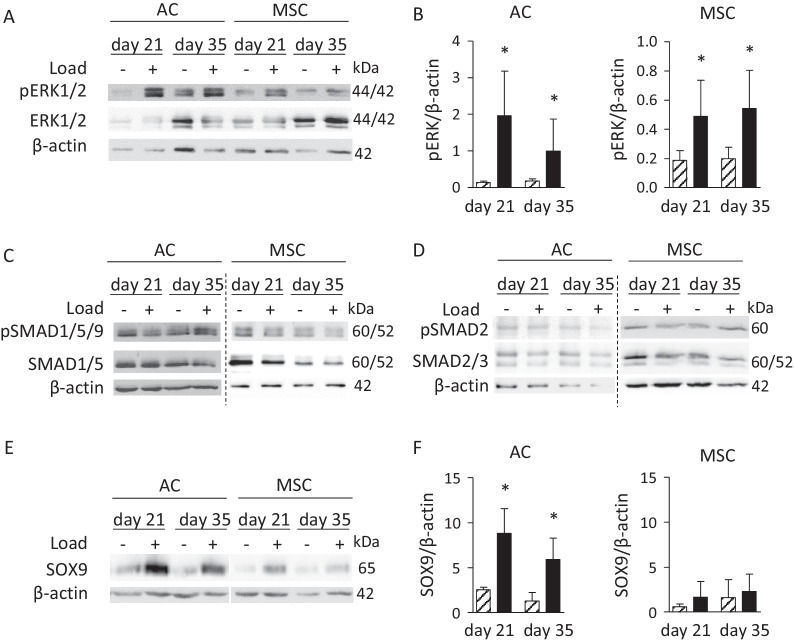
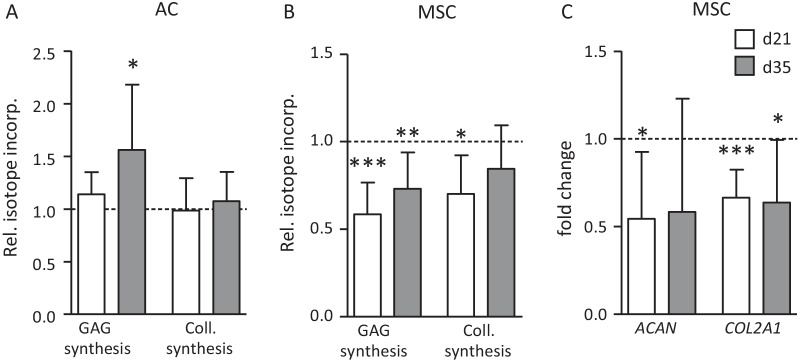
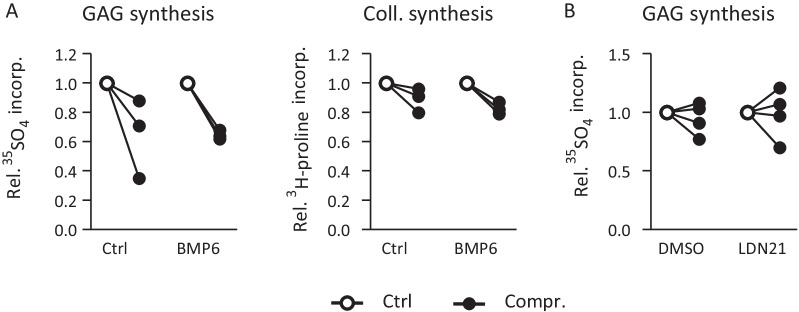
MSC and AC formed neocartilage of similar proteoglycan content with a hardness close to native tissue. Mechano-stimulation on day 21 and 35 induced a similar upregulation of mechano-response genes, ERK phosphorylation, NO production and PGE release in both groups, indicating an overall similar transduction of external mechanical signals. However, while AC maintained or enhanced proteoglycan synthesis after loading dependent on tissue maturity, ECM synthesis was always significantly disturbed by loading in MSC-derived neocartilage. This was accompanied by significantly higher COX2 and BMP2 background expression, > 100-fold higher PGE production and a weaker SOX9 stimulation in response to loading in MSC-derived neocartilage. Anabolic BMP-pathway activity was not rate limiting for ECM synthesis after loading in both groups. However, NFκB activation mimicked the negative loading effects and enhanced PGE production while inhibition of catabolic NFκB signaling rescued the load-induced negative effects on ECM synthesis in MSC-derived neocartilage.
MSC-derived chondrocytes showed a higher vulnerability to be disturbed by loading despite proper differentiation and did not acquire an AC-like mechano-competence to cope with the mechanical stress of a physiologic loading protocol. Managing catabolic NFκB influences was one important adaptation to install a mechano-resistance closer to AC-derived neocartilage. This new knowledge asks for a more functional adaptation of MSC chondrogenesis, novel pharmacologic co-treatment strategies for MSC-based clinical cartilage repair strategies and may aid a more rational design of physical rehabilitation therapy after AC- versus MSC-based surgical cartilage intervention.
多能祖细胞通过完全功能性再生骨骼缺损,要求分化细胞获得靶组织中所需的特定机械能力。我们以软骨新生为例,研究了体外间充质基质细胞(MSC)向软骨细胞的适当表型分化是否会为天然关节软骨细胞(AC)提供足够的生物学机械能力。
比较了人 MSC 和 AC 来源的新生软骨在分化过程中的机械能力,时间长达 35 天。将新生软骨层置于定制的生物反应器中进行生理动态加载,并通过放射性标记掺入测定法测定机械敏感基因和途径的激活、细胞外基质(ECM)的合成、一氧化氮(NO)和前列腺素 E(PGE)的产生。通过应用激动剂或拮抗剂测试了不同途径的输入。
MSC 和 AC 形成的新生软骨具有相似的蛋白聚糖含量,硬度接近天然组织。在第 21 天和第 35 天进行机械刺激,两组均诱导机械反应基因、ERK 磷酸化、NO 产生和 PGE 释放的相似上调,表明对外部机械信号的整体相似转导。然而,虽然 AC 在依赖于组织成熟的情况下保持或增强负荷后的蛋白聚糖合成,但在 MSC 衍生的新生软骨中,负荷总是明显干扰 ECM 合成。这伴随着 COX2 和 BMP2 背景表达明显升高,>100 倍的 PGE 产生,以及在 MSC 衍生的新生软骨中对负荷的 SOX9 刺激减弱。在两组中,BMP 途径的合成活性对于负荷后的 ECM 合成不是限速的。然而,NFκB 激活模拟了负加载效应,并增强了 PGE 的产生,而抑制分解代谢 NFκB 信号传导则挽救了 MSC 衍生的新生软骨中负荷对 ECM 合成的负向影响。
尽管分化良好,但 MSC 衍生的软骨细胞对负荷的干扰更为敏感,并且没有获得类似 AC 的机械能力来应对生理负荷方案的机械压力。管理分解代谢 NFκB 影响是一种重要的适应方式,可使机械抗性更接近 AC 衍生的新生软骨。这种新知识要求对 MSC 软骨发生进行更功能适应性改造,为基于 MSC 的临床软骨修复策略制定新的药物联合治疗策略,并有助于更合理地设计基于 AC 与 MSC 的手术软骨干预后的物理康复治疗。