Ayaki Masahiko, Negishi Kazuno
Department of Ophthalmology, Keio University School of Medicine, 35 Shinanomachi, Shinjuku-ku, Tokyo, 160-8582, Japan.
Otake Clinic Moon View Eye Center, Kanagawa, Japan.
Sci Rep. 2022 Apr 27;12(1):6848. doi: 10.1038/s41598-022-11035-9.
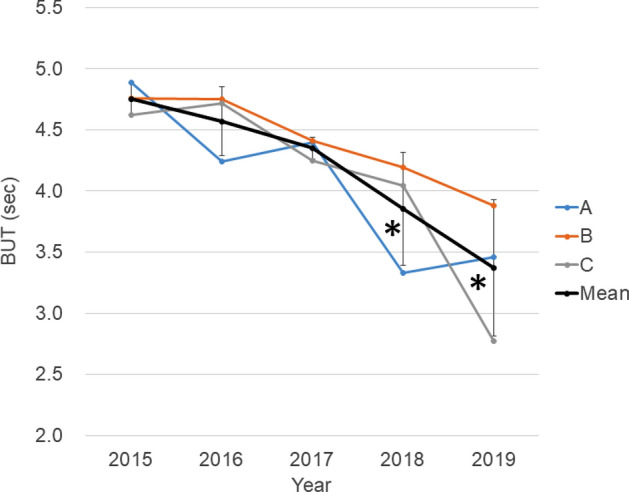
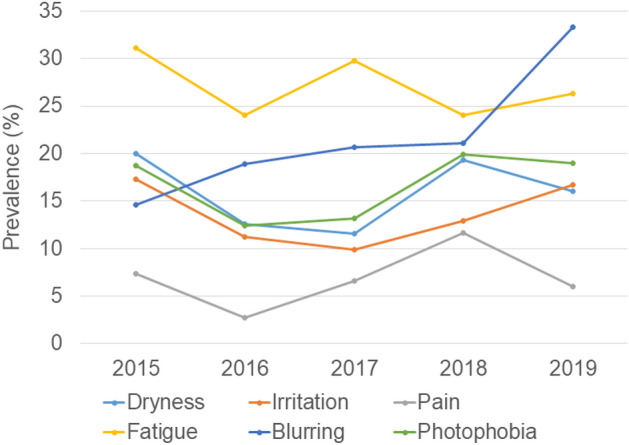
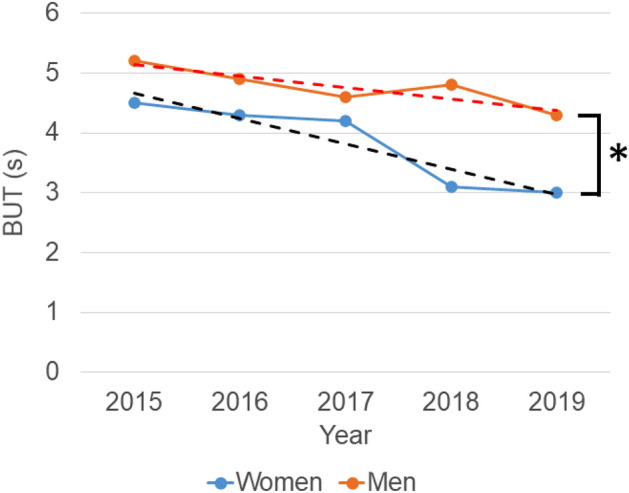
The aim of this retrospective chart review study was to evaluate the 5-year trend of ocular surface examination results in participants who visited the eye clinic from 2015 to 2019, underwent corneal and lacrimal examinations, refraction, and intra-ocular pressure measurements, and reported six dry eye-related symptoms. A total of 1468 patients were analyzed. Tear break-up time (BUT) decreased continuously for five consecutive years: 4.76 ± 1.84 s in 2015, 4.57 ± 1.70 s in 2016 (p = 0.999, vs 2015), 4.35 ± 2.06 s in 2017 (p = 0.662), 3.83 ± 2.18 s in 2018 (p < 0.001), and 3.63 ± 2.10 s in 2019 (p < 0.001). The decrease of BUT was more prominent in women than men (p < 0.001) and the correlation coefficient between calendar year and BUT was greater in women than men (p = 0.002). Schirmer test value, strip tear meniscometry value, and corneal staining score did not exhibit significant changes. Prevalence of blurring, photophobia, and pain increased toward 2019 among symptoms surveyed (eye fatigue, blurring, photophobia, dryness, irritation, and pain) and regression analysis indicated blurring (p < 0.001), photophobia (p < 0.001), and pain (p < 0.001) were correlated with BUT. In conclusion, BUT decreased continuously for five consecutive years from 2015 to 2019 and was associated with dry-eye related symptoms.
本回顾性图表审查研究的目的是评估2015年至2019年期间前往眼科诊所就诊、接受角膜和泪道检查、验光及眼压测量,并报告六种干眼相关症状的参与者眼部表面检查结果的5年趋势。共分析了1468例患者。泪膜破裂时间(BUT)连续五年持续下降:2015年为4.76±1.84秒,2016年为4.57±1.70秒(与2015年相比,p = 0.999),2017年为4.35±2.06秒(p = 0.662),2018年为3.83±2.18秒(p < 0.001),2019年为3.63±2.10秒(p < 0.001)。BUT的下降在女性中比男性更显著(p < 0.001),且日历年与BUT之间的相关系数在女性中比男性更大(p = 0.002)。泪液分泌试验值、泪河高度测量值和角膜染色评分未显示出显著变化。在所调查的症状(眼疲劳、视物模糊、畏光、眼干、眼刺激感和疼痛)中,视物模糊、畏光和疼痛的患病率在2019年呈上升趋势,回归分析表明视物模糊(p < 0.001)、畏光(p < 0.001)和疼痛(p < 0.001)与BUT相关。总之,2015年至2019年BUT连续五年持续下降,并与干眼相关症状有关。