Li Xiang, Wang Limei, Song Lulu, Wan Zhengce, Kou Jing, Zhang Mingye, Lü Yongman, Wang Youjie, Mei Surong
Key Laboratory of Environment & Health of Ministry of Education, Institute of Environmental Medicine, School of Public Health, Huazhong University of Science and Technology, Wuhan 430030, China.
Department of Maternal and Child Health, School of Public Health, Huazhong University of Science and Technology, Wuhan 430030, China.
Se Pu. 2022 May 8;40(5):461-468. doi: 10.3724/SP.J.1123.2021.12013.
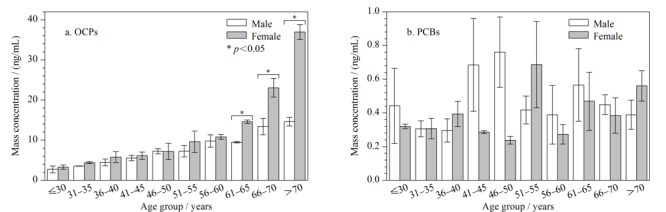
Owing to their persistence, ease of accumulation in organisms, and high toxicity, the use of persistent organic pollutants (POPs) has been limited ever since the Stockholm Convention on Persistent Organic Pollutants was signed in 2001 by the United Nations Environment Programme (UNEP). As typical POPs, organochlorine pesticides (OCPs) and polychlorinated biphenyls (PCBs) can persist in the environment for long periods. They can enter human bodies through many pathways and pose a high exposure risk to humans. OCPs and PCBs can lead to endocrine disruption, neurotoxicity, immunotoxicity, reproductive toxicity, and cancer in human beings. Accurate quantification of pollutant load levels is crucial for the evaluation of health effects. In this study, a rapid and sensitive method based on solid phase extraction-gas chromatography-tandem mass spectrometry (SPE-GC-MS/MS) was developed for the simultaneous determination of 35 OCPs and PCBs in serum. Accordingly, 100 μL of the serum sample was gently mixed with the isotope-labeled internal standard solution (10 μL) to obtain a final mass concentration of 10 ng/mL for each internal standard. After incubation overnight, the samples were mixed with 100 μL purified water for dilution. After protein precipitation with 100 mg urea, the serum samples were passed through preconditioned Oasis HLB cartridges, washed with 6 mL purified water, and eluted with 5 mL hexane-dichloromethane (1∶1, v/v). The SPE eluant was collected, evaporated to near dryness under a gentle nitrogen stream, and dissolved in 100 μL -hexane. The reconstitution in the vial insert was injected into the GC-MS/MS instrument for analysis. The analytes were separated on an Agilent J&W DB-5MS capillary column (30 m×0.25 mm×0.25 μm) with temperature programming. The mass spectrometer was operated in the electron ionization (EI) mode. The optimal mass spectrometry conditions were realized by optimizing the instrument parameters such as ion pairs and collision energies. The analytes were detected in the multiple reaction monitoring (MRM) mode, and the internal standard method was used for quantitative analysis. The OCPs and PCBs had good linearities in the range of 0.05-50.0 ng/mL. The limits of detection (LODs, =3) ranged from 1.2 to 71.4 ng/L. The recoveries of the 35 compounds were 72.6%-142% with relative standard deviations (RSDs) of less than 25% at the three spiked levels. The developed SPE-GC-MS/MS method was successfully applied to the simultaneous analysis of OCPs and PCBs in serum samples obtained from the general population in Wuhan. The results showed that the general population in Wuhan was widely exposed to OCPs and PCBs, especially the former. The detection frequencies of eight OCPs and seven PCBs were greater than 50%, and ,-DDE, ,-DDD, and methoxychlor were detected in all serum sample pools. Non-dioxin-like PCBs (NDL-PCBs) were the dominant PCB congeners, while PCB-28, PCB-153, and PCB-52 were the dominant PCBs in the general population of Wuhan. The concentration of OCPs increased with age. Moreover, the concentration of OCPs in individuals who were more than 66 years old was significantly higher as compared to that in younger individuals. The positive association differing by gender was significant in individuals over 60 years of age. There were no significant differences in PCB concentrations according to gender or age. There were no seasonal differences in the residue levels of OCPs and PCBs in the general population of Wuhan. The developed method is rapid and sensitive; it has the advantages of low limits of detection, satisfactory recoveries, accurate precision, and microsample volume, thus allowing for the simultaneous analysis of trace OCPs and PCBs in microserum samples in epidemiological studies. This robust analytical method also provides a powerful tool for the health risk assessment of OCP and PCB exposure.
由于持久性有机污染物(POPs)具有持久性、易于在生物体中积累以及高毒性的特点,自2001年联合国环境规划署(UNEP)签署《关于持久性有机污染物的斯德哥尔摩公约》以来,其使用一直受到限制。作为典型的持久性有机污染物,有机氯农药(OCPs)和多氯联苯(PCBs)可在环境中长期存在。它们可通过多种途径进入人体,对人类构成高暴露风险。OCPs和PCBs可导致人类内分泌紊乱、神经毒性、免疫毒性、生殖毒性和癌症。准确量化污染物负荷水平对于评估健康影响至关重要。在本研究中,开发了一种基于固相萃取 - 气相色谱 - 串联质谱(SPE - GC - MS/MS)的快速灵敏方法,用于同时测定血清中的35种OCPs和PCBs。相应地,将100 μL血清样品与同位素标记内标溶液(10 μL)轻轻混合,使每种内标的最终质量浓度为10 ng/mL。过夜孵育后,将样品与100 μL纯化水混合进行稀释。用100 mg尿素进行蛋白质沉淀后,血清样品通过预处理的Oasis HLB柱,用6 mL纯化水洗涤,并用5 mL己烷 - 二氯甲烷(1∶1,v/v)洗脱。收集SPE洗脱液,在温和的氮气流下蒸发至近干,然后溶解于100 μL己烷中。小瓶插入物中的复溶液被注入GC - MS/MS仪器进行分析。分析物在安捷伦J&W DB - 5MS毛细管柱(30 m×0.25 mm×0.25 μm)上通过程序升温进行分离。质谱仪在电子电离(EI)模式下运行。通过优化离子对和碰撞能量等仪器参数实现了最佳质谱条件。分析物在多反应监测(MRM)模式下进行检测,并采用内标法进行定量分析。OCPs和PCBs在0.05 - 50.0 ng/mL范围内具有良好的线性关系。检测限(LODs,n = 3)范围为1.2至71.4 ng/L。35种化合物的回收率在三个加标水平下为72.6% - 142%,相对标准偏差(RSDs)小于25%。所开发的SPE - GC - MS/MS方法成功应用于武汉普通人群血清样品中OCPs和PCBs的同时分析。结果表明,武汉普通人群广泛暴露于OCPs和PCBs,尤其是前者。8种OCPs和7种PCBs的检测频率大于50%,并且在所有血清样本库中均检测到了p,p'-DDE、o,p'-DDD和甲氧滴滴涕。非二噁英类多氯联苯(NDL - PCBs)是主要的多氯联苯同系物,而PCB - 28、PCB - 153和PCB - 52是武汉普通人群中主要的多氯联苯。OCPs的浓度随年龄增加而升高。此外,66岁以上个体中OCPs的浓度明显高于年轻个体。60岁以上个体中按性别差异的正相关具有显著性。PCB浓度在性别或年龄方面无显著差异。武汉普通人群中OCPs和PCBs的残留水平没有季节性差异。所开发的方法快速灵敏;具有检测限低、回收率令人满意、精密度准确以及样品体积小的优点,从而能够在流行病学研究中对微量血清样品中的痕量OCPs和PCBs进行同时分析。这种稳健的分析方法也为OCP和PCB暴露的健康风险评估提供了有力工具。