Xu Yanhua, Wu Jiamin, Li Qian, Zeng Wei, Wu Chujin, Yang Yuhao, Chen Zhihao, Xu Ziying
College of Resource Environment and Tourism, Capital Normal University, Beijing, China.
School of Geography, South China Normal University, Guangzhou, China.
Front Psychol. 2022 Apr 11;13:789844. doi: 10.3389/fpsyg.2022.789844. eCollection 2022.
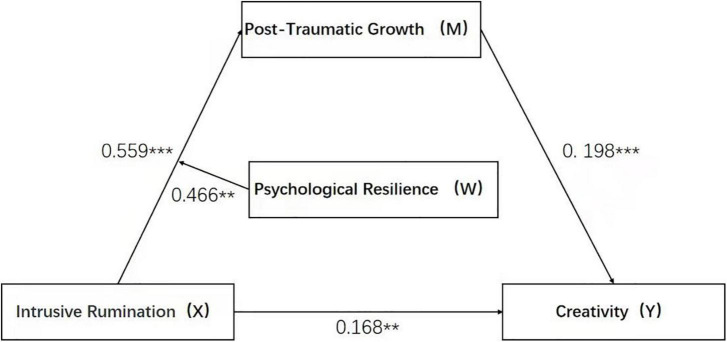
College students in the pandemic area are experiencing the problems caused by COVID-19 by themselves or people around them, how to cope with the sudden changes and adjust the psychological stress response, and get experience and grow in the fight against the pandemic is a question worth in-depth discussion. The researchers constructed a mediated regulation model to examine the effects of intrusive rumination on the creativity of college students during the COVID-19 pandemic, as well as the mediating effect of post-traumatic growth and the moderating role of psychological resilience.
A sample of 475 university students from Guangdong Province, China, were surveyed with the Runco Ideational Behavior Scale, the Event Related Rumination Inventory, the Posttraumatic Growth Inventory, and the Psychological Resilience Scale. SPSS (version 23) and PROCESS (version 3.3) were used for correlation analysis, mediation analysis, and mediated moderation analysis.
(1) Intrusive rumination was positively correlated with post-traumatic growth and creativity but negatively correlated with psychological resilience. Psychological resilience was positively correlated with post-traumatic growth and creativity. Post-traumatic growth and creativity were positively correlated. (2) Post-traumatic growth played a mediating role in the relationship between intrusive rumination and creativity. (3) Psychological resilience moderated the first half of the pathway "intrusive rumination → post-traumatic growth → creativity."
Intrusive rumination affected creativity directly and also indirectly through post-traumatic growth. At the same time, psychological resilience played a moderating role between intrusive rumination and creativity. The correlation between intrusive rumination and post-traumatic growth was stronger when levels of psychological resilience levels were higher.
疫情地区的大学生正亲身经历着由新冠疫情引发的各种问题,如何应对突如其来的变化并调整心理应激反应,在抗击疫情中获得经验并成长,是一个值得深入探讨的问题。研究人员构建了一个中介调节模型,以检验在新冠疫情期间侵入性反刍思维对大学生创造力的影响,以及创伤后成长的中介作用和心理韧性的调节作用。
选取来自中国广东省的475名大学生作为样本,使用润科创意行为量表、事件相关反刍思维量表、创伤后成长量表和心理韧性量表进行调查。运用SPSS(23版)和PROCESS(3.3版)进行相关分析、中介分析和中介调节分析。
(1)侵入性反刍思维与创伤后成长和创造力呈正相关,但与心理韧性呈负相关。心理韧性与创伤后成长和创造力呈正相关。创伤后成长与创造力呈正相关。(2)创伤后成长在侵入性反刍思维与创造力的关系中起中介作用。(3)心理韧性调节了“侵入性反刍思维→创伤后成长→创造力”这一路径的前半部分。
侵入性反刍思维直接影响创造力,也通过创伤后成长间接影响创造力。同时,心理韧性在侵入性反刍思维与创造力之间起调节作用。当心理韧性水平较高时,侵入性反刍思维与创伤后成长之间的相关性更强。