Cai Wenjun, Pan Yuhong, Cheng Anchun, Wang Mingshu, Yin Zhongqiong, Jia Renyong
Research Center of Avian Disease, College of Veterinary Medicine, Sichuan Agricultural University, Chengdu, China.
Institute of Preventive Veterinary Medicine, Sichuan Agricultural University, Chengdu, China.
Front Microbiol. 2022 Apr 11;13:869441. doi: 10.3389/fmicb.2022.869441. eCollection 2022.
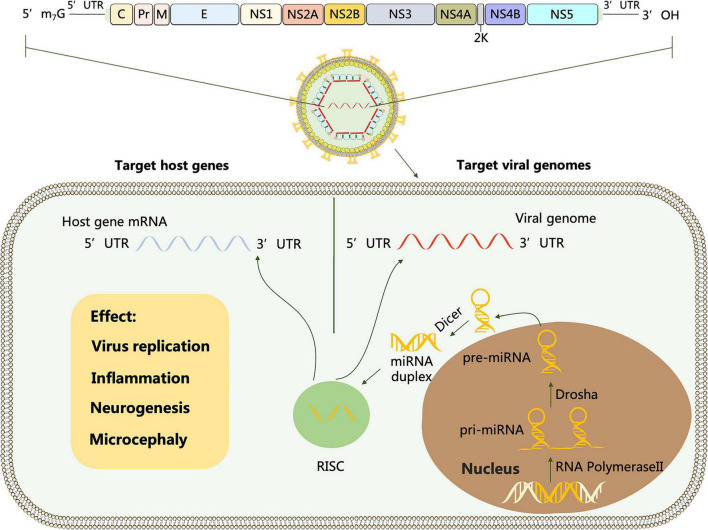
MicroRNAs (miRNAs) are small non-coding RNA that affect mRNA abundance or translation efficiency by binding to the 3'UTR of the mRNA of the target gene, thereby participating in multiple biological processes, including viral infection. genus consists of small, positive-stranded, single-stranded RNA viruses transmitted by arthropods, especially mosquitoes and ticks. The genus contains several globally significant human/animal pathogens, such as Dengue virus, Japanese encephalitis virus, West Nile virus, Zika virus, Yellow fever virus, Tick-borne encephalitis virus, and Tembusu virus. After flavivirus invades, the expression of host miRNA changes, exerting the immune escape mechanism to create an environment conducive to its survival, and the altered miRNA in turn affects the life cycle of the virus. Accumulated evidence suggests that host miRNAs influence flavivirus replication and host-virus interactions through direct binding of viral genomes or through virus-mediated host transcriptome changes. Furthermore, miRNA can also interweave with other non-coding RNAs, such as long non-coding RNA and circular RNA, to form an interaction network to regulate viral replication. A variety of non-coding RNAs produced by the virus itself exert similar function by interacting with cellular RNA and viral RNA. Understanding the interaction sites between non-coding RNA, especially miRNA, and virus/host genes will help us to find targets for antiviral drugs and viral therapy.
微小RNA(miRNA)是一类小的非编码RNA,通过与靶基因mRNA的3'非翻译区(3'UTR)结合来影响mRNA丰度或翻译效率,从而参与包括病毒感染在内的多种生物学过程。黄病毒属由节肢动物传播的小型正链单链RNA病毒组成,尤其是蚊子和蜱虫。该属包含几种具有全球重要意义的人类/动物病原体,如登革病毒、日本脑炎病毒、西尼罗河病毒、寨卡病毒、黄热病病毒、蜱传脑炎病毒和坦布苏病毒。黄病毒入侵后,宿主miRNA的表达发生变化,发挥免疫逃逸机制以创造有利于其生存的环境,而改变的miRNA反过来又影响病毒的生命周期。越来越多的证据表明,宿主miRNA通过直接结合病毒基因组或通过病毒介导的宿主转录组变化来影响黄病毒复制和宿主-病毒相互作用。此外,miRNA还可与其他非编码RNA,如长链非编码RNA和环状RNA相互交织,形成相互作用网络来调节病毒复制。病毒自身产生的多种非编码RNA通过与细胞RNA和病毒RNA相互作用发挥类似功能。了解非编码RNA,尤其是miRNA与病毒/宿主基因之间的相互作用位点将有助于我们找到抗病毒药物和病毒治疗的靶点。