Wang Peiyu, Huang Qi, Meng Shushi, Mu Teng, Liu Zheng, He Mengqi, Li Qingyun, Zhao Song, Wang Shaodong, Qiu Mantang
Department of Thoracic Surgery, Peking University People's Hospital, No. 11 Xizhimen South Street, Beijing 100044, China.
Department of Thoracic Surgery, The First Affiliated Hospital of Zhengzhou University, 1 Jianshe East Road, Zhengzhou, Henan 450003, China.
EClinicalMedicine. 2022 Apr 16;47:101384. doi: 10.1016/j.eclinm.2022.101384. eCollection 2022 May.
Breathomics testing has been considered a promising method for detection and screening for lung cancer. This study aimed to identify breath biomarkers of lung cancer through perioperative dynamic breathomics testing.
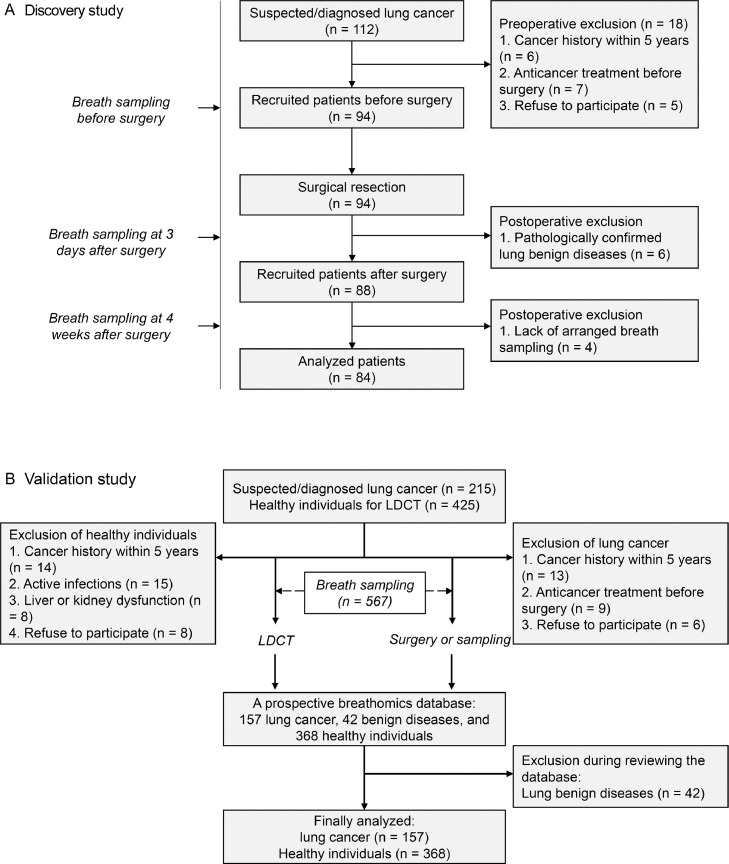
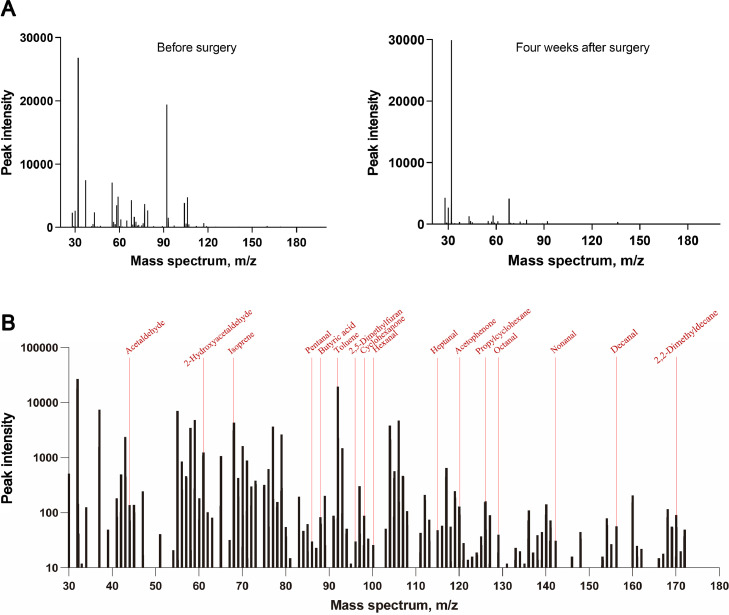
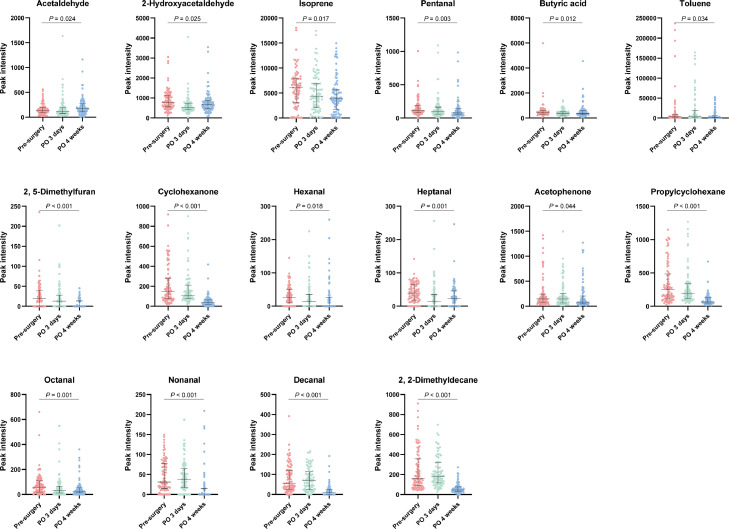
The discovery study was prospectively conducted between Sept 1, 2020 and Dec 31, 2020 in Peking University People's Hospital in China. High-pressure photon ionisation time-of-flight mass spectrometry was used for breathomics testing before surgery and 4 weeks after surgery. 28 volatile organic compounds (VOCs) were selected as candidates based on a literature review. VOCs that changed significantly postoperatively in patients with lung cancer were selected as potential breath biomarkers. An external validation was conducted to evaluate the performance of these VOCs for lung cancer diagnosis. Multivariable logistic regression was used to establish diagnostic models based on selected VOCs.
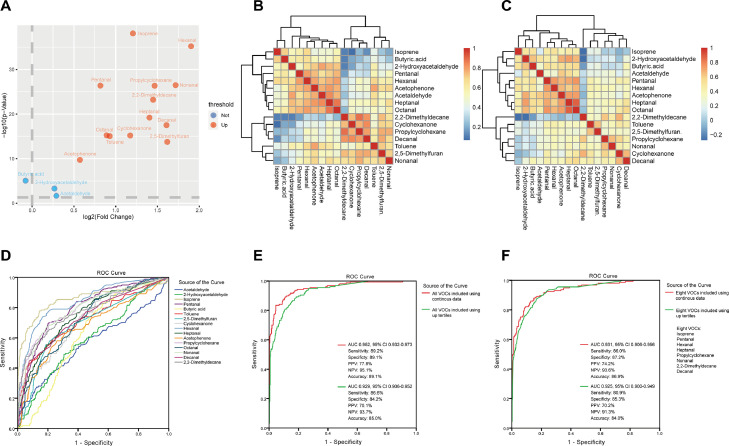
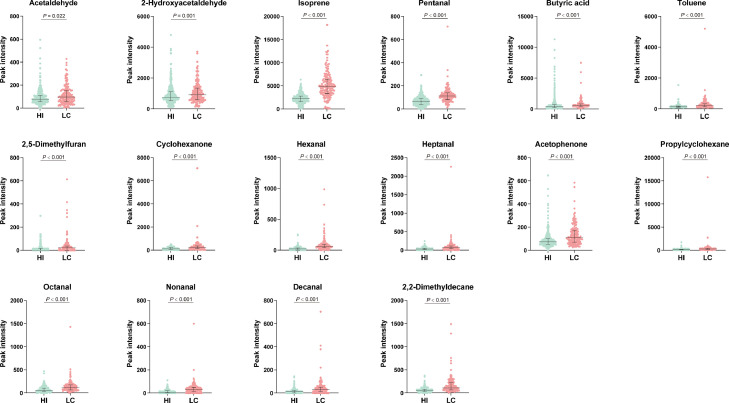
In the discovery study of 84 patients with lung cancer, perioperative breathomics demonstrated 16 VOCs as lung cancer breath biomarkers. They were classified as aldehydes, hydrocarbons, ketones, carboxylic acids, and furan. In the external validation study including 157 patients with lung cancer and 368 healthy individuals, patients with lung cancer showed elevated spectrum peak intensity of the 16 VOCs after adjusting for age, sex, smoking, and comorbidities. The diagnostic model including 16 VOCs achieved an area under the curve (AUC) of 0.952, sensitivity of 89.2%, specificity of 89.1%, and accuracy of 89.1% in lung cancer diagnosis. The diagnostic model including the top eight VOCs achieved an AUC of 0.931, sensitivity of 86.0%, specificity of 87.2%, and accuracy of 86.9%.
Perioperative dynamic breathomics is an effective approach for identifying lung cancer breath biomarkers. 16 lung cancer-related breath VOCs (aldehydes, hydrocarbons, ketones, carboxylic acids, and furan) were identified and validated. Further studies are warranted to investigate the underlying mechanisms of identified VOCs.
National Natural Science Foundation of China (82173386) and Peking University People's Hospital Scientific Research Development Founds (RDH2021-07).
呼吸组学检测被认为是一种有前景的肺癌检测和筛查方法。本研究旨在通过围手术期动态呼吸组学检测来识别肺癌的呼吸生物标志物。
探索性研究于2020年9月1日至2020年12月31日在中国北京大学人民医院前瞻性开展。采用高压光电离飞行时间质谱对手术前及术后4周进行呼吸组学检测。基于文献综述选择了28种挥发性有机化合物(VOCs)作为候选物。将肺癌患者术后显著变化的VOCs选为潜在的呼吸生物标志物。进行外部验证以评估这些VOCs对肺癌诊断的性能。使用多变量逻辑回归基于选定的VOCs建立诊断模型。
在对84例肺癌患者的探索性研究中,围手术期呼吸组学显示16种VOCs为肺癌呼吸生物标志物。它们被分类为醛类、烃类、酮类、羧酸类和呋喃类。在包括157例肺癌患者和368例健康个体的外部验证研究中,在调整年龄、性别、吸烟和合并症后,肺癌患者的16种VOCs谱峰强度升高。包含16种VOCs的诊断模型在肺癌诊断中的曲线下面积(AUC)为0.952,灵敏度为89.2%,特异性为89.1%,准确率为89.1%。包含前八种VOCs的诊断模型的AUC为0.931,灵敏度为86.0%,特异性为87.2%,准确率为86.9%。
围手术期动态呼吸组学是识别肺癌呼吸生物标志物的有效方法。已识别并验证了16种与肺癌相关的呼吸VOCs(醛类、烃类、酮类、羧酸类和呋喃类)。有必要进一步研究以探究已识别VOCs的潜在机制。
中国国家自然科学基金(82173386)和北京大学人民医院科研发展基金(RDH2021 - 07)。