Darwish Reham S, Hammoda Hala M, Ghareeb Doaa A, Abdelhamid Ali S A, Harraz Fathallah M, Shawky Eman
Department of Pharmacognosy, Faculty of Pharmacy, Alexandria University Alkhartoom Square Alexandria 21521 Egypt
Biological Screening and Preclinical Trial Laboratory, Department of Biochemistry, Faculty of Science, Alexandria University Alexandria Egypt.
RSC Adv. 2021 Jul 14;11(40):24624-24635. doi: 10.1039/d1ra01681d. eCollection 2021 Jul 13.
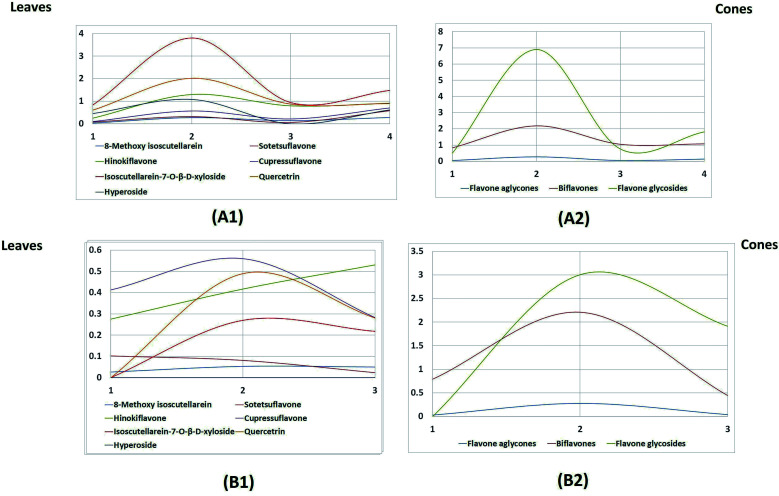
In this study, the seasonal dynamics of the flavonoids in the cones and leaves of oriental ( L. Franco) as well as the anti-inflammatory activity of their extracts were investigated. The important chemical markers of the studied extracts were determined using untargeted HPTLC profiling, which was further utilized to assess the seasonality effect on the composition of these metabolites over three seasonal cycles. A quantitative HPTLC method was developed and validated for the identified chemical markers of oriental : hyperoside, quercetrin, isoscutellarein-7--β-xyloside, cupressuflavone, hinokiflavone, sotetsuflavone and isoscutellarein-8-methyl ether. The highest amounts of flavonoids were observed during the summer and winter seasons, where the leaves possessed higher contents of flavonoids compared to cones. Flavone glycosides are a major class of flavones encountered in leaves, while the cones mainly accumulated biflavones. The results showed that the effect of seasonal variation on the accumulation of flavonoids within the cones was less pronounced than in the leaves. The summer leaves showed a remarkable reduction in the levels of INF-γ, where the value decreased to 80.7 ± 1.25 pg mL, a significantly lower level than that obtained with piroxicam (180 ± 1.47 pg mL); this suggests a noteworthy anti-inflammatory potential. OPLS (orthogonal projection to latent structures) models showed that flavonoidal glycosides, quercetrin, hyperoside and isoscutellarein-7--β-xyloside were the most contributing biomarkers to the reduction in pro-inflammatory mediators in LPS-stimulated WBCs. The results obtained in the study can thus be exploited to establish the best organs as well as the optimal periods of the year for collecting and obtaining certain biomarkers at high concentrations to guarantee the efficacy of the obtained extracts.
在本研究中,对东方侧柏(L. Franco)球果和叶片中黄酮类化合物的季节性动态及其提取物的抗炎活性进行了研究。使用非靶向HPTLC分析确定了所研究提取物的重要化学标志物,并进一步利用该分析评估了三个季节周期内季节性对这些代谢物组成的影响。针对东方侧柏已鉴定的化学标志物:金丝桃苷、槲皮苷、异野黄芩素-7-β-D-木糖苷、扁柏黄酮、扁柏双黄酮、苏铁双黄酮和异野黄芩素-8-甲醚,开发并验证了一种定量HPTLC方法。在夏季和冬季观察到黄酮类化合物含量最高,此时叶片中的黄酮类化合物含量高于球果。黄酮糖苷是叶片中主要的黄酮类化合物类别,而球果主要积累双黄酮。结果表明,季节性变化对球果内黄酮类化合物积累的影响不如对叶片的影响明显。夏季叶片中INF-γ水平显著降低,降至80.7±1.25 pg/mL,明显低于吡罗昔康(180±1.47 pg/mL)的水平;这表明其具有显著的抗炎潜力。OPLS(正交投影到潜在结构)模型表明,黄酮类糖苷、槲皮苷、金丝桃苷和异野黄芩素-7-β-D-木糖苷是LPS刺激的白细胞中促炎介质减少的最主要生物标志物。因此,本研究所得结果可用于确定一年中收集和获取高浓度特定生物标志物的最佳器官和最佳时期,以确保所获提取物的功效。