Rentscher Kelly E, Carroll Judith E, Polsky Lilian R, Lamkin Donald M
Cousins Center for Psychoneuroimmunology, Semel Institute for Neuroscience and Human Behavior, University of California, Los Angeles, USA.
Department of Psychiatry and Biobehavioral Sciences, David Geffen School of Medicine, University of California, Los Angeles, USA.
Brain Behav Immun Health. 2022 Apr 12;22:100461. doi: 10.1016/j.bbih.2022.100461. eCollection 2022 Jul.
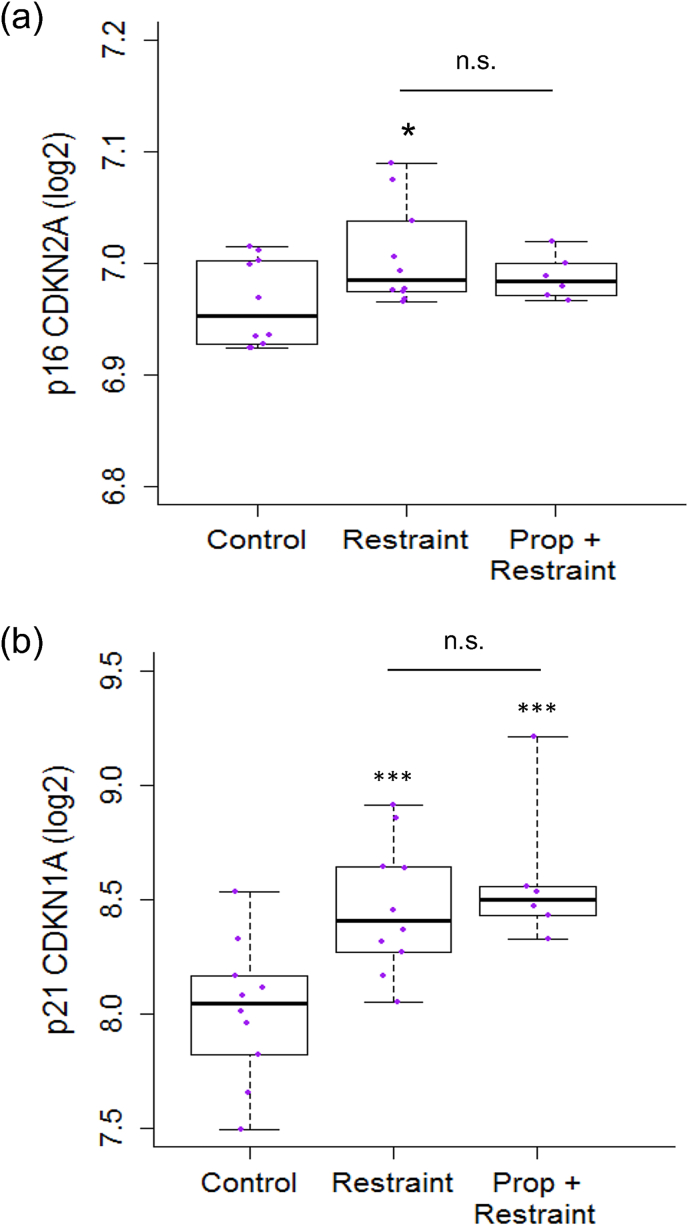
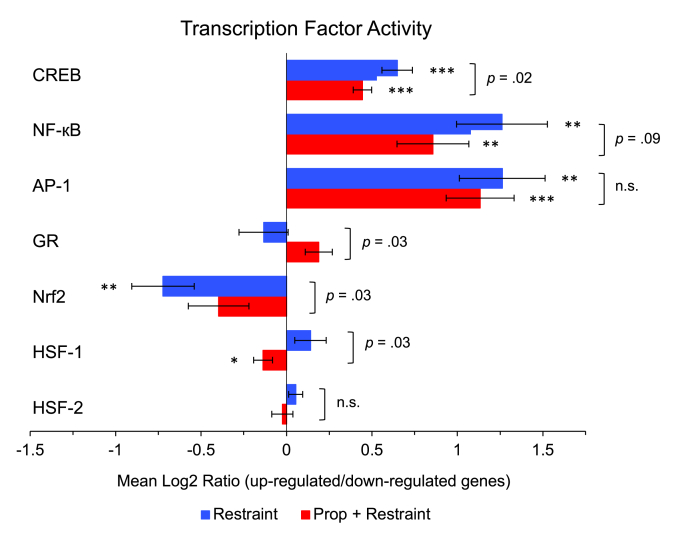
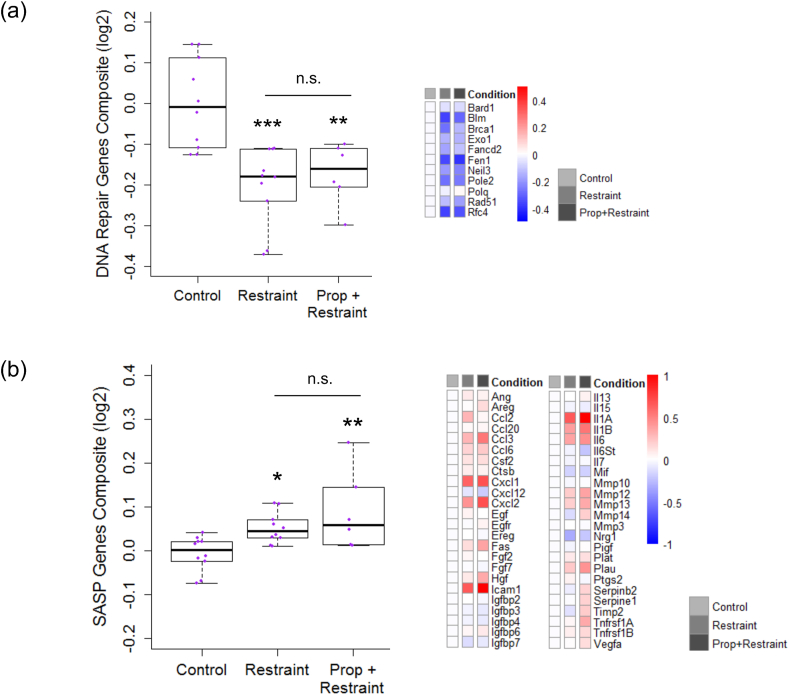
Research with animals and humans has demonstrated that chronic stress exposure can impact key biological aging pathways such as inflammation and DNA damage, suggesting a mechanism through which stress may increase risk for age-related disease. However, it is less clear whether these effects extend to other hallmarks of the aging process, such as cellular senescence. Male SCID mice were exposed to 14 days of restraint stress, with ( = 6) or without ( = 10) propranolol administration, or a non-stress control condition ( = 10). Normal femoral bone marrow leukocytes were isolated from engrafted leukemia cells that had been injected prior to the stressor, as the mice were also under a cancer challenge. We performed whole genome transcriptional profiling to assess indicators of biological aging: cell stress, DNA damage repair, cellular senescence markers p16 and p21, and the pro-inflammatory senescence-associated secretory phenotype (SASP). ANCOVAs that adjusted for tumor load and Fisher's pairwise comparisons revealed that stressed mice had enhanced p16 ( = .02) and p21 ( = .004), lower DNA damage repair ( < .001), and higher SASP ( = .03) gene expression than control mice. Stressed mice also showed up-regulated beta-adrenergic (CREB) and inflammatory (NF-B, AP-1) and down-regulated cell stress (Nrf2) transcription factor activity relative to control mice (s < .01). Propranolol reversed CREB and Nrf2 activity (s < .03). Findings suggest that chronic stress exposure can impact several key biological aging pathways within bone marrow leukocytes and these effects may be partially mediated by sympathetic beta-adrenergic receptor activation.
对动物和人类的研究表明,长期暴露于应激状态会影响炎症和DNA损伤等关键生物衰老途径,这提示了一种应激可能增加与年龄相关疾病风险的机制。然而,目前尚不清楚这些影响是否会扩展到衰老过程的其他特征,如细胞衰老。将雄性SCID小鼠暴露于14天的束缚应激中,一组(n = 6)给予普萘洛尔,另一组(n = 10)不给予普萘洛尔,还有一组(n = 10)作为非应激对照。由于小鼠同时还面临癌症挑战,因此从应激源施加前注射的移植白血病细胞中分离出正常的股骨骨髓白细胞。我们进行了全基因组转录谱分析,以评估生物衰老指标:细胞应激、DNA损伤修复、细胞衰老标志物p16和p21,以及促炎衰老相关分泌表型(SASP)。经肿瘤负荷校正的协方差分析和Fisher成对比较显示,与对照小鼠相比,应激小鼠的p16(P = .02)和p21(P = .004)表达增强,DNA损伤修复能力降低(P < .001),SASP基因表达更高(P = .03)。与对照小鼠相比,应激小鼠还表现出β-肾上腺素能(CREB)和炎症(NF-κB、AP-1)转录因子活性上调,细胞应激(Nrf2)转录因子活性下调(P < .01)。普萘洛尔可逆转CREB和Nrf2活性(P < .03)。研究结果表明,长期暴露于应激状态会影响骨髓白细胞内的几个关键生物衰老途径,这些影响可能部分由交感β-肾上腺素能受体激活介导。