Department of Gynaecology and Obstetrics, Jeroen Bosch Hospital, Henri Dunantstraat 1, 5223 GZ, s-Hertogenbosch, The Netherlands.
Department of Gynaecology and Obstetrics, Grow School for Oncology and Developmental Biology, Maastricht University Medical Centre+, P Debyelaan 25, 6229 HX, Maastricht, The Netherlands.
Int Urogynecol J. 2023 Jan;34(1):211-223. doi: 10.1007/s00192-022-05185-7. Epub 2022 Apr 28.
Pelvic organ prolapse (POP) is a frequent occurring health issue, especially concerning elderly women. The objective of this study is to examine the long-term outcomes of laparoscopic sacrohysteropexy (LSH) and vaginal sacrospinous hysteropexy (SSHP) for treatment of uterine prolapse.
A retrospective study of patients who underwent a LSH or SSHP. Validated questionnaires and an outpatient examination visit were used to investigate the effects of both surgical treatments. The primary outcome was the composite outcome of success for the apical compartment, defined as no recurrence of uterine prolapse (POP-Q measurement C ≤ 0), no subjective recurrence of POP, and/or not requiring therapy for recurrent prolapse. Secondary outcomes were peri- and postoperative data, anatomical failure, prolapse beyond hymen, subjective outcomes, and disease-specific quality of life.
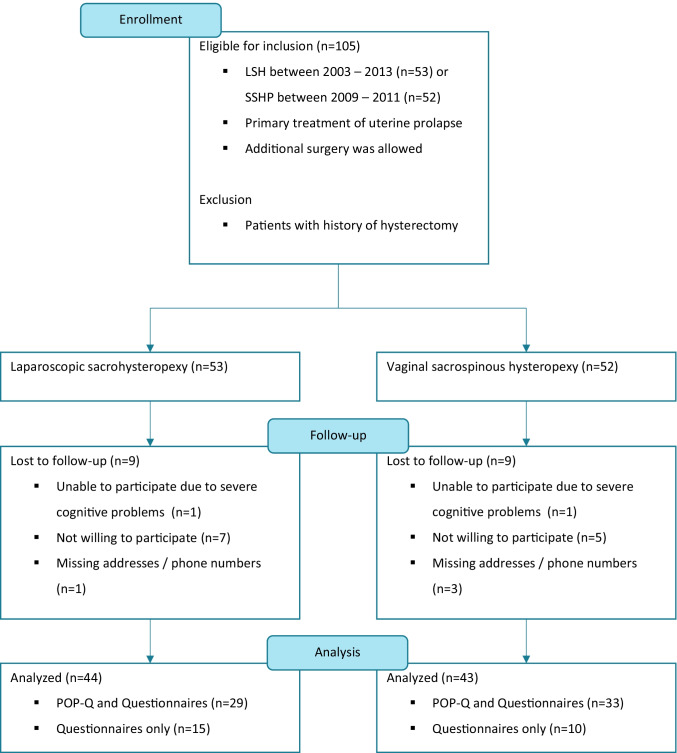
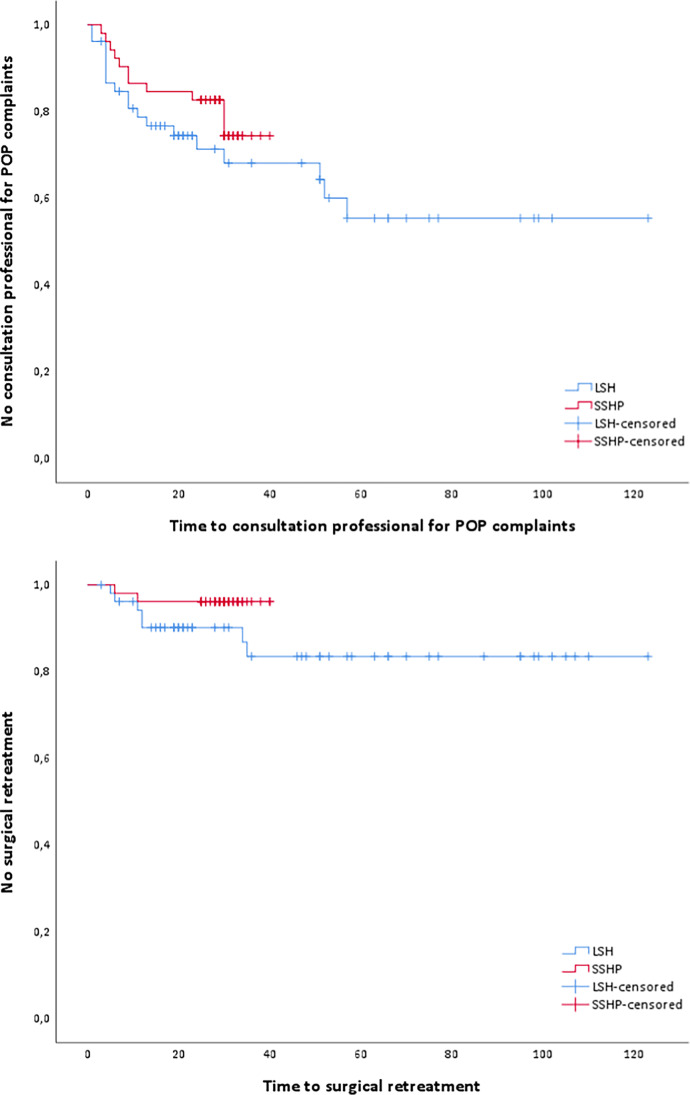
We included 105 patients, 53 in the LSH group and 52 in the SSHP group. The overall response rate of the questionnaires was 83% (n = 87) after a mean follow-up time of 4.5 years (54.2 months; 95% CI 44.8-64.2 months) in the LSH group and 2.5 years (30.1 months; 95% CI 29.3-31.5 months) in the SSHP group. There were no clinically relevant differences between the study groups in composite outcome of success (p = 0.073), anatomical failure of the apical compartment (p = 0.711), vaginal bulge symptoms for which patients consulted professionals (p = 0.126), and patient satisfaction (p = 0.741). The operative time was longer in the LSH group (117 min; interquartile range (IQR) 110-123) compared to the SSHP group (67 minutes; IQR 60-73) (p < 0.001). The duration of hospital stay was also longer in the LSH group (4 days) than in the SSHP group (3 days) (p = 0.006).
LSH and SSHP seem to be equally effective after long-term follow-up in treating uterine prolapse in terms of objective and subjective recurrence.
盆腔器官脱垂(POP)是一种常见的健康问题,尤其是老年女性。本研究的目的是探讨腹腔镜子宫骶骨固定术(LSH)和阴道骶棘韧带固定术(SSHP)治疗子宫脱垂的长期疗效。
对接受 LSH 或 SSHP 的患者进行回顾性研究。使用有效问卷和门诊检查来评估两种手术治疗方法的效果。主要结局为顶壁复合结局成功,定义为子宫脱垂无复发(POP-Q 测量 C ≤ 0)、无主观 POP 复发和/或无需治疗复发脱垂。次要结局为围手术期数据、解剖学失败、处女膜外的脱垂、主观结局和疾病特异性生活质量。
我们纳入了 105 例患者,LSH 组 53 例,SSHP 组 52 例。LSH 组平均随访时间为 4.5 年(54.2 个月;95%置信区间 44.8-64.2 个月),问卷总应答率为 83%(n = 87);SSHP 组平均随访时间为 2.5 年(30.1 个月;95%置信区间 29.3-31.5 个月),问卷总应答率为 70%(n = 36)。两组在复合结局成功(p = 0.073)、顶壁解剖学失败(p = 0.711)、阴道膨出症状就诊(p = 0.126)和患者满意度(p = 0.741)方面均无临床相关差异。LSH 组手术时间(117 分钟;四分位间距(IQR)110-123)明显长于 SSHP 组(67 分钟;IQR 60-73)(p < 0.001)。LSH 组的住院时间(4 天)也长于 SSHP 组(3 天)(p = 0.006)。
长期随访后,LSH 和 SSHP 治疗子宫脱垂的效果相当,无论是在客观还是主观复发方面。