Lee Jae Seob, Saroha Rakesh, Cho Jung Sang
Department of Engineering Chemistry, Chungbuk National University, Cheongju, Chungbuk, 361-763, Republic of Korea.
Nanomicro Lett. 2022 Apr 28;14(1):113. doi: 10.1007/s40820-022-00855-z.
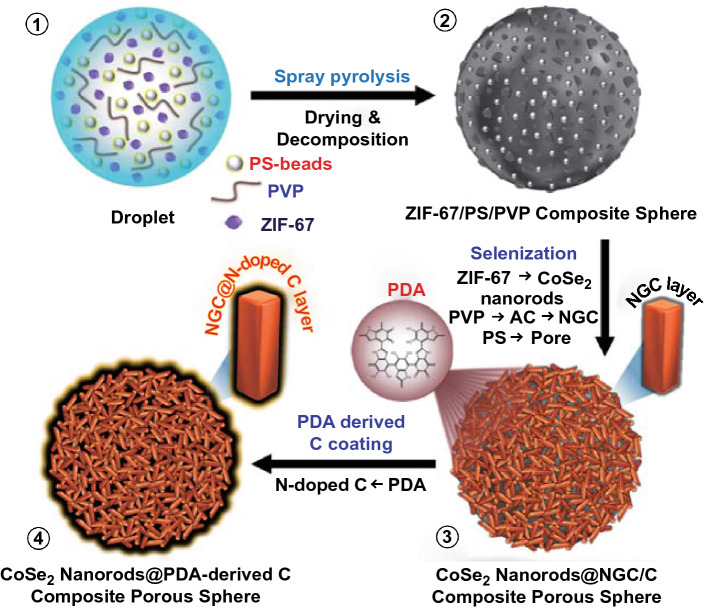
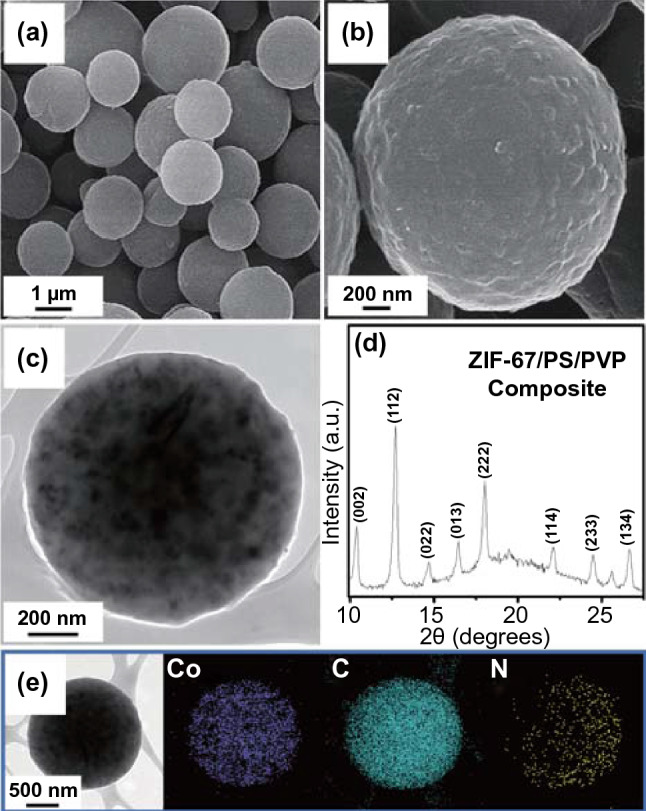
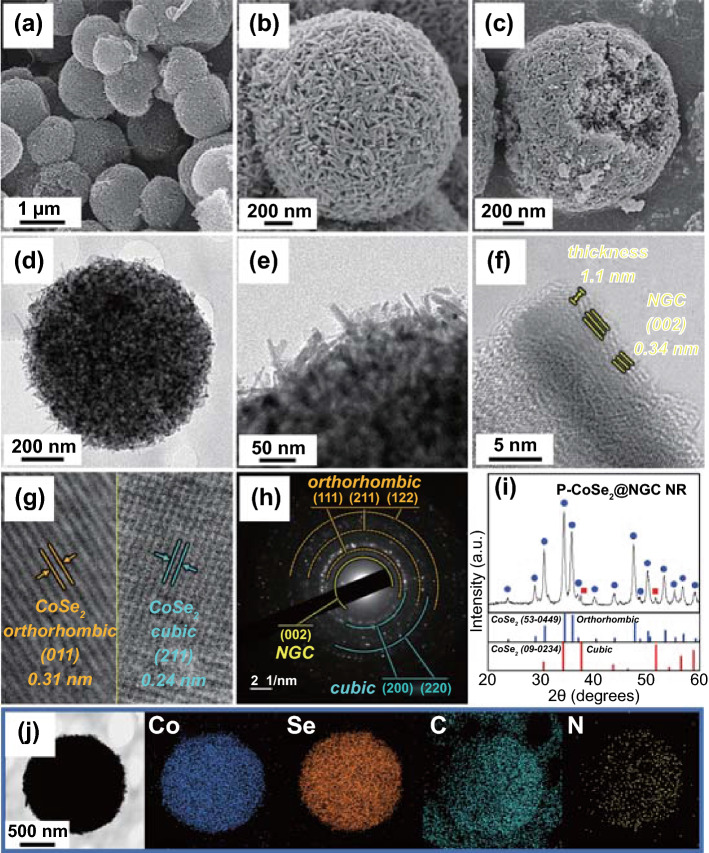
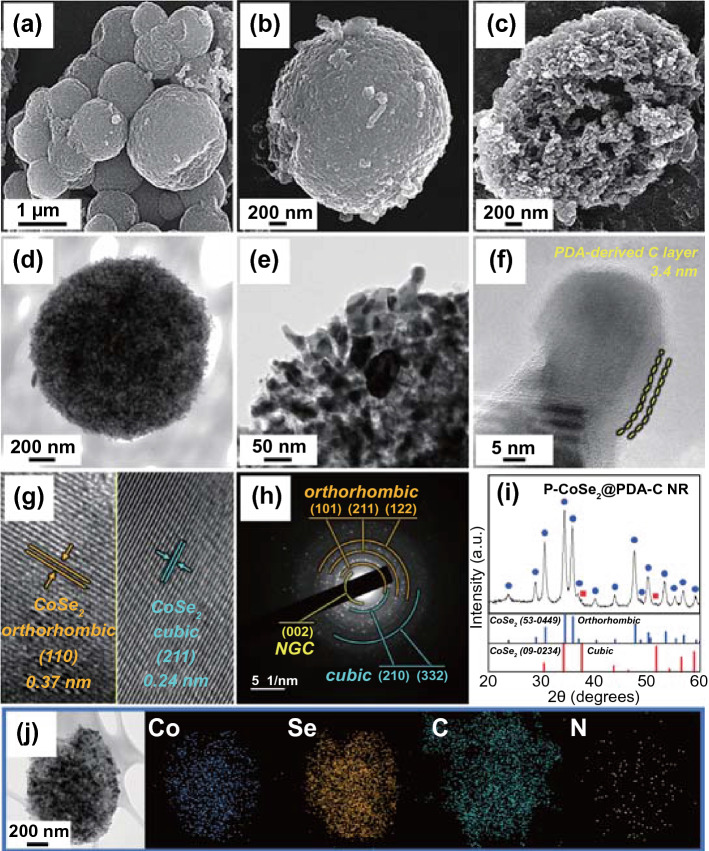
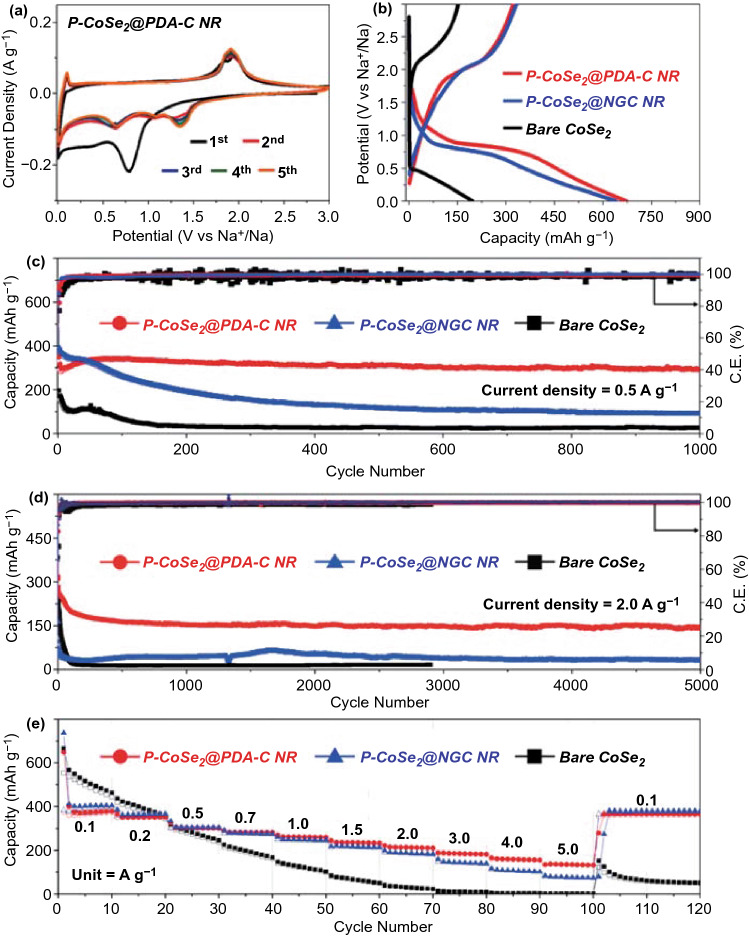
Metal-organic framework-templated nitrogen-doped graphitic carbon (NGC) and polydopamine-derived carbon (PDA-derived C)-double coated one-dimensional CoSe nanorods supported highly porous three-dimensional microspheres are introduced as anodes for excellent Na-ion batteries, particularly with long-lived cycle under carbonate-based electrolyte system. The microspheres uniformly composed of ZIF-67 polyhedrons and polystyrene nanobeads (ϕ = 40 nm) are synthesized using the facile spray pyrolysis technique, followed by the selenization process (P-CoSe@NGC NR). Further, the PDA-derived C-coated microspheres are obtained using a solution-based coating approach and the subsequent carbonization process (P-CoSe@PDA-C NR). The rational synthesis approach benefited from the synergistic effects of dual carbon coating, resulting in a highly conductive and porous nanostructure that could facilitate rapid diffusion of charge species along with efficient electrolyte infiltration and effectively channelize the volume stress. Consequently, the prepared nanostructure exhibits extraordinary electrochemical performance, particularly the ultra-long cycle life stability. For instance, the advanced anode has a discharge capacity of 291 (1000th cycle, average capacity decay of 0.017%) and 142 mAh g (5000th cycle, average capacity decay of 0.011%) at a current density of 0.5 and 2.0 A g, respectively.
金属有机框架模板化的氮掺杂石墨碳(NGC)和聚多巴胺衍生碳(PDA衍生碳)双包覆的一维CoSe纳米棒负载的高度多孔三维微球被引入作为用于优异钠离子电池的阳极,特别是在基于碳酸盐的电解质体系下具有长寿命循环。使用简便的喷雾热解技术合成由ZIF-67多面体和聚苯乙烯纳米珠(ϕ = 40 nm)均匀组成的微球,随后进行硒化过程(P-CoSe@NGC NR)。此外,使用基于溶液的包覆方法和随后的碳化过程获得PDA衍生碳包覆的微球(P-CoSe@PDA-C NR)。合理的合成方法受益于双碳包覆的协同效应,产生了高导电性和多孔的纳米结构,这可以促进电荷物种的快速扩散以及有效的电解质渗透,并有效地疏导体积应力。因此,所制备的纳米结构表现出非凡的电化学性能,特别是超长的循环寿命稳定性。例如,先进的阳极在电流密度为0.5和2.0 A g时,第1000次循环的放电容量为291(平均容量衰减0.017%),第5000次循环的放电容量为142 mAh g(平均容量衰减0.011%)。